David Steele Obituary: How to Find the Correct Record
Searching for a David Steele obituary? Learn how to identify and locate the correct record from thousands of listings with our helpful guide.
A search for “David Steele obituary” can lead to several different people, including a racing driver with 60 national USAC victories, a British historian, and an automotive-parts manager. The correct record is identified by matching middle initials, locations, occupations, family names, and dates, not by the name alone.
You may be searching for a parent, grandparent, former colleague, or distant relative and find several obituary pages that seem plausible. One record may describe a professional athlete, another an academic, and another a retiree from Pennsylvania. The details can look convincing until you notice that the locations, family relationships, and life histories don't match.
Treat the search as a genealogy identification problem first and an obituary-reading task second. A careful process will help you avoid attaching the wrong parents, spouse, memories, or photographs to your family tree. The obituary research guide can also provide useful context as you organize the search.
Table of Contents
- Why Your David Steele Obituary Search Returns Multiple Results
- Five David Steeles Documented in Public Records
- How to Identify the Correct David Steele Record
- Death Notices Versus Preserved Life Stories
- Building a Complete Memorial Record After Publication
- Practical Examples for Memory Collection
- Verifying Obituary Information Across Sources
- Comparing Digital Preservation Platforms for Memorial Records
- Creating Your Own Life Story Archive
- Quick Reference Guide for Obituary Research
- Preserving Family Connections Through Accurate Records
Why Your David Steele Obituary Search Returns Multiple Results
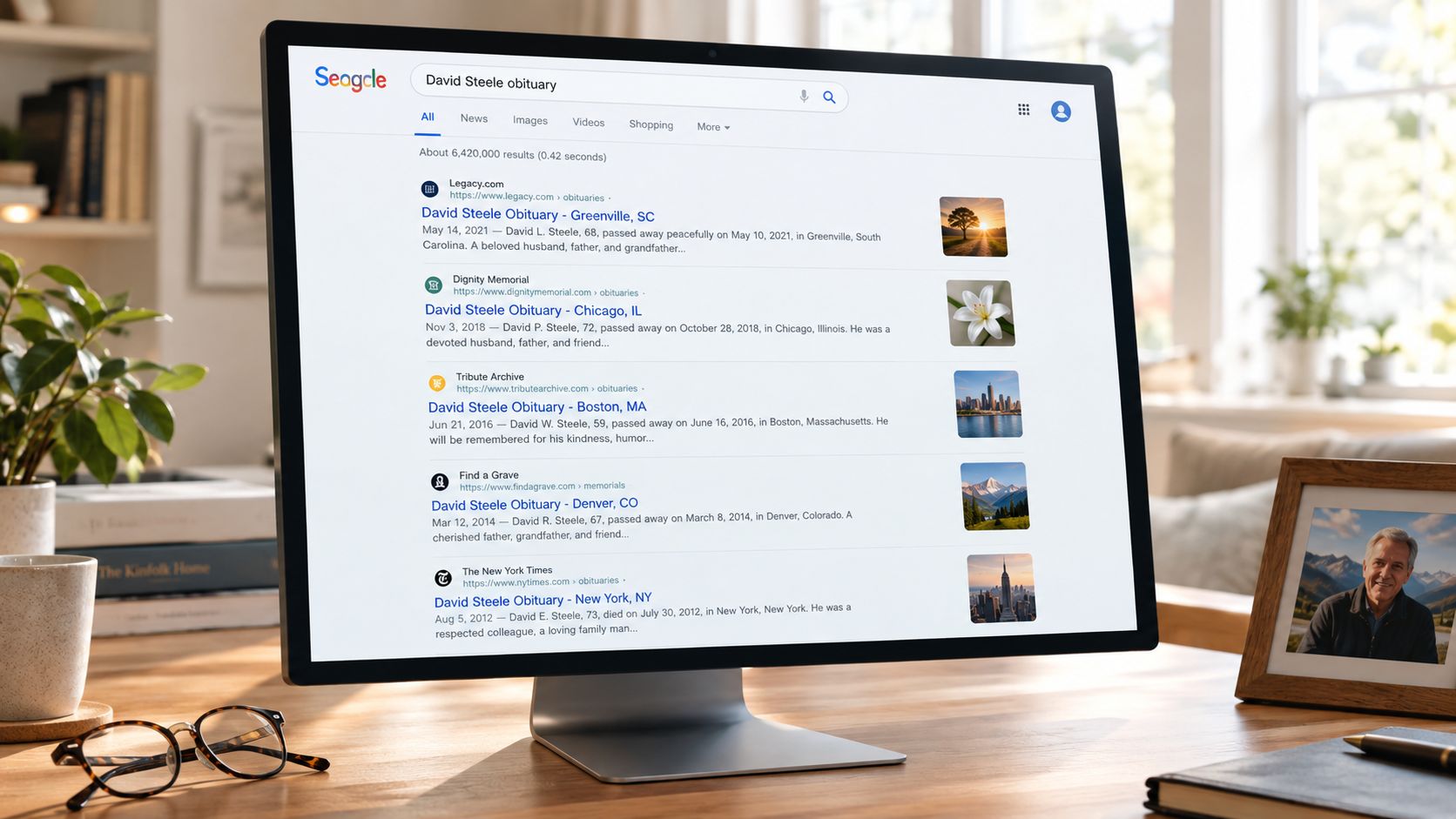
Searching for David Steele often produces a confusing mixture of memorial pages, newspaper notices, institutional announcements, and historical references. The name appears across different generations and professions, so a result that ranks prominently in a search engine isn't necessarily the person you're trying to find.
Start by writing down what you already know before opening more records. Include the person's approximate age, city or county, occupation, spouse or parents, and any middle initial. Then compare those details against each result. If one notice mentions Pennsylvania and another concerns a racing career in Florida, you're not looking at conflicting versions of one life. You're looking at separate people.
Begin with identity markers
Use this quick screening list:
- Middle initial or alternate name: Record forms such as David L. Steele, David H. Steele, or Dave Steele can separate one person from another.
- Place: Match the death location, residence, workplace, or funeral home to your family information.
- Life context: An occupation, university affiliation, military connection, or racing record can confirm or reject a match.
- Family links: Compare the spouse, children, parents, and siblings named in the notice.
Practical rule: Never add a person to your family tree because the full name and a death date look familiar. Require at least two independent identity matches.
An incorrect obituary can create false family connections that later appear in copied online trees. Once those errors spread, later researchers may treat an unsupported relationship as established history.
Five David Steeles Documented in Public Records
The available records show why a single-name search isn't enough. They identify at least five distinct people called David Steele or associated with that name, separated by era, geography, and professional life.
| Identity | Distinguishing markers |
|---|---|
| David MacFarland “Dave” Steele | American professional racing driver, born May 7, 1974, and died March 25, 2017. |
| Dr. David Steele | British modern historian associated with the University of Leeds, who died in 2019. |
| David L. Steele | Pennsylvania automotive-parts manager, born January 16, 1936, and died May 11, 2023, in Wildwood, Florida. |
| David H. Steele | Colorado community member whose public obituary record places his death in 2025. |
| Rev. David Steele | Nineteenth-century religious figure, born in 1803 and died in 1887. |
The racing driver is especially easy to confuse with unrelated records because his public profile is extensive. David MacFarland Steele's racing record includes 60 national USAC feature victories and consecutive Silver Crown Series championships in 2004 and 2005. Those details point to a motorsport identity, not to an older relative whose obituary only shares the same name.
Dr. David Steele belongs to a completely different research path. The University of Leeds identifies him as a modern historian whose work focused on Victorian British political history and nineteenth-century Anglo-Irish relations. His academic publications, rather than racing results or Pennsylvania employment, provide the strongest confirmation.
David L. Steele's full middle initial is equally important. His obituary describes a long career in automotive-parts management, a marriage to Nancy Engelman, and retirement to Florida. Those markers can distinguish him from the historian, driver, and other people in the search results.
The remaining records demonstrate why historical context matters. A nineteenth-century minister and a Colorado community member won't share the same document types, places, or family chronology as a twentieth-century professional.
How to Identify the Correct David Steele Record
Build a verification panel before you decide that an obituary belongs to your relative. Put the candidate's name at the top, then create fields for middle initial, birth information, death information, location, occupation, spouse, children, parents, and affiliations. Leave unknown fields blank rather than filling them with assumptions.
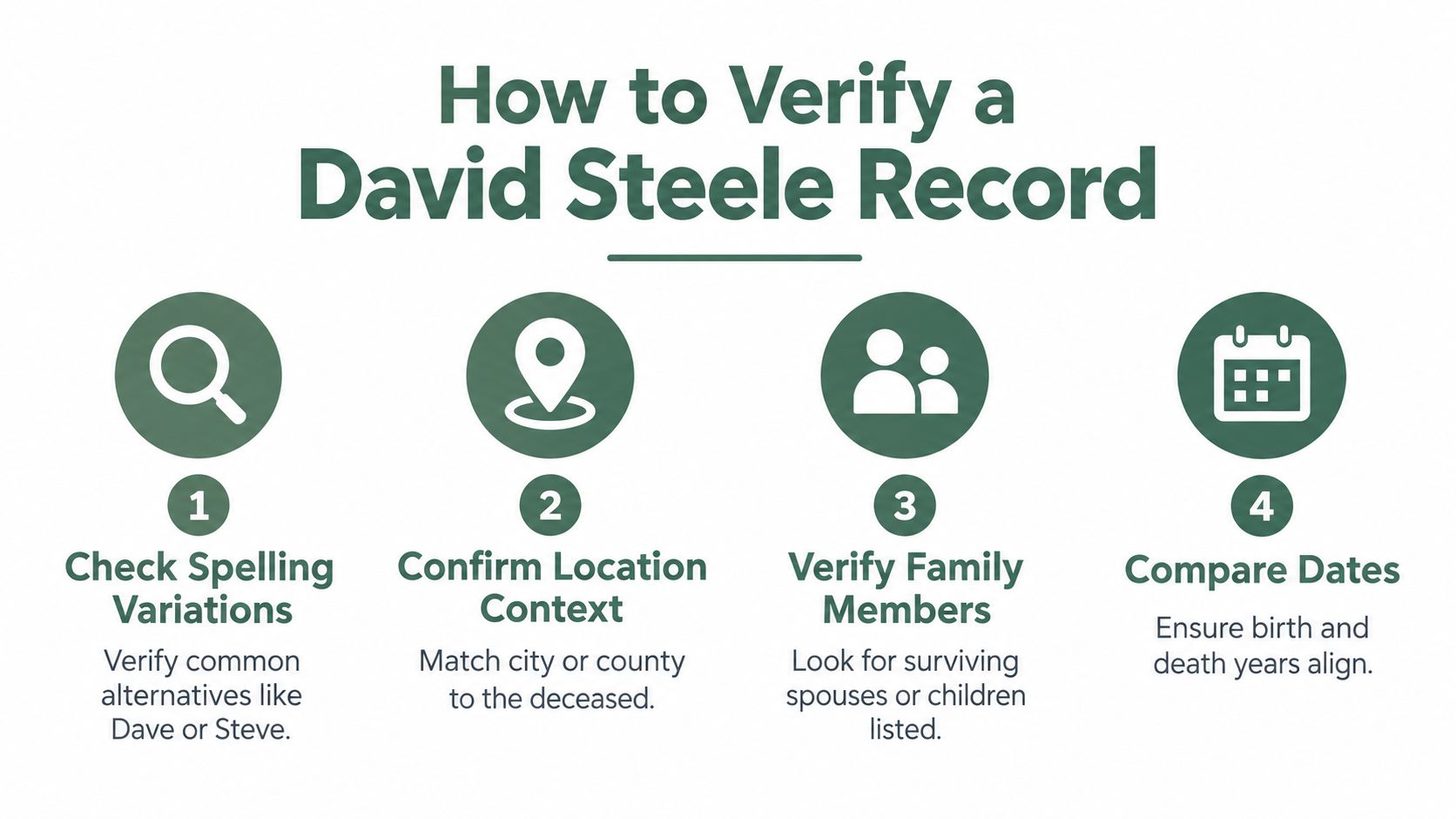
Use a match-and-mismatch method
Compare the candidate against your known information one field at a time.
- Name: Check middle initials, nicknames, spelling variations, and forms such as Dave Steele.
- Place: Match the town, county, state, country, or institution. A funeral home can be more useful than a broad search result.
- Relationships: Look for the spouse, children, parents, or siblings you already know.
- Dates: Compare birth and death years with family documents, cemetery records, or newspaper notices.
- Occupation: Treat a distinctive career as a strong clue, but confirm it with another field.
- Source type: Give greater weight to a funeral-home notice, institutional announcement, newspaper archive, or family-provided record that names specific relationships.
David L. Steele illustrates the value of retaining a middle initial. Without the “L,” a researcher could easily merge his record with another David Steele and attach the wrong employment or family information.
For broader family-history methods, the ancestry research resource offers a useful place to organize your approach.
A short video can reinforce the habit of checking identity details before accepting a record.
Death Notices Versus Preserved Life Stories
An obituary and a life story serve different purposes. A traditional death notice usually prioritizes the facts a reader needs immediately, such as the date of death, surviving relatives, funeral arrangements, and burial information. That structure is useful, but it can leave out the habits, humor, friendships, and ordinary moments that made the person recognizable to loved ones.
David L. Steele's record shows how a concise notice can still preserve meaningful anchors. It identifies his 46-year career as an automotive-parts manager, his marriage to Nancy Engelman for 65 years, and his retirement to Florida in 2004, as documented in his published obituary. Those facts establish a timeline, but they don't fully describe what family life, work, or retirement felt like.
What each format captures
| Death notice | Preserved life story |
|---|---|
| Date and place of death | Personal memories and anecdotes |
| Funeral or burial information | Character, humor, and values |
| Surviving relatives | Relationships as remembered by different people |
| Career or public achievements | Everyday routines, traditions, and photographs |
The difference is important when you search for a David Steele obituary. You may be looking for legal or genealogical confirmation, or you may be trying to recover a fuller portrait of someone you knew. The first task requires documented facts. The second requires conversations, photographs, letters, and contributions from people who shared the person's life.
A useful memorial record keeps those categories separate. Label dates, relationships, and occupations as verified facts. Label a story about kindness, stubbornness, humor, or community involvement as a personal recollection unless another source confirms it.
Building a Complete Memorial Record After Publication
A published obituary doesn't have to be the final record. Families can use it as a factual foundation, then invite people to add memories that a formal notice couldn't accommodate.
Begin with the obituary's confirmed information. Copy the name, dates, places, family relationships, occupation, service details, and known achievements without rewriting them from memory. Then create a separate area for contributions. This separation protects the factual timeline while giving relatives room to describe the person in their own words.
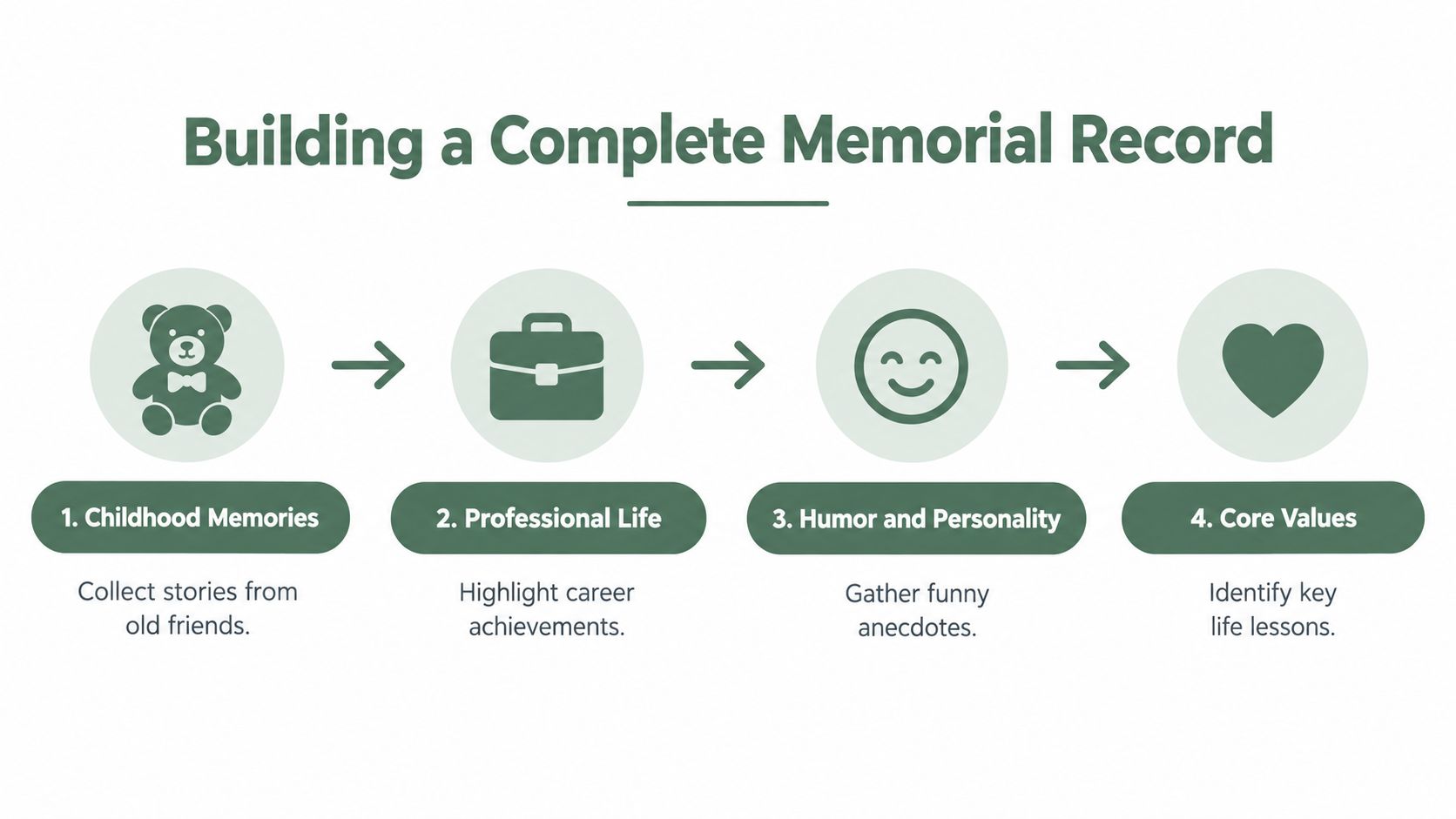
Invite memories by theme
Send contributors a small set of prompts rather than asking, “Does anyone have a story?” Specific questions make it easier for people to recall useful details.
- Childhood: What did David enjoy before adulthood, and who knew him during those years?
- Professional life: What work did he take pride in, and how did colleagues describe his approach?
- Humor and personality: What expression, habit, joke, or routine immediately brings him to mind?
- Core values: What lesson did he repeat or demonstrate through his actions?
- Relationships: Which friendships, family traditions, or community ties shaped his daily life?
- Photographs and documents: Who can identify the people, place, approximate period, or event shown?
Ask each contributor to identify their relationship to David and explain when the memory occurred. A family member's recollection can be valuable even when it doesn't establish a precise date. It should be presented as memory, not as a verified timeline entry.
The result is a multi-perspective memorial that complements the death notice. It doesn't replace the original record. It adds the human detail future relatives often search for after the logistical information has been read.
Practical Examples for Memory Collection
A good prompt asks for a scene, not a general opinion. “What was David like?” may produce a short answer. “What did David do when a family gathering became stressful?” is more likely to bring back a specific moment.
Use a shared document or a private message thread, and give contributors permission to answer only the questions they can address. Organize responses under clear categories so a story about work doesn't disappear among unlabeled photographs.
Prompts that produce usable detail
- For childhood memories: “Where did David spend time after school, and what activity did he return to repeatedly?”
- For work: “Can you describe a project, responsibility, or workplace habit that showed his character?”
- For humor: “What story do people tell when they want to make others laugh about David?”
- For values: “What did David do that demonstrated patience, loyalty, responsibility, or generosity?”
- For relationships: “Which person, group, or community mattered most to him, and how did he show it?”
- For traditions: “What meal, holiday practice, trip, game, or ritual would the family associate with David?”
- For photographs: “Who appears in this image, where was it taken, and what was happening?”
Invite older relatives to speak by telephone or record an audio conversation if typing is difficult. Afterward, ask permission before transcribing or publishing the recording.
Don't duplicate the verified obituary line by line. Use the factual notice for dates and relationships, then use contributions to explain how those facts appeared in daily life. That distinction creates a richer archive without turning every recollection into an unsupported claim.
Verifying Obituary Information Across Sources
No single record should carry every part of a family history. Funeral-home notices may provide service details and close relatives. Newspaper archives can preserve local context. Cemetery records may confirm names and dates. Institutional announcements can establish a career or affiliation, while family members can clarify relationships and personal history.
Compare sources field by field rather than asking which source feels most authoritative. If two records agree on a location and spouse but differ on a birth year, preserve both observations and investigate the disagreement. A typographical error, an incomplete notice, or a family decision to omit a survivor can explain the difference.
A practical source sequence
- Start with the obituary: Copy its exact name, date, location, and listed relationships.
- Check a second publication: Look for a newspaper archive or another formal notice covering the same person.
- Test institutional details: If the candidate was an academic, employee, minister, or public figure, seek an announcement from the relevant institution.
- Review cemetery evidence: Compare the grave marker or cemetery record with the written notice.
- Ask relatives: Use family information to resolve nicknames, stepfamily relationships, and memories that formal records omit.
Dr. David Steele provides a clear example of institutional verification. The University of Leeds biography records that he taught there for 34 years, retired in 1999, and wrote major works including Irish Land and British Politics 1865–70. Those details can confirm an academic identity when a name-only search produces unrelated results.
Researchers working with local notices may also find value in Philadelphia death-notice archives, especially when a family connection leads to Pennsylvania newspapers or records.
Comparing Digital Preservation Platforms for Memorial Records
Digital memorial options differ in what they preserve and who can contribute. A general obituary page may provide a public notice and condolence area. A genealogy service may emphasize family relationships, citations, and source organization. A dedicated memorial platform may combine biography, timeline, photographs, stories, audio, and written tributes.
Choose based on the record you need to maintain, not on appearance alone.
| Platform type | Useful for | Questions to ask |
|---|---|---|
| General obituary site | Public notice and service information | Can the family update or correct the page? |
| Genealogy service | Family trees and source connections | Can memories be separated from documented facts? |
| Memorial platform | Stories, media, contributions, and a lasting tribute | Can relatives contribute with controlled access? |
| Private family archive | Sensitive documents and personal material | Who maintains backups and permissions? |
Look for clear ownership rules, export options, privacy controls, contributor permissions, and a way to identify photographs or audio files. Families should also consider how they would preserve records if a commercial service changes its policies. Guidance on archiving for compliance and cost savings offers a useful reminder that preservation includes organization and retention, not just uploading files.
For a broader comparison of memorial formats, review online memorial sites. A service such as remembers.life can hold obituary text, service details, photographs, biographies, timelines, guestbook entries, and family contributions in one memorial page. The right choice depends on the family's privacy needs, collaboration plans, and long-term access preferences.
Creating Your Own Life Story Archive
Start with one person and one reliable record. Trying to document an entire family at once usually creates scattered notes, duplicate photographs, and unresolved identity questions. A focused archive for the correct David Steele can become a model for later relatives.
Create four folders or sections:
- Verified biography: Store the exact name, dates, places, occupations, relationships, and source links.
- Life timeline: Arrange major events in order, leaving uncertain dates clearly marked as approximate or unconfirmed.
- Memories and contributions: Add stories under labels such as childhood, work, humor, values, relationships, and traditions.
- Photographs and documents: Keep original files, captions, contributor names, and any known dates together.
Use a consistent file name that includes the person and subject, such as “David Steele, workplace photograph, contributor name.” Don't rename an image in a way that turns an assumption into a fact. “David at factory, date unknown” is safer than assigning a precise year without evidence.
Set access rules early
Decide which material is public, family-only, or private. A funeral notice may be appropriate for public access, while a scanned letter or personal audio recording may require permission from the people mentioned. Record who may add memories, who can correct facts, and who will manage the archive in the future.
Review the record periodically. When a relative supplies a new detail, add the contributor's name and explain whether the information is documented or recalled. That simple habit preserves both the story and its provenance.
Quick Reference Guide for Obituary Research
Keep this checklist beside you while searching for a David Steele obituary.
Verification panel
- Full name and middle initial
- Birth and death information
- Residence and death location
- Occupation or institutional affiliation
- Spouse, children, parents, and siblings
- Distinctive achievements or community connections
- Source for each confirmed field
Source checklist
Check the funeral-home notice first, then compare a newspaper archive, cemetery record, institutional announcement, or family document. Record disagreements rather than silently choosing the version you prefer. A source that lacks a detail hasn't necessarily disproved it, but it shouldn't be used to confirm it.
Memory framework
Invite contributions about childhood, professional life, personality, values, relationships, traditions, photographs, and lessons. Ask for concrete scenes and identify each contributor. Keep recollections separate from verified dates and relationships.
Preservation criteria
Before selecting a digital service, check:
- Access: Can family members view the record easily?
- Collaboration: Can approved contributors add stories or photographs?
- Organization: Are biography, timeline, gallery, and guestbook content distinct?
- Privacy: Can sensitive material remain restricted?
- Continuity: Can the family retain or export its material?
This framework turns an unfocused search into a repeatable research process. You first identify the person, then verify the record, then preserve the life story.
Preserving Family Connections Through Accurate Records
An incorrect David Steele obituary can do more than waste time. It can connect your family to the wrong parents, attach another person's occupation to your relative, or cause a stranger's memories to appear in your family history. The mistake may remain invisible until a later researcher compares locations, dates, or relationships.
Accurate identification protects the people represented in the record. It also gives contributors confidence that their photographs and stories belong to the right memorial. A racing achievement belongs to the driver who earned it. An academic publication belongs to the historian who wrote it. A long working life and family record belong to the person whose initials, location, and relationships confirm the match.
Once the identity is secure, the archive can become more personal. Relatives can add the funny story, the familiar routine, the workplace memory, or the lesson that a formal notice couldn't contain. Future generations will inherit both the documented facts and the lived experience surrounding them.
Every life has a story worth preserving, but preservation begins with the correct name attached to the correct person.
Use remembers.life to create a shared memorial record with obituary details, biographies, timelines, photographs, stories, audio, and written tributes. Start by building a verified David Steele profile, then invite relatives and friends to contribute memories that make the record complete.