10 Family Group Photo Ideas for Every Generation
Explore 10 family group photo ideas for every age, family size, mobility level, location, theme, and wardrobe preference.
Your family wants a photograph that feels like more than a standard lineup. Grandparents need a comfortable place to sit, children may lose interest quickly, relatives may live in different homes, and everyone's calendar is already crowded. The right concept has to include the people who matter without asking them to perform for the camera.
The strongest family group photo ideas match your relationships, comfort levels, available space, and the story you want future generations to understand. A formal portrait can preserve lineage. A kitchen session can show how your family lives. A time-capsule project can record the home, objects, pets, and ordinary routines that a single group pose can't explain.
Family portraiture has followed this same movement from exclusivity to everyday memory-making. Painted likenesses were once mainly available to wealthy households, while commercial daguerreotype studios began appearing around 1840. By the 1860s, family portraits had become increasingly popular as photography grew more affordable and widespread, and amateur photography later became the norm for most family pictures. This history of family portraits helps explain why today's photographs can be both formal records and personal documents.
The ideas below move from legacy portraits and accessible arrangements to candid sessions, cultural storytelling, themed concepts, and fuller visual archives. Once the images are made, remembers.life gives relatives a natural place to preserve the names, stories, and memories attached to them.
Table of Contents
- 1. Multi-Generational Family Portrait
- 2. Seated Family Circle or Wreath Formation
- 3. Candid Action and Lifestyle Family Photos
- 4. Chronological Age Progression Family Display
- 5. Heritage and Cultural Family Portrait
- 6. Milestone and Legacy Photo Series
- 7. At-Home Family Photo Sessions
- 8. Themed Family Photo Concepts
- 9. Sibling and Cousin Group Photos
- 10. Time Capsule Family Photo Documentation
- 10-Point Comparison of Family Group Photo Ideas
- Turn Today's Photos Into Tomorrow's Family History
1. Multi-Generational Family Portrait
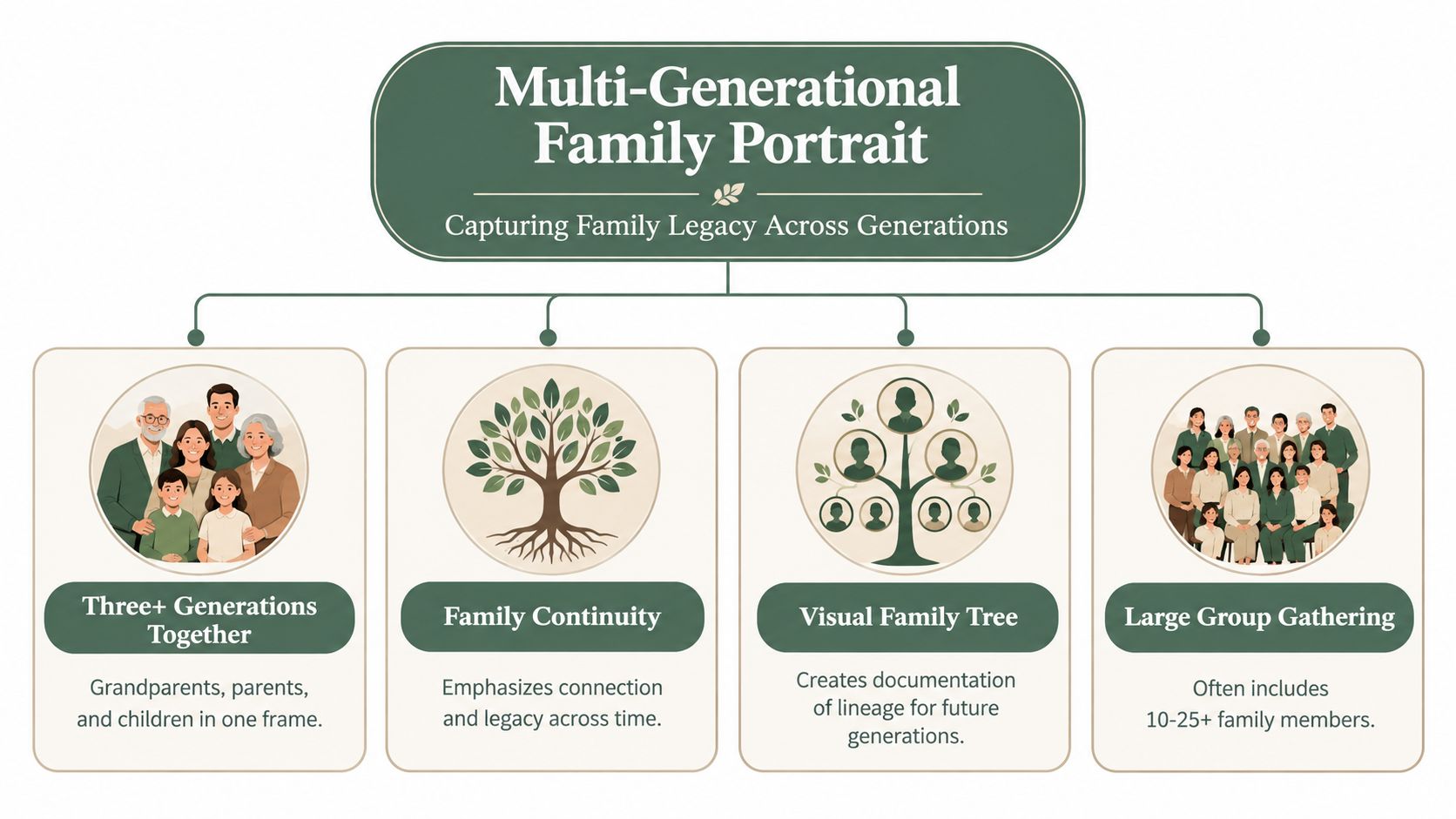
A multi-generational portrait places grandparents, parents, children, and sometimes great-grandchildren in one carefully arranged frame. It's one of the most enduring family group photo ideas because the image does more than show who attended a gathering. It records lineage, belonging, and continuity.
Start with the whole-family photograph while everyone is fresh. Choose a garden, beach, family property, or another location with personal meaning, and schedule for early morning or late afternoon when the light is usually softer. Outdoors can provide room for a large group, but a shaded porch or bright indoor room may be more comfortable for older relatives.
Arrange for visibility and comfort
Height-based rows work well, but they aren't the only solution. Place seated relatives on sturdy chairs or a bench, keep standing adults behind them, and position children beside the adults who make them feel secure. If someone uses a wheelchair, don't hide the chair or force an uncomfortable transfer. Build the composition around that person so the arrangement feels intentional.
Coordinate clothing by color family rather than requiring identical outfits. Soft neutrals, denim, earth tones, or a restrained seasonal palette can create cohesion while allowing each generation to dress comfortably.
Practical rule: Make the first frame the one everyone needs. Experiment only after you've secured a clear portrait with every person visible.
Take several versions, including one looking toward the camera and another with relatives looking at one another. Then record names, relationships, date, and place. You can later pair the photograph with guidance on preserving old family photos, so the portrait remains understandable rather than becoming an unidentified file.
2. Seated Family Circle or Wreath Formation
A seated circle changes the emotional temperature of a group portrait. Instead of arranging everyone in rows facing forward, place family members around a blanket, rug, picnic setting, or cluster of comfortable furniture. The camera sees connection through eye lines, hands, expressions, and the way people naturally turn toward one another.
This setup suits a family that wants intimacy rather than formality. It can work in a garden, living room, covered patio, or park. A large blanket defines the space, while cushions, folding chairs, and benches help relatives who can't sit on the ground. For a very large family, create two connected circles or use a curved arrangement around the central surface.
Make the circle genuinely accessible
Don't treat floor sitting as a requirement. Put older adults or mobility-limited relatives on chairs at the back of the circle, then place children on cushions and adults around them. The photograph will still read as a shared formation if everyone faces inward. A raised camera position can reveal the shape, but a photographer standing at normal eye level often captures warmer expressions.
Neutral, comfortable clothes usually work better than formal clothing here. Tight skirts, restrictive trousers, or shoes unsuitable for the location will make people self-conscious. Ask relatives to talk, share food, look at the youngest child, or tell a familiar story while the photographer works.
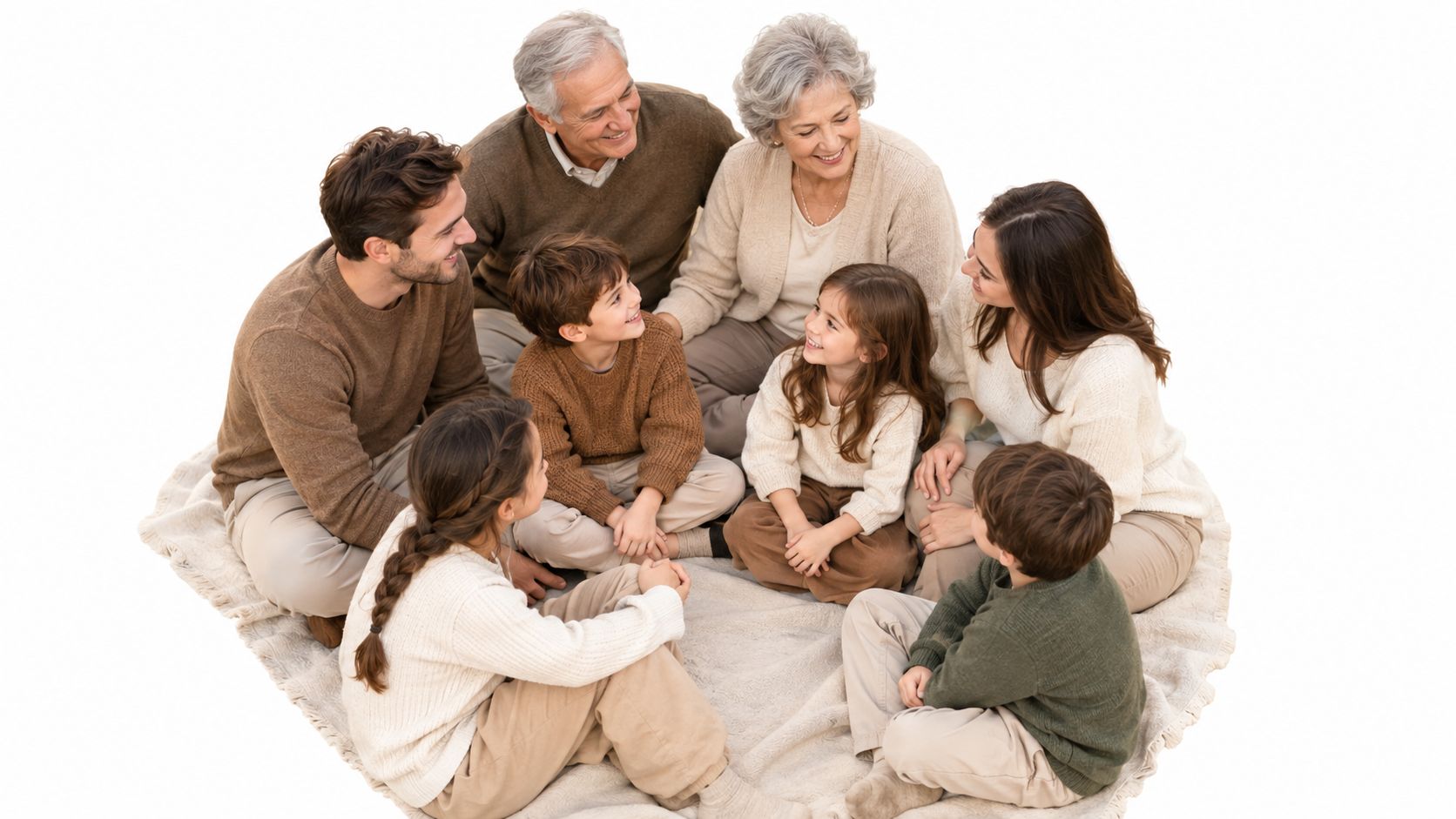
The trade-off is visibility. A pure overhead image may show the pattern beautifully but reduce facial detail, while a lower angle preserves expressions but makes the circle less obvious. Capture both if possible, and let comfort decide the arrangement rather than forcing a perfect geometric shape.
3. Candid Action and Lifestyle Family Photos
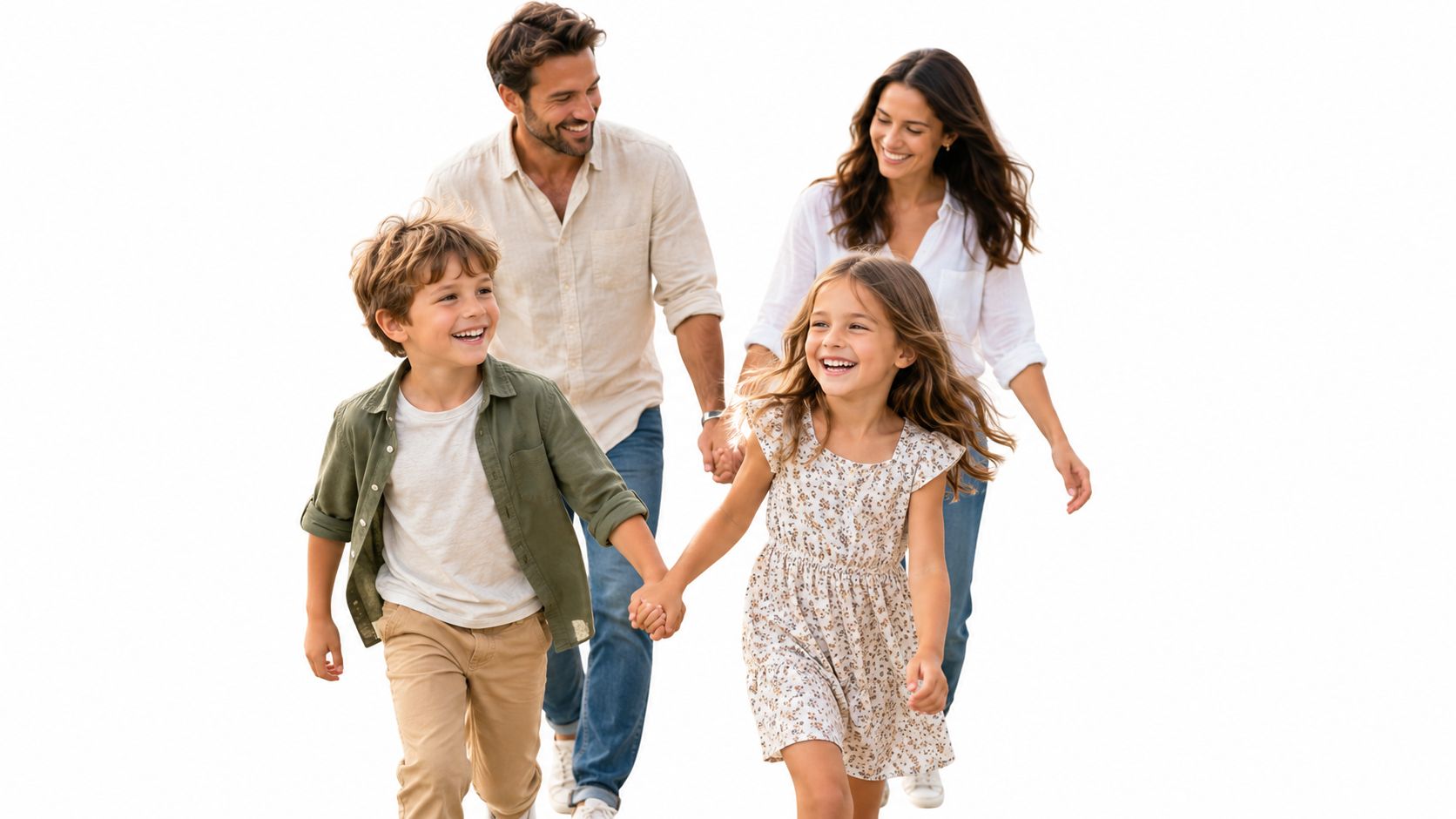
Candid photography works best when the activity matters more than the pose. Ask the family to cook a familiar meal, play cards, walk a known route, water plants, sort photographs, or sit together with a pet. The activity gives hands and attention somewhere to go, which reduces the pressure of being watched.
Choose a location where relatives already know how to behave. A home, garden, community room, or family business can reveal relationships more naturally than an unfamiliar studio. Tell everyone that they don't need to smile at the camera or pretend the activity is more exciting than it is. The photographer should watch for the moments between instructions, including concentration, teasing, helping, and quiet affection.
Choose reality over a performance
A lifestyle session isn't automatically better because it contains movement. Running, jumping, or fast games can exclude grandparents, young children, and anyone with limited mobility. Replace those prompts with seated games, recipe preparation, storytelling, music, or a slow walk with planned resting places.
The most useful activity is one your family would still do if the camera disappeared.
A photographer experienced in documentary work should know how to use quick shutter speeds, anticipate interaction, and give direction without turning every moment into a pose. The trade-off is that candid galleries can contain fewer universally perfect faces. In exchange, they often preserve the gestures and relationships that make the family recognizable to itself.
For a fuller family-life reference, this video about connected family photography can help you think about prompts that create interaction without demanding artificial smiles.
4. Chronological Age Progression Family Display
Some family photographs gain meaning by being repeated. Choose a place you can return to, such as a front step, family property, favorite park, or the same wall at home. Recreate a similar arrangement each time, then display the images in chronological order so viewers can see children grow, adults age, and the family unit change.
The method doesn't need to be elaborate. Keep a simple record of the date, location, participants, and any major context. If someone can't attend, note that rather than leaving future viewers to guess why the group changed. Consistency helps comparison, but family life won't always cooperate.
Build a record that survives the original files
Use the same photographer when practical, or provide future photographers with an earlier image for reference. Keep original files, edited copies, and scans in organized folders. A printed display or album can sit alongside a digital archive, giving relatives an accessible way to revisit the sequence.
A useful variation pairs a current image with an older family photograph from the same place. Recreating a childhood pose can be playful, but don't pressure relatives to match an arrangement that no longer suits their bodies or relationships. A seated version may be more meaningful than a technically identical one.
Archive note: The date and participant list are part of the photograph's meaning, not administrative extras.
This project also works for annual reunions, anniversaries, and changing households. When older photographs already exist, digitizing old photographs can bring them into the same visual collection. The trade-off is patience. The project becomes more valuable over time, but it requires someone to maintain the records and keep the tradition going.
5. Heritage and Cultural Family Portrait
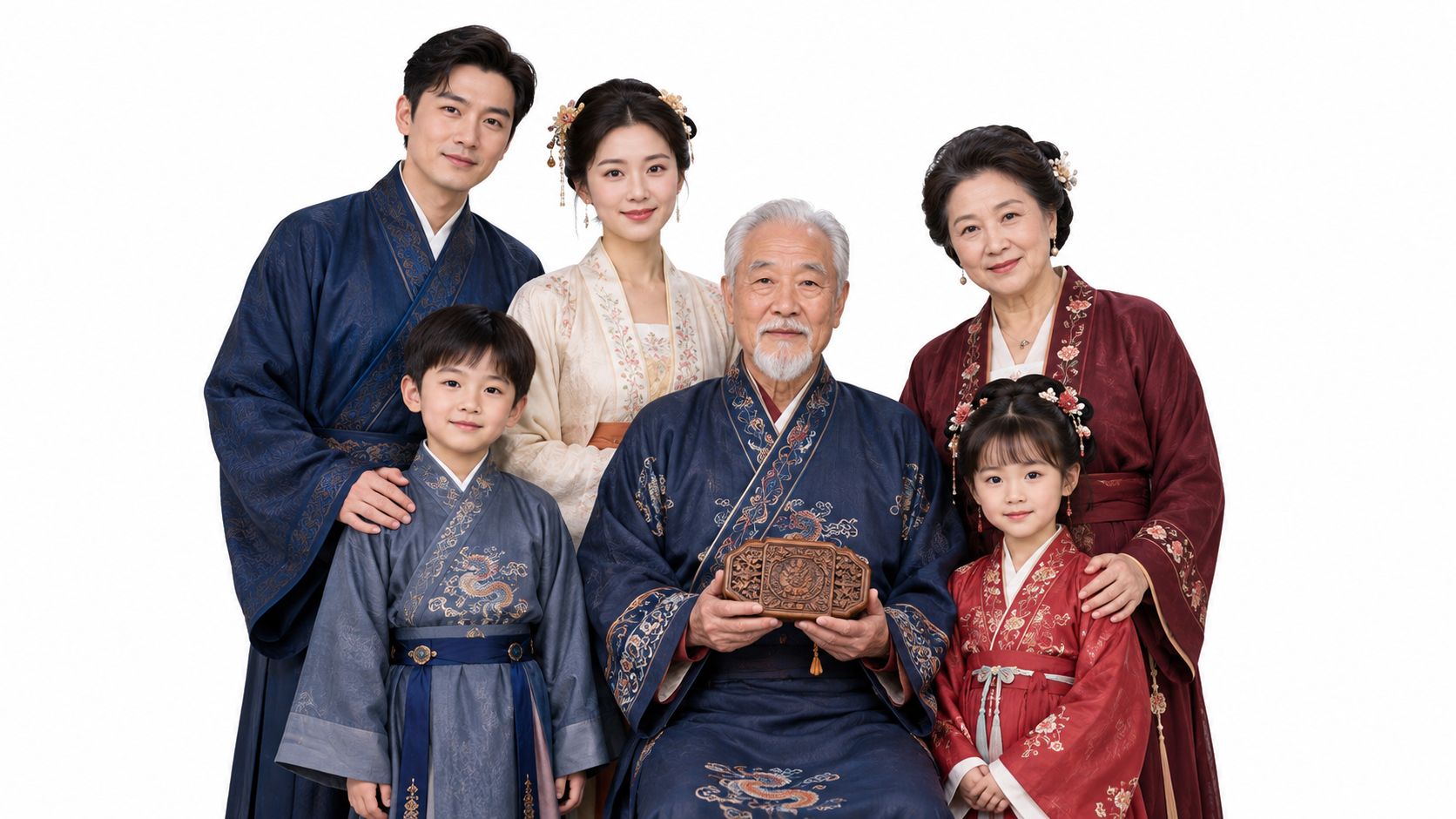
A heritage portrait can show family identity through clothing, food, architecture, heirlooms, or a ceremony. The strongest images don't use cultural elements as decoration. They explain something about where the family comes from, what it practices, and what elders want younger relatives to remember.
Begin with a family conversation. Ask which garments, objects, locations, words, recipes, or celebrations carry genuine significance. A traditional outfit may be appropriate for one relative and uncomfortable or unfamiliar for another. Let each person participate at a level that feels respectful, and consult someone knowledgeable when an item has religious, ceremonial, or community-specific meaning.
Photograph the context as well as the group
Create a formal portrait, then photograph details that help future viewers understand it. These might include an embroidered garment, a family recipe being prepared, an instrument, a craft, or an heirloom held by the person who can explain it. Write down names and meanings while everyone still remembers them.
A heritage session can take place at home, in a place of worship where photography is permitted, at a family-owned business, or in a setting connected to the family's history. Accessibility matters here as much as visual atmosphere. Choose a location with reliable seating, nearby parking, shade, and routes that don't require relatives to walk farther than they comfortably can.
Clothing coordination should support the story rather than flatten it. One family might wear traditional clothing together, while another may combine contemporary outfits with a shared textile or meaningful object. A photographer should listen before directing.
The trade-off is preparation. Research, permission, clothing, and interpretation take time, but the result can teach future generations far more than a generic portrait in a beautiful location.
6. Milestone and Legacy Photo Series
A milestone portrait marks a chapter, not just a date. An anniversary, retirement, significant birthday, or family-business transition can bring relatives together around a story that already has emotional weight. The photographs should show both the person or couple being honored and the network of people connected to that milestone.
Choose a meaningful setting whenever possible. It might be the family home, a workplace, a favorite gathering place, or the location where a couple began their life together. If the event includes a celebration, plan the formal group photograph before guests become tired or distracted. Then let the photographer document greetings, speeches, food, gifts, and private exchanges.
Combine formal proof with lived emotion
A strong series can include:
- The essential group portrait: Include the honoree, close relatives, and anyone whose presence defines the milestone.
- A relationship-focused frame: Photograph partners, siblings, grandchildren, or longtime friends together.
- The celebration details: Capture objects, decorations, handwritten notes, food, and the setting.
- Quiet moments: Leave room for expressions that aren't directed toward the camera.
Formal clothing may suit an anniversary or retirement, while familiar clothing may better represent a family business or home gathering. Provide chairs, water, shade, and rest periods for older adults. Don't make the person being celebrated stand through every setup.
Print matters for this kind of record. A framed portrait can honor the occasion, while a narrative collection can preserve the surrounding story. A photo essay book can hold formal portraits, candid scenes, captions, and messages from relatives in one physical object.
The trade-off is scope. More photographs create a richer record, but they also require stronger organization. Decide in advance which people, objects, and moments must appear, then allow the rest to unfold naturally.
7. At-Home Family Photo Sessions
Home is often the most accessible meaningful location a family has. It offers familiar seating, bathrooms, food, medication, quiet rooms, and the objects that make the household recognizable. It also gives older relatives and young children a place to pause without turning a break into a disruption.
Start by identifying the rooms with the best natural light and the clearest connection to family life. A kitchen can show shared routines, a living room can support a seated group portrait, and a bedroom or porch may reveal a quieter relationship. Tidy visible surfaces, but don't remove every personal object. A family photograph becomes more informative when it includes the chair everyone uses, the books an older relative reads, or the table where celebrations happen.
Work with the home you have
Ask the photographer to assess light and backgrounds rather than trying to make every room look like a studio. Coordinate clothing with the home's colors, but prioritize comfort. For a large group, use the largest room for the essential frame and smaller rooms for subgroups or detail photographs.
A home session can include a formal portrait on the stairs or sofa, followed by ordinary actions. Grandparents can read to children, siblings can prepare food, and relatives can look through old albums. These scenes give the final collection a sense of place that an outdoor backdrop can't provide.
The trade-off is visual control. Homes contain clutter, mixed lighting, and private items you may not want photographed. Decide what should stay outside the frame, tell the photographer about sensitive spaces, and don't over-clean until the home loses its character.
This approach also suits families separated by mobility or attention needs. People can join for the part of the session that works for them, and the photographer can build the final story from several comfortable rooms rather than asking everyone to remain in one pose.
8. Themed Family Photo Concepts
A theme gives a family a shared creative language. It could be a seasonal setting, a decade-inspired wardrobe, a favorite book, a color palette, a gardening day, or a beach picnic. The concept should reveal personality, not force everyone into costumes they dislike.
Start with the family's interests and the location. A fall theme belongs outdoors among changing leaves, while a cooking theme needs a workable kitchen and ingredients the family uses. Choose two or three visual anchors, such as color, props, and setting. Too many objects compete with faces and make the photograph feel like a set rather than a family memory.
Coordinate without making everyone identical
Ask relatives to stay within a color family instead of wearing matching outfits. Include accessories or objects that people can hold comfortably. If a theme involves children, keep a simple seated or standing version available for relatives who can't participate in active scenes.
A decade theme can be adapted across generations. Older adults might wear clothing connected to their own memories, while younger relatives interpret the period more loosely. That contrast can become part of the story. A seasonal concept can work indoors if weather, temperature, or mobility makes an outdoor setting impractical.
A theme should open conversation. If it stops people from acting like themselves, simplify it.
Take the formal themed portrait first, then loosen the structure. Let family members talk, adjust props, and interact without trying to keep every detail perfect. The trade-off is visual cohesion versus authenticity. A highly controlled image may look polished, but a slightly untidy frame can preserve more of the family's real character.
9. Sibling and Cousin Group Photos
Sibling and cousin photographs preserve relationships that often exist outside the main family hierarchy. These are the people who shared bedrooms, holidays, jokes, childhood games, and family stories. A dedicated same-generation portrait can therefore feel more personal than another full reunion photograph.
Schedule the image around a gathering when possible, but don't wait for a perfect event if the group is difficult to assemble. Choose a meaningful location, such as a childhood home, family garden, school, or favorite meeting place. Start with a straightforward group frame, then let the relatives talk and tease one another.
Photograph the history between them
Ask the group to recreate an older photograph if one exists. The location and pose may have changed, and those differences can be valuable. Take a formal version for sharing, then make space for hugs, walking, seated conversation, and the expressions that appear when people stop monitoring the camera.
For mixed ages, use levels rather than forcing everyone to stand. A bench, steps, or low wall can create natural variation. If someone has limited mobility, position the group around them and use close framing so the composition emphasizes connection rather than distance.
Clothing doesn't need to match. Similar tones can help, but the group's shared gestures will often matter more than coordinated outfits. Ask permission before including partners or children if the intention is specifically to document siblings or cousins.
The trade-off is emotional and practical. A playful session may produce the most honest photographs, but it can also create fewer conventional portraits where every face is directed forward. Capture the safe, shareable frame first, then give the group room to be itself.
10. Time Capsule Family Photo Documentation
A time capsule project records more than who stood together. It documents the family home, pets, vehicles, favorite possessions, workplaces, neighborhood, routines, and places people return to. Years later, these details can explain how the family lived in a way that a polished portrait can't.
Create a written plan before the session. Include the essential group photograph, each household, older relatives, children, pets, meaningful objects, exterior and interior views of the home, and locations associated with work or leisure. Add captions as you go. A photograph of a table becomes more valuable when future relatives know who built it, who used it, or why the family kept it.
Preserve the story with the image
Photograph details at different distances. Wide frames establish the home or location, medium frames show people using it, and close photographs record hands, tools, recipes, letters, clothing, and objects. Invite relatives to describe ordinary routines, and record those explanations in writing or audio if everyone agrees.
Organize the collection by theme or chronology. Keep original files, edited images, captions, dates, names, and places together. Make backup copies in separate locations, and consider professional archival scanning for printed photographs or fragile materials. A photo scanning service can help bring older images into the same archive as the new documentation.
The trade-off is volume. A time capsule can become overwhelming if every object receives equal attention. Prioritize details that reveal relationships, work, culture, daily life, and change. The finished collection should feel navigable, not like an unsorted camera roll.
10-Point Comparison of Family Group Photo Ideas
| Family Photo Type | Implementation Complexity 🔄 | Resource Requirements ⚡ | Expected Outcomes ⭐ / 📊 | Ideal Use Cases | Key Advantages ⭐ |
|---|---|---|---|---|---|
| Multi-Generational Family Portrait | High, complex coordination and staging 🔄 | Large space, professional photographer, time and budget ⚡ | Heirloom-quality group portraits; clear lineage documentation 📊 | Reunions, anniversaries, legacy preservation | Timeless documentary value; strong emotional impact ⭐ |
| Seated Family Circle or Wreath Formation | Medium, arrangement and elevated shooting angle 🔄 | Medium space, cushions/blanket, elevated camera or ladder ⚡ | Intimate, inclusive composition with all members visible 📊 | Mixed-age groups, mobility-limited family gatherings | Comfortable for elderly; natural expressions; egalitarian composition ⭐ |
| Candid Action and Lifestyle Family Photos | Medium–High, requires anticipation and adaptive shooting 🔄 | Extended session time (2–3 hrs), fast shutter gear, relaxed locations ⚡ | Authentic storytelling series; emotionally resonant images 📊 | Families wanting natural moments and routines | Genuine emotions; great for shy or camera-averse members ⭐ |
| Chronological Age Progression Family Display | Very high, long-term commitment and consistency 🔄 | Annual sessions, consistent pose/location, archival storage ⚡ | Powerful timeline showing aging and family evolution over decades 📊 | Long-term traditions, milestone anniversaries, family history projects | Increasingly meaningful legacy; strong emotional narrative ⭐ |
| Heritage and Cultural Family Portrait | Medium–High, cultural research and respectful planning 🔄 | Traditional clothing, culturally significant locations, specialized photographer ⚡ | Culturally rich portraits that document identity and traditions 📊 | Celebrating heritage, educating descendants, cultural ceremonies | Preserves cultural history; visually distinctive and meaningful ⭐ |
| Milestone and Legacy Photo Series | Medium, event coordination and staged elements 🔄 | Professional photographer, event planning, budget for prints ⚡ | Professional commemorative images suitable for display and archives 📊 | Anniversaries, retirements, big birthdays, business milestones | Formal, high-quality documentation of life achievements ⭐ |
| At-Home Family Photo Sessions | Low–Medium, home prep and flexible shooting 🔄 | Minimal travel, variable natural light, photographer skilled in interiors ⚡ | Authentic, comfortable portraits grounded in everyday life 📊 | Newborns, mobility-limited families, documentary domestic shots | Comfortable subjects; convenient and often more affordable ⭐ |
| Themed Family Photo Concepts | High, creative direction, styling and prop coordination 🔄 | Costumes/props, styling, specialized photographer or stylist ⚡ | Visually cohesive, memorable images that express personality 📊 | Holiday cards, playful families, creative campaigns | Unique, shareable portraits; fun family experience ⭐ |
| Sibling and Cousin Group Photos | Medium, scheduling and focused composition 🔄 | Small–medium space, possible separate session, simple props ⚡ | Energetic, authentic peer-group images highlighting lateral bonds 📊 | Sibling reunions, cousin gatherings, milestone meetups | Captures same-generation relationships; often relaxed and fun ⭐ |
| Time Capsule Family Photo Documentation | Very high, extensive planning, organizing and archiving 🔄 | Significant time, professional organization, digital/physical archives ⚡ | Comprehensive multi-dimensional archive of family life and era 📊 | Family historians, legacy projects, long-term archival efforts | Deep historical value; richly detailed context for descendants ⭐ |
| Practical Tips 💡 | Plan logistics early; schedule golden hour; arrange by height | Prepare locations and gear; budget time and backups | Aim for mix of formal and candid shots; archive digitally | Match format to family size, mobility and goals | Work with experienced photographers; keep records and backups 💡 |
Turn Today's Photos Into Tomorrow's Family History
Choose the concept by asking what your family needs, not what looks most popular online. A multi-generational portrait works well when lineage and visibility matter. A seated circle or at-home session can reduce physical demands. Candid activities suit families who connect through doing, while a heritage portrait gives cultural meaning a visible place. A time capsule is the strongest choice when you want future relatives to understand daily life as well as faces.
Family size should shape the plan from the start. A large group may need one essential portrait followed by smaller household, sibling, and generation-based combinations. A smaller family can spend more time on movement, conversation, or meaningful details. Don't make every person remain present for every frame. Build a schedule that allows relatives to arrive, rest, participate, and leave without making the whole session depend on one long stretch of attention.
Mobility and comfort deserve equal status with composition. Provide chairs, shade, nearby parking, accessible paths, quiet rooms, and clear breaks. Place relatives where they feel secure, then design the frame around those choices. You won't lose emotional value by using a wheelchair, a favorite chair, a porch, or a kitchen table. Those elements may help future viewers recognize how the family really lived.
A useful session often combines one formal setup with candid details. Secure the clear group portrait first, then photograph hands preparing food, grandchildren listening to a grandparent, siblings laughing, a familiar room, or an heirloom being held by the person who understands it. Formal and informal images answer different questions. One identifies the family, while the other shows how its members relate.
Write down names, dates, places, relationships, cultural context, and the meaning of important objects. Don't assume someone in the future will recognize every face or understand why a location mattered. If older photographs are part of the collection, connect them to the new images and preserve them in a dependable archive rather than leaving everything on one phone.
Physical photo products remain relevant to family storytelling. One industry report states that 27% of U.S. adults bought a photo book or photo album in 2023, while family-history photobooks are forecast to grow at a 7.2% CAGR through 2028, according to the photobook industry data. Those figures support a practical choice: plan important images for printing, albums, and long-term viewing, not only for quick digital sharing.
Start with one decision today. Choose the concept that fits your family's mobility, space, relationships, and memory goal. List the people and meaningful elements you want included, schedule a comfortable session, and create a shared record where the finished photographs can stay connected to their stories. remembers.life lets families build a memory profile and add photographs, captions, and contributions from relatives to a shared timeline, giving the images context beyond the original shoot.
Choose one family group photo idea, write down who should be included and what each image should preserve, then arrange a relaxed session around your family's real needs. Add the finished photographs, names, dates, and memories to a shared family record on remembers.life, so relatives can continue contributing to the story.