8 Interview Questions for Parents to Preserve Their Stories
Use these interview questions for parents to uncover family memories, values, challenges, traditions, and legacy messages worth preserving.
A parent mentions an ordinary detail over coffee, perhaps the smell of a childhood kitchen, a difficult move, or the reason a family tradition began. Suddenly, the moment opens into a history no family album could capture on its own. The problem is that these details can disappear when nobody has asked the next question, recorded the answer, or saved the photograph, recipe, letter, or place name connected to it.
The right interview questions for parents make space for more than dates and names. They invite memories, values, challenges, relationships, traditions, influences, and a direct message for the people who'll come after. This guide offers eight prompts in a deliberate emotional sequence, along with practical advice for preparing the conversation, listening without taking over, handling sensitive memories, and preserving audio, video, written responses, and supporting materials.
A calm, consent-first approach matters. Your parent should be able to pause, skip a question, correct the record, or decide who can hear the finished story. The method reflects established oral-history practice, where planning questions, choosing a comfortable setting, and recording first-hand recollections help preserve details that may never have been written down. FamilySearch's oral-history guidance describes a tradition shared by major historical and family-history institutions.
You can keep the process simple with a phone and a notebook, or organize the material in remembers.life, an option for creating a lasting record of stories, memories, and experiences for future generations.
Table of Contents
- Prepare for a conversation, not an interrogation
- 1. Tell me about your most cherished family memory and why it's so important to you
- 2. What lessons or values did you want to pass down to your children, and which ones do you see they've adopted?
- 3. Can you describe a time when you overcame a significant challenge or obstacle as a parent? What did you learn?
- 4. What are you most proud of regarding your role as a parent or family member?
- 5. How have your relationships with your children or family members evolved over time? What has changed?
- 6. What traditions or rituals have been important to your family, and how have you maintained or adapted them?
- 7. Who has had the most influence on you as a parent, and what did you learn from them?
- 8. What do you hope your children and grandchildren will remember about you, and what message do you want to leave them?
- 8-Question Parent Interview Comparison
- Preserve the Voice Behind the Answers
Prepare for a conversation, not an interrogation
Before asking the first question, agree on the shape of the session. Decide whether your parent prefers audio, video, handwritten answers, or a relaxed conversation that you'll summarize afterward. Ask permission to record, explain where the file will be stored, and make it clear that stopping is always acceptable.
Choose a familiar setting with comfortable seating and limited interruption. A kitchen table, living room, garden, or favorite café may work better than a formal interview environment. Older relatives often remember more when a photograph, recipe, object, or familiar place helps recall the scene. Government and museum-adjacent family-history guidance recommends audio recording, open-ended prompts, photo-led recall, and a chronological order that begins with early memories and moves forward.
Prepare a short list, not a script you must complete. The eight questions below can support one unrushed conversation or several shorter sessions. A clinical family-history review found that structured tools improved recording by 46% to 78% compared with standard practice, while also identifying workflow friction, provider-led data entry, and poor electronic-record integration as barriers. The systematic review offers a useful lesson for family interviews: a strong prompt still fails if capturing the answer feels difficult.
Set up the recording
Test your device before your parent arrives. Place the microphone close enough to hear naturally, silence notifications, and keep a backup method available if the conversation matters. Take brief notes with names, places, approximate dates, and questions to revisit, but don't write so constantly that your parent feels observed rather than heard.
A simple preparation list helps:
- Confirm consent: Ask whether recording is welcome and whether any subjects are private.
- Gather memory triggers: Bring photographs, letters, recipes, maps, clothing, tools, or heirlooms.
- Plan a pause: Leave time for silence, tears, laughter, and corrections.
- Create a file system: Use the speaker's name, topic, and date in each filename.
- Choose a follow-up path: Decide whether you'll transcribe, summarize, edit clips, or preserve the original recording unchanged.
Don't correct a memory in the moment unless accuracy affects safety or another person's privacy. Mark the point in your notes and return to it gently. Family testimony can preserve distinctive anchor points even when a complete account is unavailable. In a PubMed-indexed study of family-recalled information, a rule based on three or more positive implications produced 98% specificity, 39% sensitivity, and 45% positive predictive value. The study's findings support a careful approach: treat remembered details as valuable evidence, while labeling uncertainty rather than forcing false precision.
1. Tell me about your most cherished family memory and why it's so important to you
Start with warmth. This question gives your parent control over the first story and often reveals what the family means to them without demanding an explanation of difficult experiences. A cherished memory might involve teaching someone to bake, a child's first day at school, a holiday gathering, or a trip where an ordinary mishap became a family joke.
Listen for the details beneath the event. Ask who was present, what happened before and afterward, and why the memory has stayed vivid. If your parent mentions a kitchen, ask about the smell of the food, the tools they used, or who taught them the recipe. If they describe a school day, ask what they noticed in the child's face, what surprised them, and what they learned about their own role as a parent.
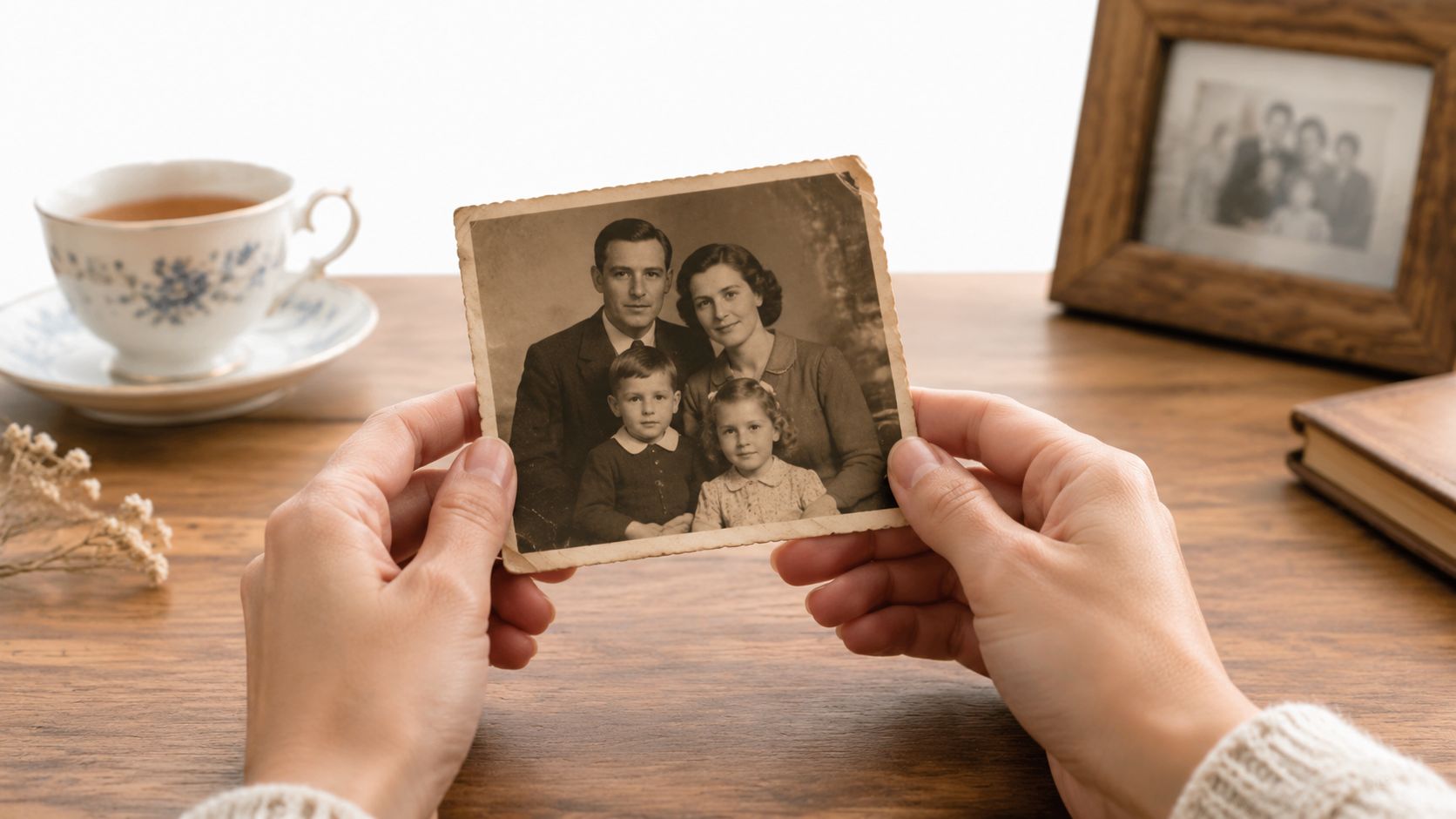
Follow the feeling, not just the chronology
A good follow-up doesn't sound like a demand for more facts. Try, “What made that moment stay with you?” or “What do you remember hearing?” Then allow the answer to breathe. Silence often gives someone time to move from a general summary into the scene itself.
Notice recurring themes. One parent may describe family humor, another may focus on sacrifice, faith, food, travel, or a quiet act of care. Those themes can guide later questions and help you organize the eventual record into life chapters rather than disconnected anecdotes.
If the story belongs in a written memory book, preserve the parent's own phrasing alongside your summary. The guidance in this resource on writing a memory book can help turn a spoken recollection into a fuller record without flattening its emotional texture. Save the original audio or video too, because a transcript captures words more easily than hesitation, laughter, emphasis, or a familiar voice.
2. What lessons or values did you want to pass down to your children, and which ones do you see they've adopted?
This question moves from what happened to why your parent made certain choices. It can reveal the values they tried to teach deliberately, the habits they modeled without realizing it, and the principles their children adopted only much later.
Ask about specific examples instead of accepting broad labels. “You valued resilience” becomes more meaningful when your parent describes a moment of financial pressure, a difficult career decision, or a family responsibility. Ask which values came from their own parents, which they chose to keep, and which they consciously changed. A parent may discover that children learned generosity from watching daily behavior rather than from any formal lesson.
Make room for mixed results
Don't turn the conversation into a report card. A parent may feel proud that a child embraced a tradition but uncertain about whether they passed on patience, openness, or confidence. Ask about both intentions and outcomes with care. “What did you hope they'd understand?” is usually more productive than “Did you succeed?”
The most revealing answer may involve delayed understanding. A child might dismiss advice when young and recognize its meaning years later. That story can document how values evolve across generations, particularly for middle-aged families whose adult children are now making independent choices.
Keep the connection concrete:
- Name the value: Ask whether it was kindness, independence, faith, responsibility, curiosity, loyalty, or something else.
- Find the example: Ask for a scene that shows the value in practice.
- Trace the source: Explore what your parent inherited from earlier generations.
- Acknowledge change: Ask whether the value means something different today.
- Record the child's perspective: If appropriate, invite siblings or adult children to share what they remember learning.
A parent-focused conversation can also become part of a wider family project. These interview questions for grandparents offer related prompts that help compare how wisdom, customs, and expectations travel through generations. Preserve differences rather than trying to create one official family interpretation.
3. Can you describe a time when you overcame a significant challenge or obstacle as a parent? What did you learn?
Begin with the circumstances, not the lesson. Ask your parent to describe what was happening, what decisions they faced, and what support was available. Financial strain, illness, bereavement, relocation, separation, or raising a child with additional needs may all belong in the family record, if your parent chooses to discuss them.
Some experiences do not end with a tidy insight. Your parent may have learned to ask for help, accept uncertainty, set a boundary, or recognize that endurance has limits. Let that uncertainty remain part of the answer.

Use follow-up questions that keep the process visible:
- Reconstruct the moment: What surprised you, and what were you afraid might happen?
- Identify support: Who helped, and what kind of help made a difference?
- Trace the effect: How did the experience affect family relationships, work, faith, health, or your approach to parenting?
- Ask about change: What would you handle differently now?
A middle-aged parent or someone over 50 may remember the event differently from adult children who lived through it. If appropriate, invite those perspectives later, without asking anyone to settle on one official version.
Watch your parent's response. If emotion surfaces, pause the recording and ask whether they want a break, a different question, or no record of that part. Tissues and reassurance can help, but respectful silence may offer more support than quickly changing the subject.
Practical rule: Your parent can revise the story. A recording made with permission may still be removed, restricted, or corrected later.
After the main account, note names, places, documents, photographs, or relatives who could add context. Keep the original recording alongside any edited version. For help shaping the material into a reflective account, use this guide to life-story writing while preserving your parent's own words.
4. What are you most proud of regarding your role as a parent or family member?
A family archive should include moments of pride. Many parents describe mistakes readily, yet hesitate to name what they did well. This question gives them room to recognize their contribution without presenting themselves as perfect.
Start with the answer they offer, then ask for one scene that makes it real: “Can you tell me about a moment that shows this?” A proud memory might involve a child seeking advice, relatives staying connected through disruption, or a small act of care that went unnoticed at the time. Ordinary routines can carry as much meaning as major milestones.
The story may reveal work that was shared. Ask what made the achievement difficult and who helped make it possible. A spouse, sibling, neighbor, teacher, or friend may have supported the family in ways the parent did not mention at first. Recording that context produces a fuller account than listing successes alone.
Use these prompts selectively:
- Focus on impact: What difference do you believe you made?
- Invite small memories: Which everyday moment still feels meaningful?
- Explore recognition: Did a child or relative ever express appreciation?
- Allow complexity: What are you proud of, and what do you wish you had handled differently?
- Preserve the voice: If you create a written version, keep the answer in first person.
For families in midlife or beyond 50, this question can connect personal achievement with the wider family story. Invite the parent to name what they hope adult children or grandchildren understand about that contribution, while leaving room for their own interpretation.
Do not supply the praise yourself. Listen for pride, uncertainty, gratitude, and regret, and let them coexist. If emotion appears, slow down and ask whether the parent wants to continue, pause, or leave that part unrecorded. With permission, keep the original recording beside any edited transcript so the tone and wording remain available later.
5. How have your relationships with your children or family members evolved over time? What has changed?
Family relationships are not fixed portraits. They move from dependence to authority, negotiation, distance, friendship, caregiving, and sometimes renewed closeness. Asking about change helps your parent describe the relationship as a living story rather than a set of roles.
Begin with a timeline. Ask what the relationship felt like when the children were young, during adolescence, when they left home, and in adulthood. Then ask whether a particular event shifted the connection. A divorce, remarriage, move, illness, birth of grandchildren, shared work, or honest conversation may have changed how family members understood one another.
Keep the question open on purpose
Don't assume that change means improvement. A relationship may have deepened, become more complicated, or remained distant. Let your parent decide what changed and whether the change was welcome. Ask about communication, boundaries, shared interests, and the ways each person learned to see the others more fully.
Useful follow-ups include:
- “When did you first notice the relationship changing?”
- “What surprised you about your child as an adult?”
- “What do you understand now that you didn't understand then?”
- “How do you stay connected when you disagree?”
- “Is there anything you'd like future generations to understand about this relationship?”
Sensitive answers may involve estrangement, conflict, or private information about another person. Your parent's permission to record their story doesn't automatically grant permission to publish someone else's medical, legal, or personal details. Discuss whether names should be changed, whether certain passages should remain private, and who may access the finished record.
A respectful interview doesn't force reconciliation or manufacture a happy ending. It preserves perspective. Future relatives may value an honest account of how people tried to understand one another, even when the relationship remained unfinished.
6. What traditions or rituals have been important to your family, and how have you maintained or adapted them?
A family tradition often looks ordinary from the inside. A particular dish, prayer, song, holiday arrangement, reunion, summer journey, or way of welcoming guests may seem too familiar to document. Ask anyway. The meaning often appears in the origin story, the people who carried it forward, and the changes that kept it alive.
Invite your parent to describe the tradition as if a future relative had never seen it. Who participates? When does preparation begin? What objects, ingredients, words, clothing, or gestures matter? Where did it come from, and who introduced it to the family?
Preserve the practice, not only the explanation
A recipe without technique can be incomplete. Ask how the parent knows when the food is ready, what substitutions are acceptable, and which steps they learned by watching rather than measuring. Record the preparation, photograph the tools and serving dishes, and identify the people connected to each object.
Traditions also change. A holiday meal may move from one home to another, a religious practice may be adapted, or a reunion may become a smaller gathering. Ask what was lost, what survived, and why the change mattered. Adaptation doesn't make a tradition less authentic. It shows how a family makes meaning under new circumstances.
If the family still practices the ritual, record it in action with permission. A short video can preserve pace, gesture, sound, and participation in ways that a written description can't. Use the embedded example below as a reminder that visual context can help a future family member understand not only what people did, but how the tradition felt in practice.
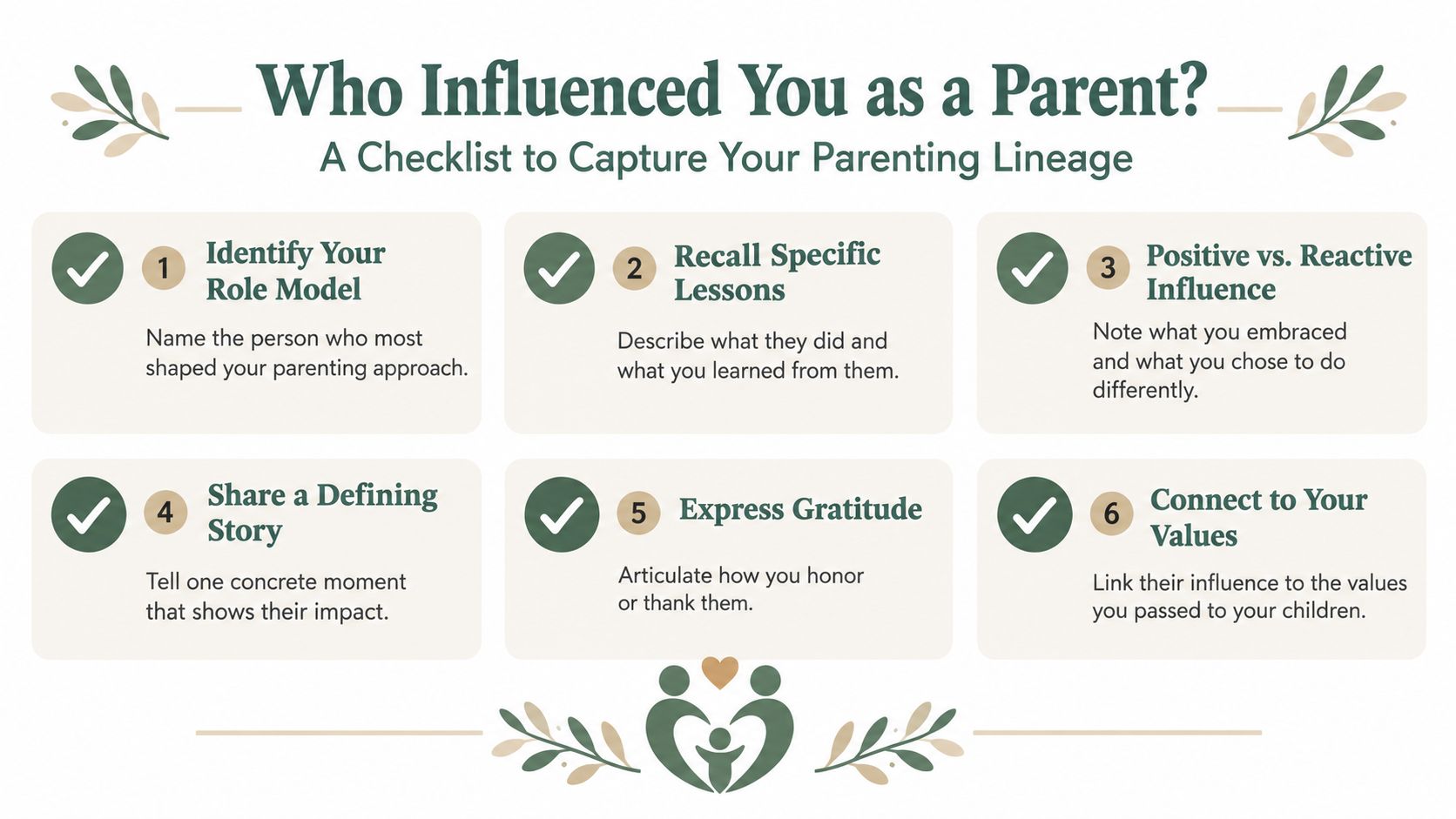
7. Who has had the most influence on you as a parent, and what did you learn from them?
A parent's approach often began with someone else's example. That person could be a mother, father, grandparent, teacher, neighbor, coach, faith leader, or friend. They may have modeled patience and generosity, or shown your parent which behaviors they wanted to avoid.
Start with a person and a scene. Ask, “What did they do that stayed with you?” Follow with questions about the words, habits, boundaries, or gestures your parent remembers. Then ask which lessons entered their own parenting, which they changed, and why.
Listen for the choice behind the influence
Influence can carry gratitude and pain at the same time. One relative may have taught determination, while another made emotional openness feel possible. An absence, harsh discipline, or family silence may have led your parent to choose a different way of raising children.
Keep the conversation with your parent's decisions. Do not press for forgiveness, defend the earlier generation, or judge the person being described. Ask, “How did that experience shape the parent you wanted to become?” This gives your parent room to acknowledge harm while explaining the choices they made afterward.
A useful follow-up is, “What do you hope your children understood about that choice?” It connects the story to the larger family journey without repeating the earlier discussion of values.
The people who influence parenting do not always give the best advice. Their example may show a parent what to protect, or what to change.
Record the person's full name, relationship, location, and any memorable expression, checking spellings after the interview. If an older photograph appears, scan it with permission and identify everyone pictured. Save the recording, transcript, and image together, with the date and your parent's preferred access settings. That pairing helps future family members connect a voice and story to recognizable faces rather than unexplained names.
8. What do you hope your children and grandchildren will remember about you, and what message do you want to leave them?
End with a direct invitation to speak to the future. This question can feel vulnerable, so explain that there's no perfect message and no need to summarize an entire life. Ask your parent to imagine that the people they love are listening now.
A parent may want descendants to remember love, humor, perseverance, faith, curiosity, responsibility, or the simple fact that family gave their life meaning. The most powerful answer may be short. Don't interrupt to improve it, and don't ask your parent to make it more polished.
Give the message a form
Offer several ways to answer:
- Speak directly: “If they could hear you right now, what would you say?”
- Write a letter: A handwritten page can preserve phrasing, pressure, and personal style.
- Record multiple takes: Let your parent pause, begin again, or choose the version that feels right.
- Connect words to actions: Ask what they hope the family will continue doing.
- Set access wishes: Confirm who may hear or read the message now and later.
A quiet setting helps. Keep the camera or phone steady, but don't let production concerns overshadow the person. A direct voice can carry affection, humor, hesitation, and emphasis that a polished text may lose. Preserve the imperfect version if your parent prefers it.
This final message can sit alongside broader practical decisions about family records and wishes. This guide to legacy planning can help you think about how the message fits within a wider record of what your parent wants future generations to know.
8-Question Parent Interview Comparison
| Question (Title) | 🔄 Implementation Complexity | ⚡ Resource Requirements | 📊 Expected Outcomes | 💡 Ideal Use Cases | ⭐ Key Advantages |
|---|---|---|---|---|---|
| Tell me about your most cherished family memory and why it's so important to you. | Moderate, open-ended, may need follow-ups | Moderate, time, audio/video recording for sensory detail | Deep, emotionally rich narratives with sensory context | Introductory interviews to capture family identity and core stories | High emotional authenticity and archival value |
| What lessons or values did you want to pass down to your children, and which ones do you see they've adopted? | Moderate, requires reflective prompts and examples | Low–Moderate, time for reflection, examples or corroboration | Clear record of parenting philosophy and transmitted values | Legacy documents aimed at guidance for younger generations | Preserves ethical framework and intentional parenting choices |
| Can you describe a time when you overcame a significant challenge or obstacle as a parent? What did you learn? | Higher, sensitive content, needs careful framing | Moderate, longer interview, emotional support/tissues | Resilience narratives with practical strategies and lessons | Inspirational sections of legacy projects; coaching resources | High motivational impact and practical wisdom for descendants |
| What are you most proud of regarding your role as a parent or family member? | Low, affirmative, encourages positive recall | Low, brief prompts, minimal setup | Uplifting, celebratory content that balances life review | Creating positive legacy chapters or confidence-building materials | Generates warm, role-model stories and boosts parental dignity |
| How have your relationships with your children or family members evolved over time? What has changed? | Moderate–High, requires nuance and timeline probing | Moderate, time, possibly multiple perspectives | Nuanced, multi-decade relationship narratives; reconciliation stories | Intergenerational understanding, healing, and context-setting | Produces deep relational insight and growth narratives |
| What traditions or rituals have been important to your family, and how have you maintained or adapted them? | Low–Moderate, concrete questions elicit specifics | Moderate, artifacts, recipes, video of rituals ideal | Actionable heritage content (recipes, steps, celebration notes) | Cultural preservation, practical guides for continuing traditions | High practical continuity value; repeatable legacy content |
| Who has had the most influence on you as a parent, and what did you learn from them? | Moderate, traces lineage and mixed influences | Low–Moderate, time; infographic or visuals optional | Mentorship and intergenerational wisdom narratives | Documenting parenting lineage, gratitude, and intentional change | Strong continuity of wisdom and contextual family meaning |
| What do you hope your children and grandchildren will remember about you, and what message do you want to leave them? | Moderate, emotionally intense; can provoke mortality reflection | Moderate, quiet setting, audio/video recording recommended | Concise, powerful legacy statements and intentional messages | Capstone legacy pieces, ethical wills, final messages to descendants | Most emotionally resonant and enduring element of a legacy project |
Preserve the Voice Behind the Answers
The interview isn't finished when the recording stops. Review the material with your parent and ask whether the story sounds accurate, whether any section should be removed, and whether the chosen audience still feels right. This step protects trust and gives your parent control over a record that represents their life.
Label every file clearly with the speaker, subject, and date. Keep the untouched original, then make working copies for transcription, clipping, or editing. If a recording includes several subjects, note who appears and when. Add a short written description so relatives can find the story without listening to every file.
Pair spoken answers with the materials that give them context:
- Photographs: Identify people, places, occasions, and approximate periods.
- Letters: Preserve envelopes, signatures, and the relationship between sender and recipient.
- Recipes: Include handwritten instructions, ingredient substitutions, tools, and serving traditions.
- Documents: Add certificates, maps, programs, diaries, or work records when your parent agrees.
- Timelines: Connect memories to homes, jobs, migrations, marriages, births, losses, and other milestones.
Don't force every question into one sitting. A parent may answer the first prompts easily and need time before discussing grief, conflict, illness, or regret. A second session can produce a better story than pushing through fatigue. After a difficult memory, ask whether your parent wants to continue, change direction, or return another day.
Memory also needs respectful interpretation. If relatives remember the same event differently, preserve the versions separately and identify who told each account. Don't combine conflicting details into one polished narrative. Distinct perspectives can show how family members experienced the same moment, and uncertainty is more honest than invented certainty.
For middle-aged and 50+ families, preservation should be practical enough to maintain. Store the original in a reliable location, keep an additional copy, and tell a trusted family member how to access it. If you use remembers.life, you can organize life stories, memories, and experiences into a record intended for future generations. The platform can sit alongside your own recordings, scans, notes, and family permissions rather than replacing the original evidence.
Share the finished record according to your parent's wishes. Some stories may be suitable for the whole family, while others should remain private until a specified time or be limited to particular relatives. Consent is not a one-time formality. Reconfirm it when you edit, publish, send, or expand the archive.
Choose one question today. Schedule an unrushed conversation, ask permission to record, place a photograph or familiar object nearby, and let your parent answer without interruption. One carefully preserved story can become the beginning of a family record that keeps growing.
remembers.life helps families organize stories, memories, and experiences into lasting records for future generations. Visit remembers.life, choose one of these interview questions for parents, and begin preserving your parent's voice with their permission.