Pays Tribute to: A Family Guide to Meaningful Tributes
Pays Tribute To. Learn how to write and deliver a tribute that honors a loved one with dignity. Practical tips, real examples, and gentle tone guidance
The page is blank, the service is tomorrow, and someone has just asked, “What should we write?” Around the kitchen table, relatives are trading memories while one person tries to turn a whole life into a few careful paragraphs. The phrase “pays tribute to” sounds formal enough for the occasion, but it won't solve the harder problem: deciding what belongs in public, what should be spoken aloud, and what deserves to remain inside the family.
A meaningful tribute doesn't need to make a person flawless. It needs to identify them clearly, tell the truth with care, and preserve something specific that would otherwise disappear. The strongest family tributes usually begin with an ordinary detail, a habit, a phrase, or a small act of care.
Table of Contents
- What It Means When a Family Pays Tribute to Someone
- Writing the Sentence That Starts a Tribute
- Drafting and Delivering the Funeral Eulogy
- Choosing the Right Tribute Format for the Right Audience
- Planning a Tribute Video That Actually Gets Watched
- Building a Private Family Record That Lasts
- Putting the Whole Tribute Plan Together
What It Means When a Family Pays Tribute to Someone
When a family pays tribute to someone, it recognizes that person's life, character, influence, sacrifice, or place in the family. That recognition can take several forms, and trouble starts when one document is expected to serve every purpose at once.
Separate the work into three distinct jobs:
- A public statement, such as an obituary, social post, or memorial page. This gives a wider audience the essential facts and a respectful account of the person's importance.
- A spoken tribute, such as a eulogy, reading, video, or musical performance. This creates an emotional experience for people gathered together.
- A private family record, built for descendants, relatives, and people who may want the fuller story later. This can hold photographs, recordings, conflicting memories, and details that don't belong in a public announcement.
The public statement needs clarity and restraint. The spoken piece needs rhythm, warmth, and room for silence. The private record can be more expansive, but it still needs consent, context, and honest labeling.
Why the three jobs should stay separate
An obituary may mention a person's work, relationships, and surviving relatives. A eulogy might focus instead on the way they welcomed guests or repaired things without being asked. A family archive may also preserve the difficult years, the stories that disagree, and the ordinary routines that made the person recognizable.
Trying to combine all of this creates a document that is too private for strangers and too thin for descendants. Decide first which job you're doing tonight. Write only for that audience.
Public remembrance has long crossed the boundary between private grief and organized commemoration. On 22 November 2004, the United Nations General Assembly adopted Resolution 59/26, designating 8–9 May as the annual Time of Remembrance and Reconciliation for Those Who Lost Their Lives during the Second World War, as described by the United Nations observance record. That precedent matters because it shows tribute operating at several levels, from governments and public institutions to families preserving personal stories.
Practical rule: Don't ask one tribute to satisfy the public, the congregation, and the grandchildren. Give each audience the version it can receive properly.
Writing the Sentence That Starts a Tribute
The phrase “pays tribute to” is a formal transitive construction. The verb needs a clear object. Someone pays tribute to a person, group, achievement, value, or sacrifice. “The family pays tribute to” is unfinished because the reader still doesn't know who is being honored.
Use this sentence stem:
[Subject] pays tribute to [honoree] for [quality, contribution, or influence] by recalling [specific memory].
That structure gives the sentence somewhere to go. It also prevents the common mistake of replacing a real memory with a general compliment.
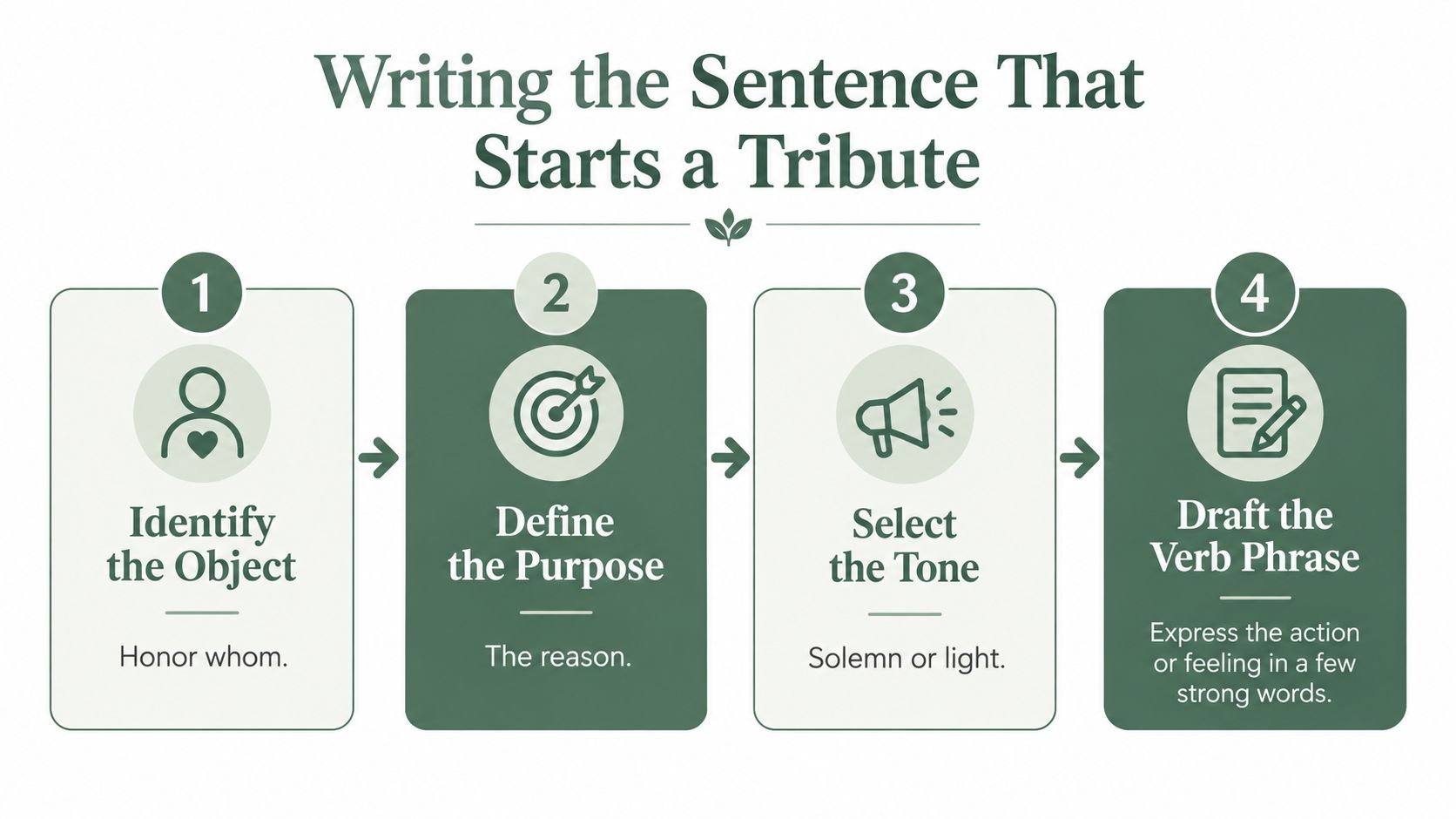
Use four deliberate decisions
The recommended drafting workflow is simple:
- Identify the honoree. Use the person's name and, when useful, their relationship to the audience.
- Name the quality or contribution. Choose patience, courage, generosity, craftsmanship, devotion, humor, or another quality you can support.
- Add one observable memory. Say what the person did, not merely what you think they represented.
- Revise for audience and tone. A funeral program, family letter, and private archive shouldn't sound identical.
Here is a weak opening:
The family pays tribute to a wonderful woman who meant so much to everyone.
It offers praise without identity, evidence, or character. A stronger version would be:
The family pays tribute to Elena for the practical kindness she showed her neighbors, remembered in the Sunday meals she prepared and shared with anyone who needed one.
The second sentence gives the reader a person, a quality, and an action. It doesn't claim that Elena was perfect. It gives the family something true to remember.
Watch the grammar and register
The to in this phrase is a preposition, not an infinitive marker. “The family pays tribute to preserving family stories” is grammatical because “preserving” functions as a gerund. “The family pays tribute to preserve family stories” is not grammatical.
The phrase also carries a formal register. Use honors, remembers, or shows respect for when you're writing a casual condolence card or a short message to relatives. Choose pays tribute to when the statement is ceremonial, archival, or deliberately dignified.
Before you keep the first draft, ask:
- Is the honoree named?
- What exact quality or contribution am I recognizing?
- What memory proves or illustrates it?
- Would the tone sound natural in this family's voice?
Drafting and Delivering the Funeral Eulogy
The morning of the service, a daughter sits on the porch with her pages spread across her lap. She has crossed out several polished sentences and written one plain memory in the margin. That memory is probably the part worth keeping.
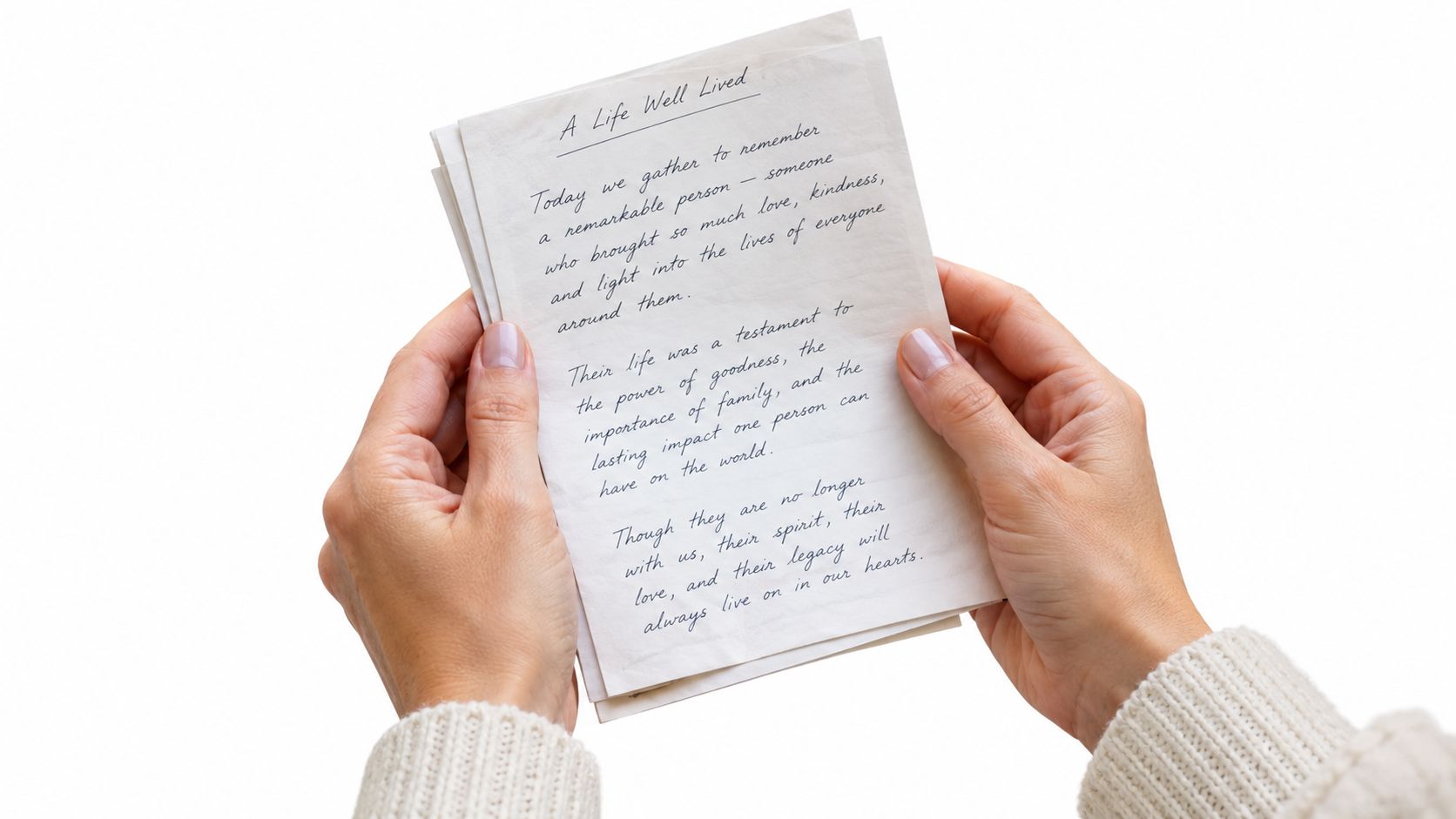
Start by asking relatives for scenes, not adjectives. Ask what the person did on an ordinary morning, who they called when someone was ill, what they repaired, cooked, collected, taught, or refused to tolerate. One useful story can carry more emotional weight than a list of accomplishments.
A sturdy eulogy usually has three movements:
- Opening memory: Begin with a scene that lets listeners meet the person.
- Middle years: Connect that scene to relationships, work, values, or turning points.
- Closing legacy: Name what the family carries forward, without promising that grief is finished.
Make the draft speakable
Read the pages aloud once. Sentences that look elegant on paper can become awkward at a lectern, especially when breathing changes under emotion. Print with wide margins, mark places to pause, and keep a glass of water within reach.
Don't apologize for crying. Stop, breathe, look down at the page, and continue when you can. If you know speaking may be impossible, give a short written version to a trusted person before the service and agree that they can take over without explanation.
The eulogy examples for a dad can help you find a structure, but don't borrow someone else's voice. Your task isn't to sound professional. It's to sound like someone who knew the person.
A eulogy should leave space for the congregation to remember privately. Avoid cramming every fact into the speech, and don't use the microphone to settle an old family dispute. The spoken tribute belongs to the room and to the people grieving in it.
When the pages are ready, rehearse the opening and closing more than the middle. If emotion interrupts you, those two sections will give you a reliable path back.
Choosing the Right Tribute Format for the Right Audience
A tribute format should answer four questions: Who will read or hear it? How much detail is appropriate? What tone fits? What could cause avoidable harm? The same story may belong in several places, but it shouldn't appear unchanged in all of them.
| Format | Audience | Typical Length | Tone | Main Risk |
|---|---|---|---|---|
| Obituary | Public readers, community, extended contacts | Short | Clear and respectful | Publishing private details or incorrect relationships |
| Eulogy | People attending the service | Spoken piece | Personal and emotional | Trying to include every fact |
| Private family record | Relatives and future descendants | Expansive | Honest and contextual | Losing provenance or exposing sensitive material |
| Commemorative message | Friends, relatives, or a specific occasion | Brief | Warm and focused | Sounding generic or overly formal |
Public entries often work best when they stay compact. Guidance on tribute sentences recommends roughly two to five sentences for short public entries, while longer archival records can expand the same evidence-based structure, as explained in this guidance on writing a tribute sentence.
One grandparent, four versions
Suppose a grandparent always kept a spare key and a pot of soup for relatives arriving unexpectedly.
The obituary might say:
The family remembers Margaret for the practical welcome she extended to relatives and neighbors, especially through the meals and open door she offered during difficult times.
The eulogy could tell the story of a grandson arriving late at night, finding the porch light on, and hearing Margaret say that there was soup on the stove.
The private record could add who taught her that habit, how the recipe changed, and which relatives remember her welcome differently. It might also record that she was impatient, private, or difficult during certain periods. Those details can deepen the portrait when handled with consent.
The commemorative message might say:
We pay tribute to Margaret's open door, her soup on the stove, and the way she made unexpected arrivals feel expected.
Use these funeral tribute ideas when you need prompts, then make the final choice based on audience and permission. A family doesn't owe the public its complete history.
Planning a Tribute Video That Actually Gets Watched
A tribute video needs a clear purpose before anyone starts collecting photographs. Decide whether it will play during the service, sit on a memorial page, circulate privately, or serve more than one audience. Each use changes the pacing, captions, sound, and sharing controls.
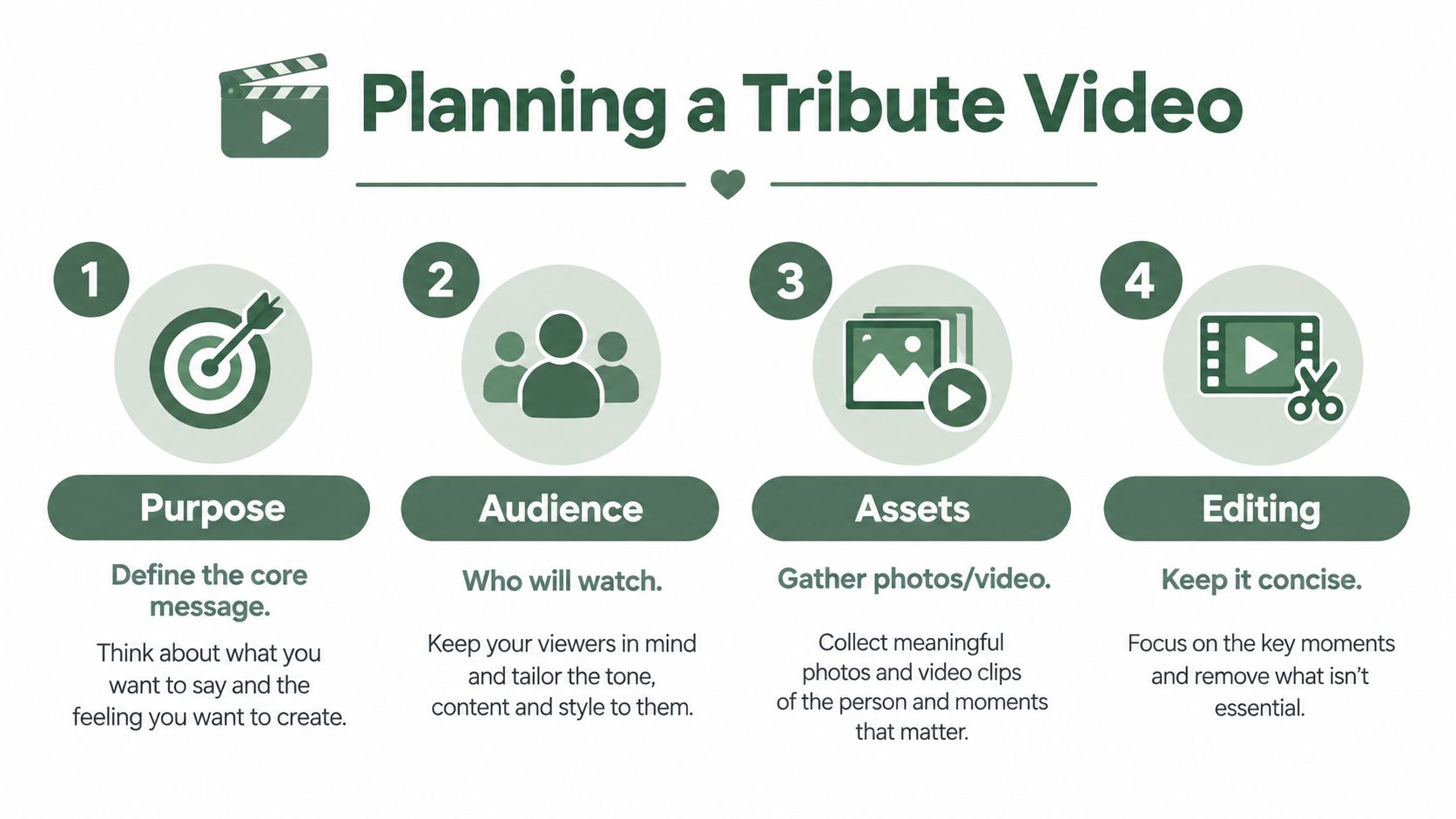
Choose a small number of strong moments rather than forcing every image into the sequence. Let faces remain visible long enough to recognize, and don't allow music to overpower a recorded voice. Add captions whenever speech matters. Captions help relatives who can't hear clearly and preserve meaning for people who watch later without sound.
Match the structure to the setting
For a service, use a simple beginning, middle, and close. Start with identification, move through relationships or periods of life, and finish with a message the room can hold.
For a memorial page, include more context and let viewers choose whether to watch. For private family sharing, preserve original clips and spoken memories alongside the edited version, with access limited to people who have permission.
A 2025 U.S. survey of 1,563 respondents reported that nearly 40% were open to creating a digital memorial page, according to the published study. That makes accessibility and sharing controls part of tribute design, not optional extras.
Collect files through a shared folder rather than leaving them in a group chat. Ask contributors to label each item with the person's name, approximate date if known, location, and the contributor's name. Families who need a practical method to share event photos online can use a dedicated upload workflow instead of asking everyone to compress files repeatedly.
Before editing, write one sentence that states the video's message. Then remove anything that doesn't support it. The family memories video guide can provide another starting point, but your family's material should determine the shape.
Building a Private Family Record That Lasts
The most important tribute may be the one no outsider ever reads. Public words mark an occasion, but a private family record can preserve voices, photographs, disagreements, translations, and context that a formal announcement can't hold.
Treat that record as a separate responsibility. Don't just upload every contribution and assume the family will sort it out later.
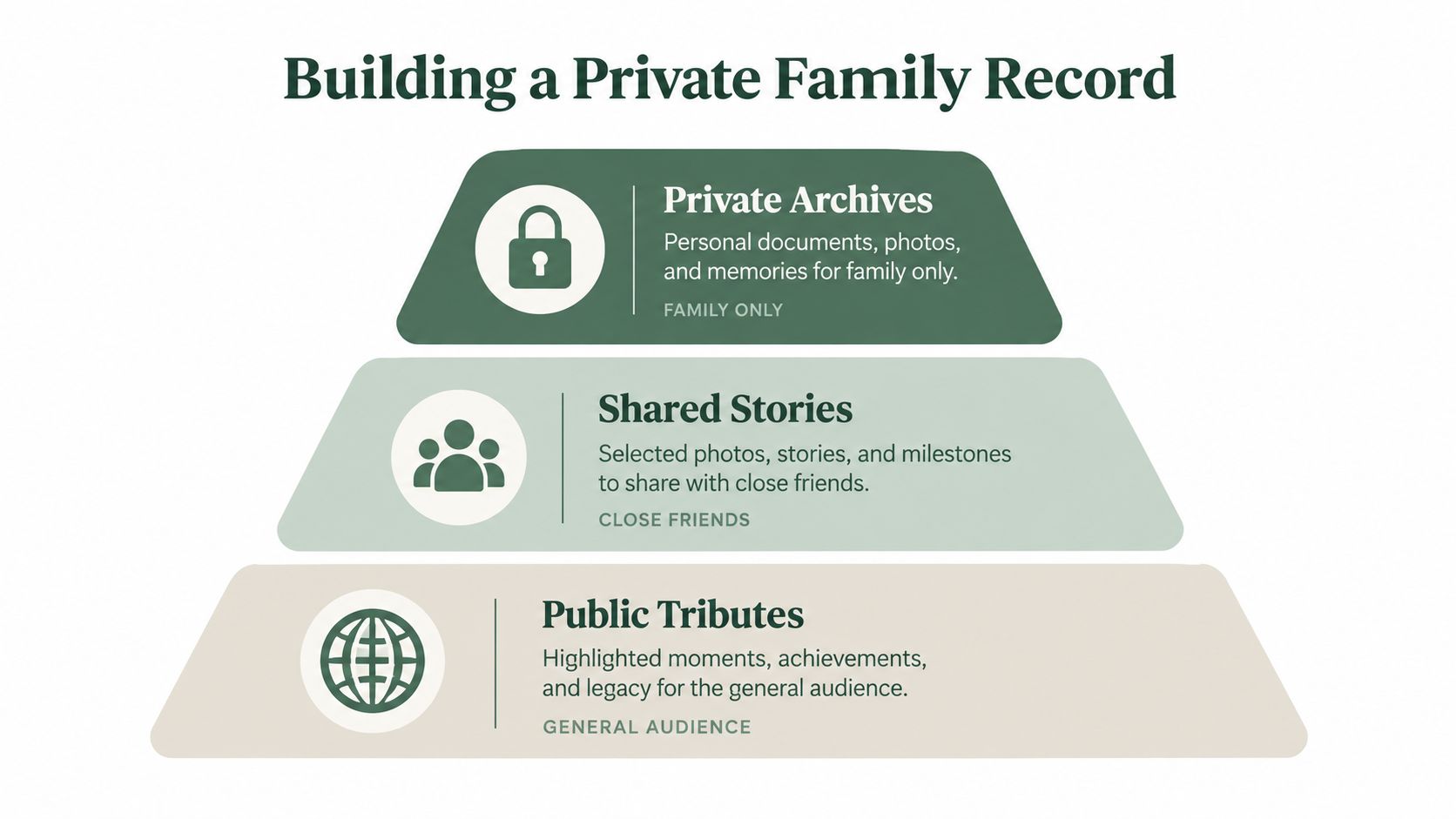
Set rules before the disagreements arrive
Write a one-page stewardship plan with two relatives. It should name:
- The steward: Who manages access, corrections, and new contributions?
- Consent: Which living people must approve stories, photographs, recordings, or identifying details?
- Provenance: Who supplied each item, and what is known about its date, place, and context?
- Corrections: How will the family record uncertainty or conflicting memories?
- Access: Which material is private, shared with close relatives, or suitable for public release?
- Continuity: Who reviews the plan if the steward can no longer manage it?
Blended families and honorary relationships need explicit language. Don't force every relationship into a legal or biological category if that would erase how the family lived. Name the relationship accurately and let people explain its meaning.
Difficult truths require judgment, not automatic concealment. Record estrangements, mistakes, and private struggles only when the value of preserving them outweighs the risk of distress or exposure. Use notes such as “family accounts differ” when certainty isn't possible, and never turn a private person's pain into public proof of authenticity.
Tribute can also teach. International Holocaust Remembrance Day, established through UN Resolution 60/7 on 1 November 2005, honors approximately six million Jewish victims and millions of other victims of Nazi persecution. The first UN commemoration took place on 27 January 2006 and drew nearly 2,200 people, as recorded by the United States Holocaust Memorial Museum. The example shows how remembrance can preserve knowledge for people who didn't witness the events themselves.
For physical photographs, use reliable family photo digitizing tips before adding files to the archive. A memory book guide can also help relatives decide how stories, images, and dates should sit together.
Putting the Whole Tribute Plan Together
Don't try to finish the obituary, eulogy, video, and archive in one sitting. Put them in order according to urgency and audience.
Tonight, write the public statement. Verify the person's name, relationships, service details, and any dates that appear in it. Ask one relative to read it as a stranger would, checking that nothing private has slipped through just because everyone at the table already knows it.
Before the service, finish the eulogy or video. Choose one person to speak and another person to take over. Print the speech, test the video with sound and captions, and keep an accessible copy on more than one device or in more than one location.
After the service, begin the private record when relatives have more breathing room. Invite people to contribute memories, but ask them to identify what they know directly, what they heard from someone else, and what they aren't certain about.
Use this quiet final check
- Names verified: Confirm names, relationships, spellings, and preferred forms of address.
- Dates checked: Mark uncertain dates as approximate rather than presenting guesses as facts.
- Consent noted: Get permission before publishing another living person's story, image, voice, or personal information.
- Steward identified: Decide who handles access, corrections, and future additions.
- Copies stored: Keep important material in two separate places.
- Formats separated: Make clear which items are public, spoken, shared privately, or reserved for the archive.
A tribute doesn't need to be perfect to be true. A small, specific account of how someone lived usually survives better than a grand statement no one recognizes.
Start with the sentence you can defend, then preserve the fuller family story at a pace everyone can bear. remembers.life offers shared online memorials and life-story pages where families can collect photographs, written memories, recordings, timelines, and tributes in one evolving record. Visit remembers.life to begin preserving the details your family will want to find later.