Preserving Your Personal Story Through a Memory Planner
Learn what a memory-keeping planner is, why it matters for preserving your personal story, and how to choose or build one that fits your life.
When her grandmother died, Lena found a battered notebook beneath a stack of winter blankets. Inside were recipes, ticket stubs, photographs, and small handwritten reflections that turned an attic into a doorway to a life she had only partly known.
Table of Contents
- A Granddaughter, a Notebook, and the Birth of a Memory-Keeping Planner
- What a Memory-Keeping Planner Actually Is
- Why Preserving Your Personal Story Changes Everything
- Common Formats and Which One Fits Your Life
- Real Examples of Personal Story Planners in Action
- Choosing or Building Your Own Memory Planner
- Passing the Story Forward
A Granddaughter, a Notebook, and the Birth of a Memory-Keeping Planner
Lena expected dust and discarded clothes. Instead, she found her grandmother's handwriting curling around a recipe for plum cake, a train ticket tucked beside a photograph, and a note about the first apartment she shared with her husband. None of the entries looked important on their own. Together, they revealed a woman who traveled, worried, celebrated, improvised, and loved with far more complexity than a family photograph could show.
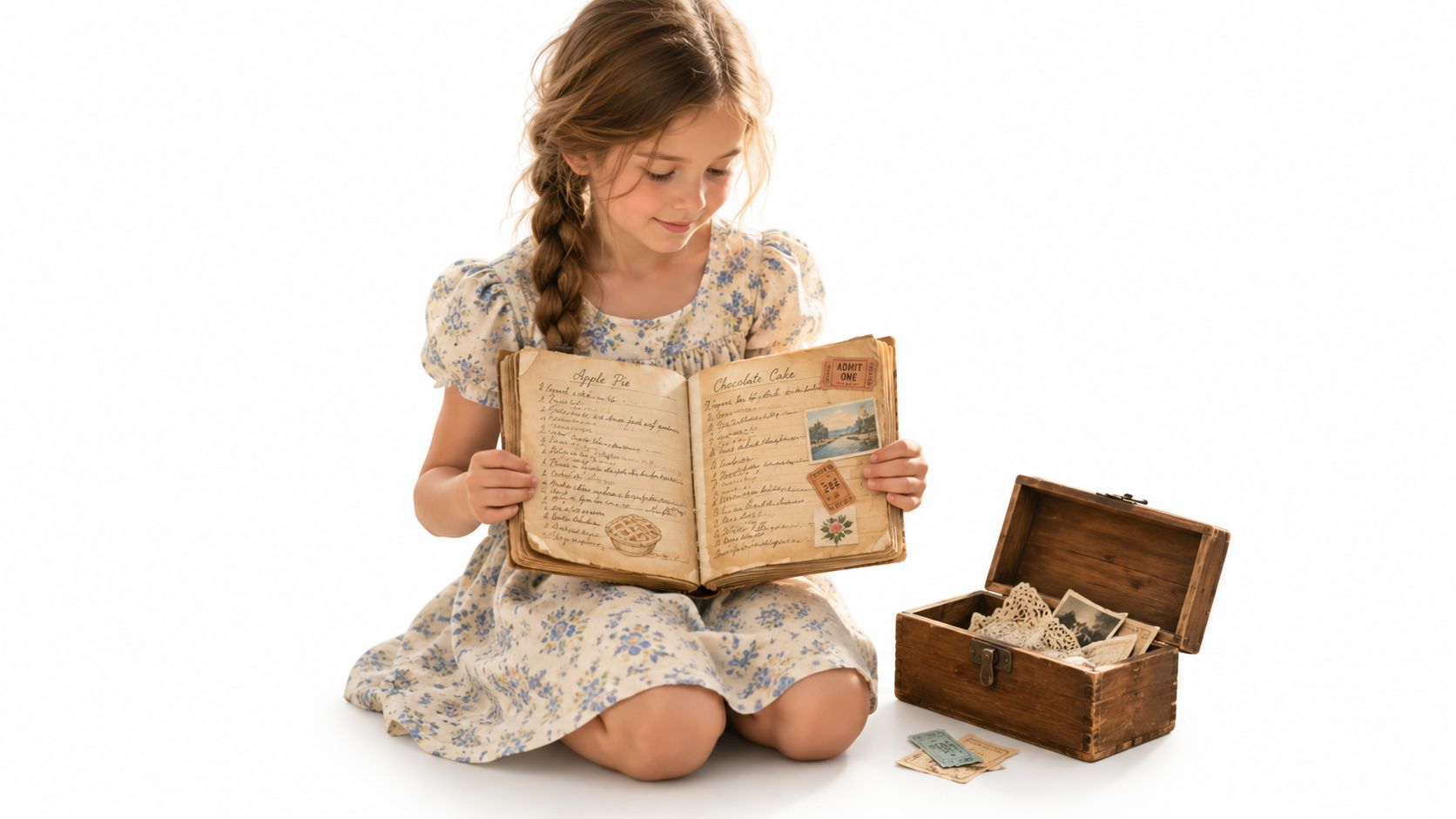
That notebook was an informal memory-keeping planner, even though nobody had given it that name. It held the fragments of a personal story in one place, giving future hands enough context to understand why each object mattered. A memory planner does the same thing deliberately. It creates a guided container for memories, photographs, family details, reflections, and keepsakes before they become separated, forgotten, or impossible to identify.
The format has grown from heirloom journals and photo albums into flexible systems that may combine prompts, timelines, reflection pages, relationship maps, audio recordings, and keepsake pockets. A parent might use one to record the story behind a family recipe. A grandchild might use another to interview an older relative. Someone facing retirement, illness, or a major move might use it to gather the chapters of their own life.
Storytelling belongs to a near-universal human tradition. Cross-cultural research cited in a 2026 statistical roundup on publishing and storytelling says storytelling appears in 98% of all cultures, where it helps transmit identity, values, and memory across generations. Preserving a personal story therefore isn't a niche pastime. It gives a familiar human behavior a reliable structure.
Practical rule: Don't wait for a perfect memoir. Preserve the small evidence that helps someone understand the life behind the name.
A guided system matters because raw memory tends to scatter. One photograph may survive in a drawer, a recipe in a kitchen folder, and a story in a relative's recollection. A planner gathers those pieces and asks the questions that connect them. If you're starting with family interviews, these interview questions for grandparents can help turn a quiet conversation into a meaningful record.
What a Memory-Keeping Planner Actually Is
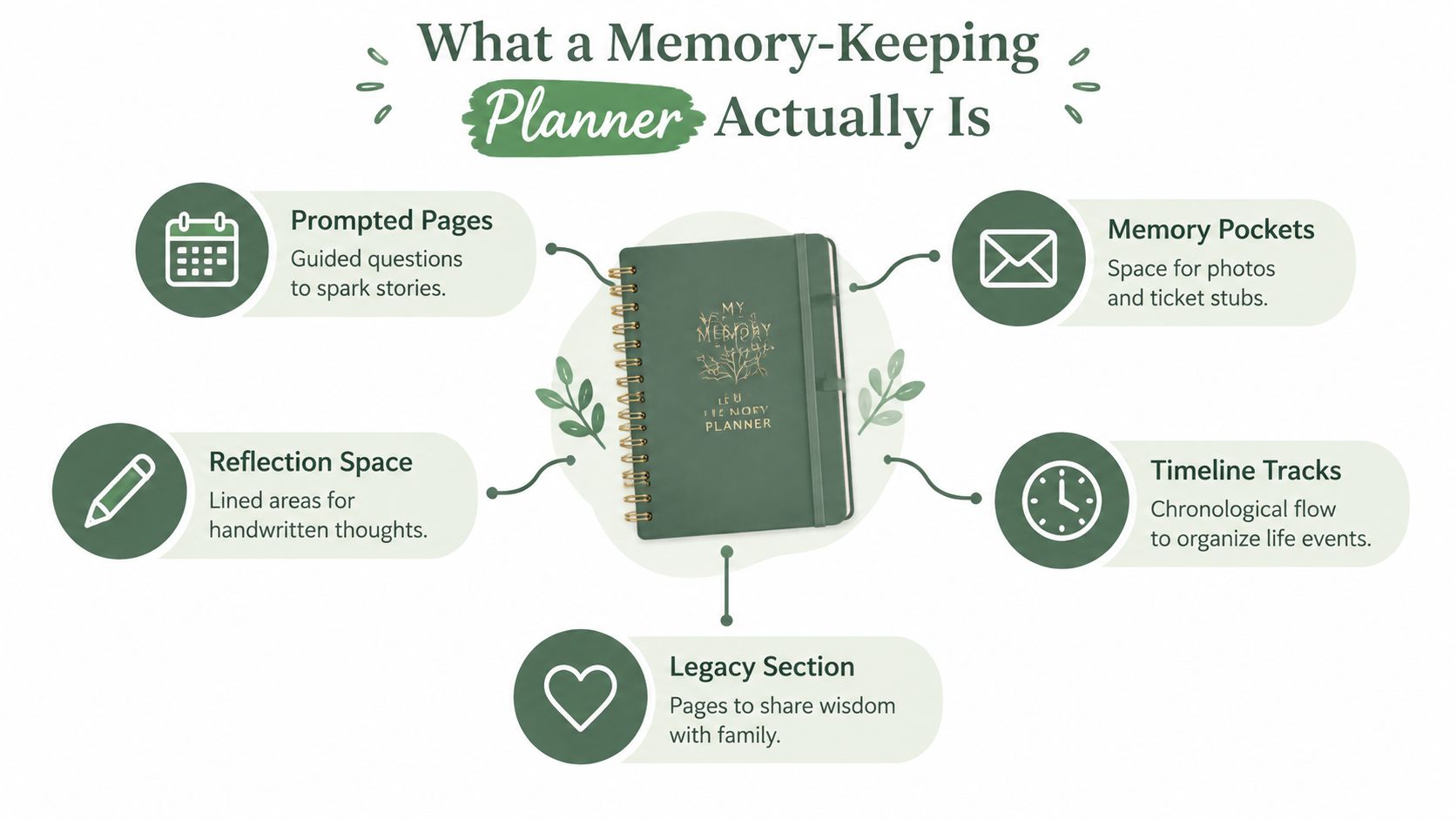
A generic diary asks, “How was your day?” A scrapbook gives you room to arrange objects and photographs. A memory-keeping planner adds a third ingredient, direction. It helps you decide which stories belong together and what information will help another person understand them later.
The essential pages
The first building block is the guided prompt. Strong prompts ask for a scene, not a slogan. “What did your childhood home smell like?” opens a different door from “Tell me about your childhood.” “Who taught you to cook?” can bring forward a person, a kitchen, a gesture, and a family tradition.
A timeline provides the spine. Leave room for years, seasons, homes, schools, work, relationships, celebrations, and losses. Exact dates are useful when you know them, but a remembered summer, winter, or stage of life can still anchor a story. Chronology helps readers follow change, while thematic pages prevent the planner from becoming a list of dates.
Photo anchors give images a voice. Beside each photograph, record names, location, approximate time, occasion, and the detail a camera couldn't capture. “This was taken at the beach” is useful. “Your uncle had just returned from sea, and he brought the blue radio shown on the blanket” is a personal story.
Other recurring elements include:
- Relationship maps: Show how parents, siblings, partners, friends, mentors, and chosen family shaped the narrator.
- Milestone trackers: Record births, moves, marriages, illnesses, jobs, achievements, departures, and deaths with space for meaning, not only dates.
- Reflection pages: Invite the writer to describe lessons, regrets, hopes, beliefs, and changes in perspective.
- Keepsake pockets: Protect letters, recipes, pressed flowers, programs, ticket stubs, and handwritten notes.
- Legacy pages: Gather advice, family traditions, favorite sayings, and messages intended for younger relatives.
Organizing a life beyond the calendar
Date order works well for a journey, but it can't hold every meaningful connection. A page about “women who taught me resilience” may include a mother, teacher, friend, and daughter from different decades. A chapter on migration, faith, work, or food may cross the entire timeline.
Use dividers for life chapters, relationships, or themes, then add a simple index. The planner should help a reader move from a photograph to a person, from a recipe to a place, and from a milestone to the feeling surrounding it.
A useful planner doesn't force every memory into the same shape. It gives a short prompt to someone who has only a few minutes, a full page to someone ready to reflect, and a pocket or recording option when an object or voice carries more meaning than handwriting.
For a visual introduction to preserving stories, this memory-planning video can complement the written pages. Use it as inspiration, then adapt the format to the person whose life you're recording.
Why Preserving Your Personal Story Changes Everything
A granddaughter opens her grandmother's notebook and finds more than names and dates. One page explains why the family moved, another describes a recipe changed by necessity, and a third recalls the fear behind a brave decision. Scattered experiences now form a story the family can recognize as its own. A difficult season becomes evidence of endurance, while an ordinary ritual becomes a thread between generations.
Structured life-story work has been studied as a biographical intervention, rather than casual reminiscing. In a quasi-experimental study of 60 adults aged 50 to 90 with mild-to-moderate intellectual disability, a program delivered over 6 months was associated with better mood, interest, pleasure, adaptive functioning, and personal well-being than usual activities, as reported in the PubMed study on life story work. Results were stronger among people with better communication ability. That finding gives families a practical direction: patient conversation, well-shaped prompts, and suitable ways to record responses can affect what someone is able to share.
Why structure beats a vague invitation
“Tell me about your life” can feel impossibly broad. A planner makes the first question smaller. It might ask about a first job, one kitchen, a lasting friendship, or an object carried through several homes. Such boundaries reduce the pressure to produce a polished autobiography and make particular memories easier to approach.
A critical review found that simple reminiscence did not reliably improve autobiographical memory in healthy older adults. Structured approaches, including life-story books and chronological reviews of significant events, showed better gains. The same review of reminiscence and autobiographical memory describes later findings involving amnestic mild cognitive impairment and Alzheimer's disease, including improvements in autobiographical memory and, in one group, an episodic-memory improvement that remained at follow-up.
| Outcome Area | Casual Reminiscing | Structured Memory Planner |
|---|---|---|
| Recall | May move freely between disconnected moments | Uses prompts, images, and timelines to anchor details |
| Mood | Can offer pleasant companionship | Creates purposeful activity with visible progress |
| Identity | May repeat familiar stories | Connects experiences into a fuller sense of self |
| Family communication | Depends on who happens to be present | Leaves a shareable record for relatives |
| Legacy | Often disappears with the conversation | Can become a written, audio, visual, or digital archive |
The planner also changes the conversation between generations. A grandchild who learns why a family moved, how a recipe changed, or what an ancestor feared before acting bravely receives more than background information. Family history becomes personal, and the older storyteller sees difficult experiences acknowledged rather than forgotten. Research on narrative interventions has linked storytelling with self-identity, attitudes toward aging, and family communication. An intergenerational digital storytelling program also showed feasibility and preliminary benefits for identity validation and generativity, as described in this research review on narrative and intergenerational storytelling.
A planner cannot promise healing, perfect recall, or agreement about the past. It can offer a clearer, safer invitation to speak, listen, reflect, and leave something understandable behind.
Common Formats and Which One Fits Your Life
No single planner format suits every storyteller. A person with stiff fingers may speak more easily than write. A busy parent may need a prompt that takes a few minutes. A family spread across countries may need shared digital access, while an older adult may treasure the physical weight of paper and photographs.
| Format | Best For | Effort per Entry | Strongest Strength |
|---|---|---|---|
| Guided print journal | People who enjoy handwriting and clear prompts | Short to moderate | Tactile focus and visible continuity |
| Blank or hybrid notebook | Writers who want freedom with some organization | Flexible | Personal expression and custom layouts |
| Digital app or scrapbook platform | Families sharing from different places | Short to moderate | Easy combination of text, photos, audio, and video |
| Video oral history | Narrators whose voice and expressions matter | Moderate preparation | Preserves speech, gesture, humor, and presence |
| Scrapbook hybrid | Visual storytellers with physical keepsakes | Moderate | Combines objects, captions, photographs, and design |
Match the format to the storyteller
A busy parent might keep a guided journal near the kettle and answer one prompt while dinner cooks. A traveling adult may use a phone-based system to add a voice note after visiting a childhood town. A tech-savvy grandchild can coordinate family uploads, scan photographs, and add captions while relatives contribute from home.
An older adult documenting later chapters may prefer a large-print binder, an easy voice recorder, or an interview led by a trusted family member. The important decision isn't whether the result looks polished. It's whether the person can use the system without fatigue, confusion, or unnecessary technical steps.
Families considering a digital route can explore this guide to turning memories into digital records. Digital storage can make sharing easier, but it still needs names, dates, descriptions, and a backup plan. A beautiful file with no context becomes another mystery for the next generation.
Choose the format that makes speaking possible, not the format that looks most impressive on a shelf.
You can also combine methods. Record a conversation, transcribe the strongest passage, print a photograph, and attach the audio access details to the page. A personal story doesn't need to live in only one medium.
Real Examples of Personal Story Planners in Action
Maya began with a frightening reason. After her father received a serious diagnosis, she bought a weekend prompt journal because she wanted to ask questions before every conversation became about appointments. At first, she wrote only a paragraph at a time.
Her prompt was simple: “Describe a day when you felt responsible for someone else.” Her father wrote about repairing a bicycle for his younger brother, then remembered the neighbor who lent him tools, then described the workshop where he learned patience. Maya dated each entry, added photographs, and marked names that needed clarification. Over the following months, separate memories began forming connected chapters about work, family, and responsibility.
The result wasn't a perfect manuscript. It was a working memoir with a beginning, recurring characters, and details that would otherwise have vanished.
A family archive made together
The Alvarez siblings chose a shared digital album after realizing that each person held different pieces of their mother's life. One sibling had photographs, another had recipes, and another remembered the stories behind family celebrations.
Each week, they gave their mother one prompt on a phone call. “Which meal did your family make when money was tight?” brought forward a lentil recipe, a story about a neighbor, and the reason she always saved the cooking water. They uploaded the recording, added a transcript, and placed the recipe beside photographs of the kitchen.
Their shared album became more than a collection of images. It showed how resourcefulness, hospitality, and humor traveled through the family.
Walter's decade-by-decade workshop
Walter, a retired carpenter, disliked blank pages. He preferred index tabs labeled by decade and kept a small audio recorder beside his scrapbook. For each chapter, he added a photograph, a tool sketch, and a short recording.
One prompt asked, “What did your hands learn before your words could explain it?” Walter answered by describing how he recognized good timber by touch. His page held a picture of his first workbench, a shaving of wood, and an audio story about the apprentice who taught him to sharpen a plane.
The lesson from these examples is practical. A planner becomes useful when it gives memory a repeatable shape. One person may write every weekend, another may record a weekly answer, and someone else may organize one decade at a time. The format follows the storyteller, not the other way around.
Choosing or Building Your Own Memory Planner
A planner should begin with the storyteller's life, not with a notebook or app. A grandmother who tells stories while cooking may record audio beside the stove. A brother who keeps family photographs may prefer captions and scanned letters. Start by asking:
- Which medium feels natural? Choose handwriting, typing, speaking, photographs, or a mixture.
- Who will participate? Work alone, invite siblings, interview a parent, or welcome contributions from several generations.
- What rhythm can last? Set a small routine that leaves room for memory without making the work feel like a chore.
- What should the finished record become? It might grow into a memoir, audio archive, family keepsake, or changing collection.
Build around real access needs
A parent with arthritis may answer two spoken questions more comfortably than write a page. An older relative with fading eyesight may need large-print pages, strong contrast, a comfortable pen, or enlarged text on a tablet. For an oral-history conversation, place a phone on a stable stand, use good lighting, and choose a quiet room, so the narrator can focus on the story rather than the equipment.
Digital storytelling projects also face technological barriers, uneven digital literacy, and inconsistent methods. A recent review notes that shorter formats may suit people with cognitive or digital limitations, while longer formats allow deeper reflection and memory preservation, as described in this review of digital storytelling for older adults. Offer both options: one brief response for a busy or tiring day, and one extended reflection for a story that needs more time.
Shape the planner around details only your family can supply:
- Recipes and rituals: Record ingredients, substitutions, smells, and the person who taught the dish.
- Migration and home: Mark places lived, reasons for moving, and what each home meant.
- Work and craft: Preserve tools, skills, colleagues, and lessons learned.
- Family language: Include sayings, nicknames, songs, and words that do not translate neatly.
- Photograph notes: Identify everyone and add the story outside the frame.
A digital service such as remembers.life allows people to add names, photographs, stories, and milestones, then invite relatives to contribute through writing, audio, or video. A printed binder can hold selected pages and keepsakes beside it.
For prompts and structure ideas, use this guide to life story writing. Before the first entry, gather photographs, a pen or recording device, storage for keepsakes, a contact list, and a simple file-naming system. Then answer one question. A planner gains its shape through the stories that follow.
Passing the Story Forward
A finished planner should remain a living artifact. When a cousin sees an old photograph, they may supply the name of someone outside the frame. A recipe can bring a grandchild into the kitchen beside an older relative. A page about grief may explain a silence that once felt personal. Each response adds context and gives the family story somewhere new to grow.
Storytelling also carries more than nostalgia. Research connects life review and narrative work with identity validation, generativity, cultural identity, emotional healing, and stronger narrative agency. These effects help explain why a personal record can shape mood, self-understanding, and family bonds across generations. The planner becomes a place to ask where the family came from, what its members endured, and which values still guide them.
Give the record somewhere to go
Pass it forward with a small, deliberate ritual:
- Mark a milestone: Present a completed chapter at a birthday, retirement, wedding, or family gathering.
- Pair words with evidence: Place photographs, recipes, letters, and captions beside the memories they clarify.
- Schedule story time: Read one page together and ask each person what it brings back.
- Leave room for replies: Invite children and grandchildren to add memories, corrections, or questions.
- Review it regularly: Add chapters as the family changes, so preservation remains an ongoing practice.
Some people describe this lasting inheritance as identity capital. It is not money. It is knowledge, belonging, perspective, and family language carried from one generation to the next. Descendants receive more than facts about an ancestor. They gain material for interpreting their own choices, relationships, and place in the family.
A digital record can sit beside a binder, memory box, or spoken archive. This guide to digital legacy planning can help families decide what to preserve, who should access it, and how contributions will be maintained. Choose one photograph, object, or unanswered question today. The entry does not need polished prose. A voice, detail, or remembered phrase is enough to begin.
A shared service such as remembers.life can hold names, photographs, stories, and milestones, with written, audio, and video contributions. Start with one moment, invite someone you love to respond, and let the record become a conversation rather than a sealed box.