Write Your Own Memoir: A Practical Guide for Life Stories
Learn how to write your own memoir with this practical guide. Step-by-step workflow, prompts, structure tips, and ways to preserve your story for family.
You've probably had the same thought more than once: I should write this down before it's gone. Then the thought gets buried under errands, appointments, family logistics, and the plain fact that a whole life is too big to fit neatly onto a blank page.
That's the problem with memoir advice. It gives you prompts, sentiment, and vague encouragement. It rarely answers the hard question: how do you write your own memoir without getting crushed by the size of your own life?
My answer is simple. Don't try to capture everything. Build something your family will read, keep, and return to. That means selection, shape, and restraint. It means treating memoir as a keepsake with a point of view, not a warehouse for every memory you've ever had.
Memoir as a literary category has become much more clearly defined over time. Scholarship notes that “life writing” became a common umbrella term since 1990, and memoir increasingly came to mean a narrative about a particular period, event, or thread rather than a full cradle-to-present life account, which helps explain why focused memoirs work so much better than dutiful chronicles (short history of life writing).
Table of Contents
- Why Your Memoir Is a Keepsake, Not a Book
- Gathering the Raw Material First
- Choosing the Story Inside Your Life
- Building a Chapter Skeleton That Holds
- Writing in Sprints You Can Actually Finish
- Revising Like a Reader, Not a Parent
- Handling Family, Privacy, and Lasting Preservation
Why Your Memoir Is a Keepsake, Not a Book
Most first-time memoir writers make the same mistake. They confuse remembering with recording, and recording with story.
Your children and grandchildren do not need a complete archive of every vacation, every address, every job title, and every holiday menu. They need the stories that explain who you were, what shaped you, what you believed, what it cost you, and what you learned. If you try to include everything, the meaning gets buried under the inventory.
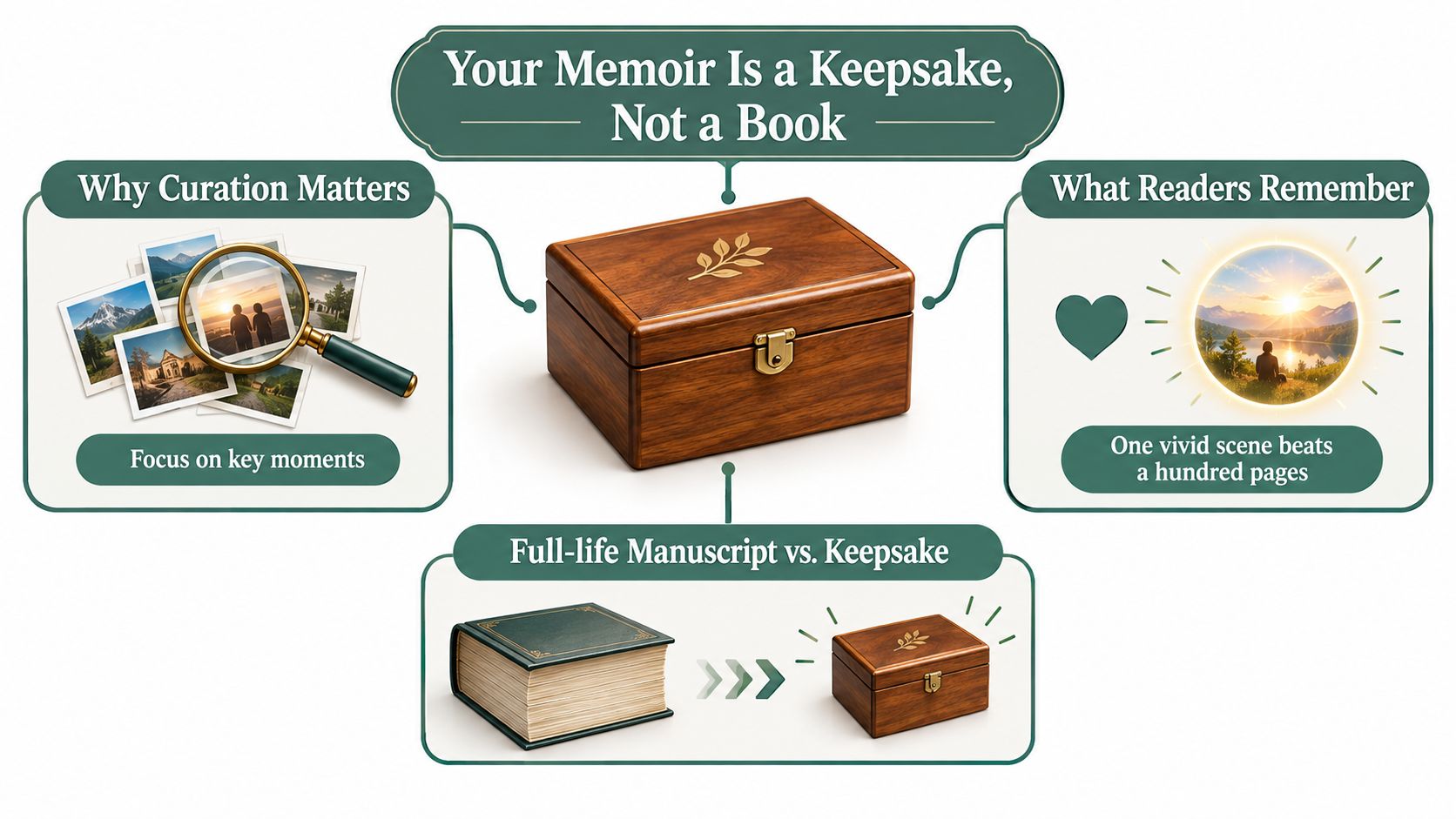
A memoir worth keeping is curated. Think of it the same way you'd think about a family album. You wouldn't hand someone a cardboard box of loose photographs and call that a gift. You'd choose the ones that matter, put them in an order that makes sense, and add enough context so another person can feel the life inside them. That's also how a strong memory book works.
What family readers actually want
Family readers aren't reading to assess your literary ambition. They're reading for recognition, surprise, and emotional truth. They want to know:
- What mattered most to you
- What changed you
- What the family never fully understood
- What you want them to carry forward
That's why the best memoirs are usually narrower than the writer expects. Independent commentary on memoir publishing has also pointed out that the practical gap isn't inspiration. It's selection. Generic prompt lists keep multiplying while older writers still ask, “What do I include?” and “Do I have to write a whole book?” The better answer is no. You need the part that holds the rest.
Practical rule: If a memory doesn't reveal character, change, conflict, or inheritance, it probably doesn't earn a full page.
The job is choosing
Here's the opinionated version. Your job is not to transcribe your life. Your job is to shape it.
That means some material goes in the main narrative. Some becomes a sidebar note. Some turns into a short letter for one child. Some stays out altogether. Good memoir writing is not an act of total inclusion. It's an act of intelligent exclusion.
If you want to write your own memoir, start there. Not with page count. Not with whether a publisher would care. Start by deciding that ten well-chosen stories can carry the emotional truth of ninety others.
Gathering the Raw Material First
Don't draft chapter one this week. That's how people lock themselves into the wrong structure and spend months polishing the wrong beginning.
Spend a short stretch gathering material first. Keep it bounded. A couple of weeks is enough if you work steadily. The point is to create a working inventory, not prose.
Use four buckets
Open one document or one notebook and create four sections.
Timeline Write decade markers or life markers. Moves, marriages, divorces, illnesses, military service, career turns, losses, conversions, caretaking years, retirements.
People List the names that changed your life. Not the full family tree. The people who left a mark. Aim for enough names that the list forces you to choose later.
Places Add the house, kitchen, church, factory floor, classroom, neighborhood street, hospital room, bus stop, fishing dock, apartment hallway. Memory often returns through place faster than through abstract thought.
Moments Write down the episodes that still carry charge. Shame, pride, grief, relief, anger, tenderness, regret, joy, defiance. If it still has heat, it belongs on the list.
Pull from objects, not just memory
Memory is useful, but it edits itself. Use external cues.
- Photographs often restore sequence and setting.
- Letters and cards recover voice and relationships.
- Old calendars and appointment books help with timing.
- Voicemails or recordings can bring back speech patterns.
- Family conversations fill in edges you may have forgotten.
If you need help sparking those conversations, a set of interview questions for grandparents can pull out details that don't surface on command.
Don't turn these notes into little essays yet. Inventory first. Story later.
Prompts that are actually useful
Skip the sugary prompts. Use prompts that force specificity:
- Which house can you still walk through in your mind
- Which relative do you rarely talk about, but still think about
- What room holds one of your strongest memories
- What decision split your life into before and after
- When did you disappoint someone, or yourself
- What ordinary routine now feels like a vanished world
A note about sources inside your own life: if you use a digital system, use it for tagging and collecting, not premature drafting. One factual option is remembers.life, which lets you add names, photos, milestones, and written stories to a timeline-style life narrative. That's useful at the inventory stage because you can capture moments before you decide where they belong.
Your only deliverable
At the end of this stage, you should have one inventory document. That document becomes your source of truth.
Not a stack of legal pads. Not ten partial introductions. Not a folder full of disconnected anecdotes. One document. When you write your own memoir this way, you stop wandering and start choosing.
Choosing the Story Inside Your Life
The worst default in memoir is beginning at birth and plodding forward because that feels responsible. It usually produces obedience, not energy.
A full-life chronology can work, but it often weakens the material. Family readers don't need a march through time. They need a spine.
Pick a frame that can carry weight
Here are the three frames I recommend most often:
| Frame | Best For | Example Spine | Risk to Watch |
|---|---|---|---|
| Chronological and selective | A life with clear eras and sharp turning points | “How I became the person who could leave, then return” | Turning into summary |
| Single thread | A vocation, marriage, friendship, caregiving role, faith journey | “The story of work and what it cost my family” | Repeating the same note |
| Thematic | Migration, resilience, secrecy, reinvention, chosen family | “What we kept, what we lost, what we passed on” | Becoming too abstract |
The point isn't to find the most impressive frame. It's to find the one that organizes your material without strangling it.
The one-sentence test
Read your inventory and start clustering episodes. Which memories belong together? Which ones speak to each other across decades? Which ones seem to argue for the same meaning?
Then write a single sentence:
- This memoir is about how I learned to live after loss.
- This memoir is about the women who held our family together.
- This memoir is about work, ambition, and what I didn't see until later.
- This memoir is about leaving one world and building another.
If you can't say it in one sentence, your frame is still mushy. If a family member who knows you well would disagree with that sentence entirely, it's probably the wrong spine.
A memoir is not your whole life. It's your life arranged around a meaning.
What to cut without guilt
Once you choose a frame, some material moves out of the main body. Good. That's not loss. That's discipline.
Use three holding pens:
- Appendix material for timelines, recipes, military records, or family trees
- Side letters for stories meant for one person more than for everyone
- Later projects for topics that deserve their own treatment
This is the part many writers resist. They think cutting means dishonoring the life. It doesn't. It means protecting the reader's attention so the important material can land.
There's also a market reality behind this, even if your main audience is family. Commentary drawing on Publishers Marketplace deal counts noted memoir deals at 267 in the most recent 12 months, down from 279 in 2023, 311 in 2022, and 322 in 2021, which is a useful reminder that “include everything” is not a compelling strategy for readers either.
The common failure
The most common reason family readers stop is not bad writing. It's chronicling. Event follows event, but the writer never shows what changed, what was understood later, or why this memory belongs in the book.
Commit to a frame before you draft. It can bend later. But don't write your own memoir as a diary dump and hope meaning appears by magic. It won't.
Building a Chapter Skeleton That Holds
A memoir chapter needs structure before it needs polish. If you skip that step, you'll end up with pages that remember plenty and move nowhere.
The simplest useful model is a three-beat chapter: anchoring scene, pressure or contradiction, changed understanding.
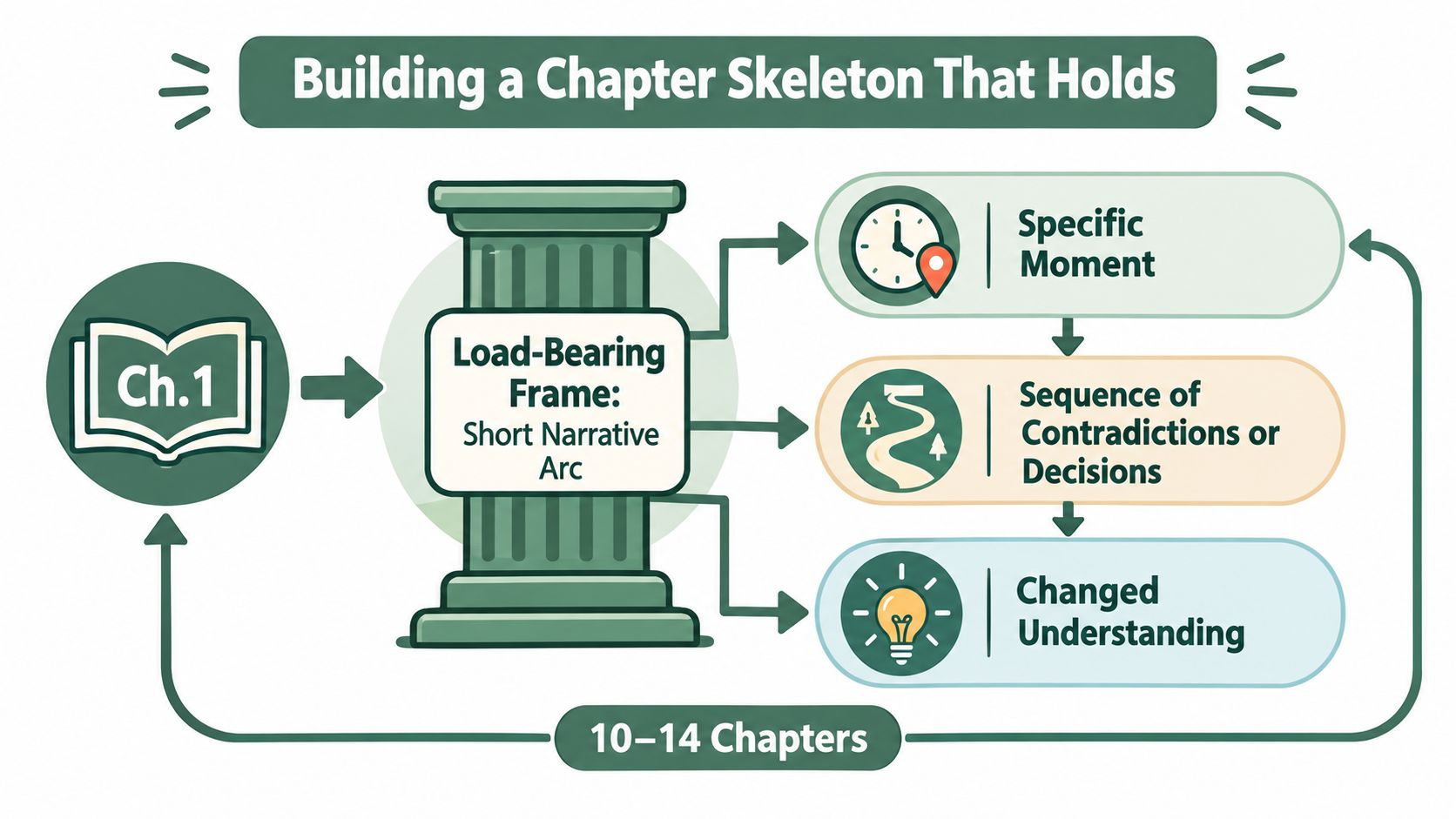
One representative chapter
Say you're writing about a family move that looked practical at the time but turned out to be emotionally costly.
Your chapter might open with one scene. You're standing in the old kitchen. A box is half packed. Someone says, “We'll make a fresh start.” Good. That's usable. It's concrete.
Then the middle deepens the picture. Why were you moving, really? Debt, pride, opportunity, a marriage strain, a layoff, a parent's illness, your own restlessness. The chapter gets stronger when the reader sees that the move was not just logistics. It was pressure.
The close lands on changed understanding. Maybe you thought you were escaping failure. Years later you understood you were also abandoning a version of yourself. That final paragraph gives the chapter its reason to exist.
Draft the skeleton before the prose
Use one sentence per beat before you write full paragraphs.
Working title
Leaving Maple StreetOpening scene
We packed the kitchen the morning after the storm, and my mother kept labeling boxes “misc.” because she couldn't bear to decide.Middle pressure
I thought we were moving for my father's new job, but later I understood money had been tighter for longer than anyone admitted.Changed understanding
That move taught me that families often rename fear as practicality.
That's a chapter skeleton. It gives you shape without locking your voice.
If you want a visual model to adapt, a family history book template can help you see how scenes, photos, and supporting material can live together without turning the book into clutter.
Use this chapter test
Before you draft any chapter, ask one question:
What did I learn here that I did not know at the start of this chapter?
If you can't answer that, you may have a memory but not a chapter.
Use this quick template:
- Chapter title
- Opening image or scene
- What was at stake
- What complicated the situation
- What I believed then
- What I understand now
- Why this belongs in the book
How to order the chapters
I prefer thematic grouping over strict chronology for most family memoirs. Put chapters in an order that builds understanding.
A chapter about your father's silence may belong next to a chapter about your own marriage, even if decades separate them. A chapter about immigration may belong beside one about language loss, not beside your high school years just because the dates line up.
That's how a memoir reads like an argument about a life, not a calendar.
Writing in Sprints You Can Actually Finish
Big writing days are overrated. They feel noble, then they disappear for two weeks and take your momentum with them.
Short, repeatable sessions are what finish memoirs. A community-based life story workshop that met for 2-hour sessions once per week for 10 weeks found a statistically significant reduction in depressive symptoms for adults 60+ compared with a wait-list control, and another randomized study of 45 adults 65+ found a similar benefit after an 8-week autobiographical writing program. In both cases, the gains were strongest for well-being rather than memory performance, which is exactly why a steady guided practice beats waiting for inspiration (autobiographical writing and well-being studies).
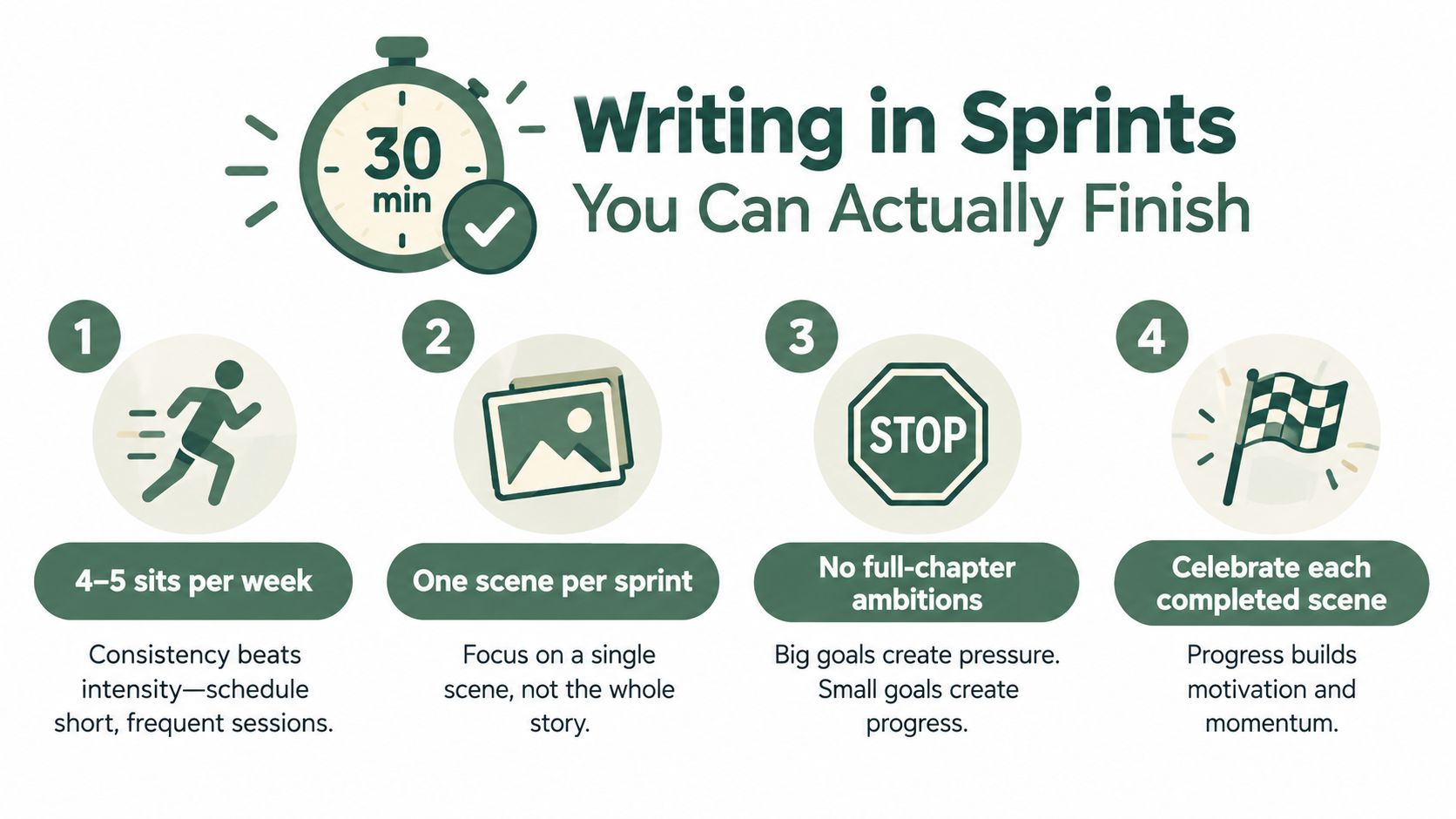
The cadence I recommend
Work in short sits. Keep each one tied to a single scene, not an entire chapter.
- Regular sessions matter more than dramatic bursts.
- One scene per sitting keeps the assignment human-sized.
- A warm-up prompt gets memory moving before you draft.
- A simple log keeps progress visible when the prose feels rough.
Use a notebook, a spreadsheet, or a life story journal. The tool doesn't matter much. The repetition does.
Warm-up prompts that unlock scenes
Before each session, answer one of these in a few lines:
- What room were you standing in
- What was the first thing said out loud
- Who were you trying to impress, protect, or defy
- What object do you remember touching
- What did you not understand then
- What do you wish you had known
These prompts work because they drag memory back into the body. Once you can see the room, hear the voice, or feel the object, the scene often opens.
Write the scene before you write the lesson. Lessons are easier to trust after the reader has lived through the moment with you.
When nothing comes
You will have dead days. Everyone does. Don't sit there demanding revelation.
Keep a parking-lot list with fragments:
- names
- overheard phrases
- smells
- family sayings
- half-remembered arguments
- odd images that won't leave you alone
A fragment is enough to begin. One chipped mug can uncover an entire winter.
A simple starter rhythm
Try this for your first stretch:
- Session one. Gather one photo and freewrite the scene around it.
- Session two. Draft a second scene from the same chapter skeleton.
- Session three. Add what was at stake.
- Session four. Write the reflection paragraph only.
- Session five. Read it aloud and mark flat spots.
That's manageable. That's how people write their own memoir instead of fantasizing about writing it.
Revising Like a Reader, Not a Parent
Drafting and revising are different jobs. Drafting says, “I remember.” Revising says, “Will another person understand, care, and keep going?”
Most memoir drafts are overprotected. The writer loves the material because the life is theirs. But the page only gets to keep what it earns.
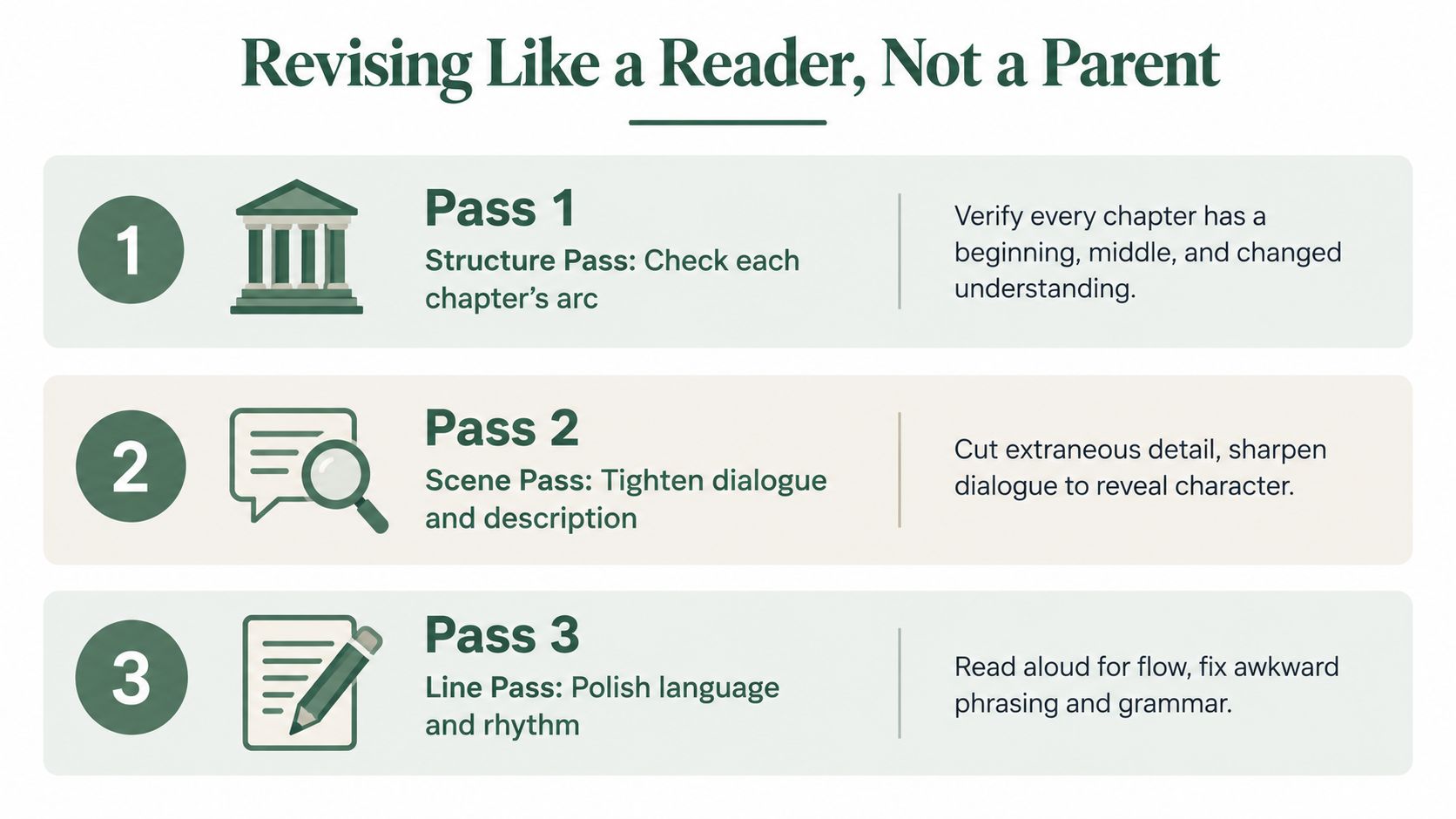
Pass one for structure
Look chapter by chapter. Ignore sentences for now.
Ask:
- Does this chapter show one clear shift
- Is there a real question or tension
- Does the ending change the meaning of the beginning
- Have I included backstory where scene should come first
Cut summary that doesn't move the chapter. Move background later if the opening scene can carry the reader in faster.
Pass two for scenes
Now get concrete. Readers can't picture abstractions.
Ask:
- What can the reader actually see or hear here
- Have I named the room, season, body posture, or spoken line
- Am I explaining emotion that the scene already shows
- Would a stranger understand why this moment matters
A randomized clinical trial in 51 nondemented adults aged 67 to 96 found that a structured autobiographical writing workshop did not improve autobiographical memory, mood, or self-concept versus control, and repeated testing itself was associated with fewer mid- and late-life events and less detail in recall over time (clinical trial on autobiographical writing outcomes). That matters because memoir writing is not a magic machine that reliably restores memory. Revision has to work with what's on the page, not with what you assume you still know.
Read the text you wrote, not the memory in your head. The memory in your head will always feel fuller.
Pass three for sentences
This is where you tighten the language.
- Cut throat-clearing openings.
- Replace weak verbs with cleaner ones.
- Remove repeated explanations.
- Watch for the “lecture voice,” especially in reflective paragraphs.
Read the whole piece aloud. Mark every place your breath catches or your voice turns preachy. Those marks are gold. They show you where the prose stopped sounding lived and started sounding managed.
Bring in one reader, not five
Late in revision, ask one trusted person to read. Not a committee. One person with taste and tact.
Ask them only a few things:
- Where did you get bored
- Where were you confused
- What stayed with you afterward
- Where did I seem to be explaining instead of showing
Do not ask whether they “liked it.” That question produces polite nonsense. Ask where the story lost force. Then decide what to change.
Handling Family, Privacy, and Lasting Preservation
A memoir doesn't only involve memory. It involves other people. If you ignore that, you create damage you could have prevented.
The family side of memoir is badly underserved. Memoir advice often acknowledges questions like “What will my family say?” and legacy-oriented prompts ask what you hope future generations will carry forward, but they rarely grapple with consent, disputed memory, or how to preserve a family story without creating a family wound. That gap matters even more now that intergenerational storytelling keeps growing as a priority, including recent interest in the questions people wish they had asked their own grandparents before it was too late (questions memoirists ask and family concerns).
Use a consent workflow
Go through your manuscript and identify every living person by name. Then flag passages involving:
- Health details
- Addiction
- Infidelity
- Custody disputes
- Financial hardship
- Family estrangements
For each passage, decide what level of exposure is necessary. Sometimes a full name is appropriate. Sometimes initials are smarter. Sometimes a scene can be generalized without weakening the truth. Sometimes you need a direct conversation before sharing it.
Have the hard conversation clearly
If a sibling or adult child appears in a sensitive chapter, don't ambush them with the finished book.
Use a plain script: I'm sharing this chapter because you're in it. I want factual accuracy and I don't want you blindsided. I'm not handing over veto power, but I do want to know if I've gotten something materially wrong or if a detail creates avoidable harm.
That's respectful and firm. Both matter.
Preserve it like it matters
People put years into memoirs and then “save” them in flimsy ways. Loose printouts vanish. Unlabeled flash drives get lost. Passwords die with the account owner.
Use durable forms:
- Printed copy on good paper in a labeled binder or folder
- A finished printed book through a reputable print-on-demand service
- A digital master file stored in two places
- A written access note with the location of files and needed passwords
Add one final page: a legacy letter. Name the steward of the memoir. State where each copy lives. Include whatever key another person needs to access the digital files.
A memoir becomes a keepsake when someone else can find it, open it, and understand why you made it.
If you want help turning scattered memories into something coherent, remembers.life gives you a practical place to collect stories, photos, milestones, and the people attached to them so you can shape the material before it disappears into drawers and devices. If you're ready to preserve a life story as a family keepsake instead of a half-finished file, visit remembers.life.