God Takes Only the Best Poem: Meaning and Memorial Uses
Explore the god takes only the best poem, its disputed authorship, meaning, and how to use this short religious verse in funeral and memorial settings.
When a family is choosing words for a funeral, even a short poem can feel like a serious decision. Someone may be searching on a phone at the wake, comparing memorial cards, while another relative asks whether the wording sounds like the person who has died.
The God Takes Only the Best poem is often chosen because it offers a familiar religious image in very little space. It doesn't remove grief, and it can't explain why a life ended. For some families, though, its gentle language feels like a hand resting on the shoulder when longer explanations are impossible.
Table of Contents
- A Familiar Verse at a Difficult Moment
- What the Poem Actually Says
- Tracing the Origin and the Authors
- Reading the Poem at a Funeral or Memorial
- Other Short Religious Verses Worth Considering
- Carrying the Poem Into Modern Memorial Formats
- Choosing and Preserving the Right Words
A Familiar Verse at a Difficult Moment
A daughter may be preparing a service booklet for her mother. A brother may need one reading for a graveside gathering. A grandchild may be helping build an online memorial and find the same verse copied across several funeral websites. In each case, the practical question sounds simple: Does this poem belong here?
The answer depends less on popularity than on fit. The poem speaks in a Christian register, using the image of God as a gardener who chooses a beautiful flower. That can feel reassuring to people who understand death through faith. It may feel less comfortable for a family whose loved one questioned religious language or preferred a secular view of life.
Its short form also gives it practical value. A reader can place it on a bookmark, include it in a sympathy card, print it inside a funeral program, or read it during a quiet pause in a service. The wording is memorable, which helps explain why related versions continue to appear in memorial settings and online collections. One documented collection of the verse preserves the recurring line, “God broke our hearts to prove to us / He only takes the best.”
Why families reach for familiar words
Grief creates an unusual kind of pressure. Families must make choices about music, readings, photographs, flowers, and announcements while also trying to absorb what has happened. A poem that many relatives already recognize can reduce one small burden.
That familiarity doesn't make the verse impersonal. A family can give it a personal centre by placing the loved one's name above it, adding a photograph, or following the reading with a memory. The poem supplies a shared religious image, while the family supplies the details that make the tribute belong to one life.
A familiar poem works best when it opens the door to remembrance, rather than taking the place of remembrance.
Before choosing it, read the words aloud. Notice whether the language brings comfort, creates tension, or sounds unlike the person being honoured. If it feels right, its simplicity may be exactly what the moment needs. If it feels too certain, another reading may leave more room for the family's honest experience.
What the Poem Actually Says
The familiar version uses a garden, a flower, and a broken object to describe loss. These images can seem old-fashioned, but their emotional movement is easy to follow when translated into plain language.
The garden and the rose
The poem begins with the idea of a garden belonging to God. Within that garden, one flower is described as especially beautiful. The garden represents creation or life, while the flower represents the person who has died.
The meaning isn't that the person was valuable only because of physical beauty. The flower stands for character, presence, and the particular goodness a person brought into the lives around them. Calling someone a cherished bloom gives the family a way to speak about worth without listing every achievement.
The next image asks why the gardener would take that flower away. In plain terms, the poem is responding to the family's question, "Why this person?" Its answer is that God chose someone precious. For a believer, that can offer a sense of divine care. For someone who doesn't share that belief, the same image may feel too definite or may be read as merely a poetic expression of the person's exceptional place in the family.
The broken vase and the sudden absence
The broken vase image turns beauty into fragility. A vase that breaks can no longer hold what it once protected, just as a family can no longer share ordinary life with the person who has died.
This image can speak to a sudden death because it recognises interruption. It can also speak after a long illness, when the family feels that a life has been altered by suffering and decline. The poem doesn't provide medical reasoning or explain the circumstances. Instead, it creates a compact picture of something precious that has been removed from familiar surroundings.
Near the end, the tone changes sharply. Grief is placed beside reassurance, and the repeated words, “God broke our hearts to prove to us / He only takes the best,” hold those two feelings together. The line doesn't deny that hearts are broken. It tries to attach love and worth to the pain.
That balance explains the poem's continuing appeal. It gives sorrow a voice, but it also offers a faith-based interpretation of the loss. Whether that interpretation comforts depends on the family, the deceased person's beliefs, and the setting in which the poem is used.
Tracing the Origin and the Authors
The history of this verse is difficult because the text appears under more than one title and with more than one attribution. Search results commonly show “God Takes Only the Best,” “He Only Takes the Best,” and “God Saw You Getting Tired.” That pattern points to a poem tradition shaped by copying, adaptation, and re-attribution rather than one universally preserved edition.
The authorship question matters for families who want to print the poem responsibly. Some pages identify an author, others use “Author Unknown,” and some present the words without any attribution at all. A poetry page dedicated to “He only takes the best” reflects this uncertainty by showing how the verse circulates in a space where its origin may be treated differently from one posting to another.
What the available record can support
One memorial-poem source identifies the verse as a variant of “God Saw You Getting Tired” and attributes it to Frances and Kathleen Coelho. The same source says Frances M. Coelho wrote it in 1939 for her mother. That is a documented attribution claim, but it shouldn't automatically be presented as conclusive proof that every version online came from one original text. The source's discussion of the poem helps readers separate an attribution from a settled publishing history.
Another record notes a January 30, 2006 posting of a related version and says it was written about the author's grandmother and grandfather. The All Poetry entry therefore shows something important about the poem's digital life. The verse has been used not only as a general funeral text, but also as a personal memorial for particular relatives.
| Claim or Title | What Is Known | Earliest Traceable Appearance |
|---|---|---|
| “God Takes Only the Best” | A title used for a widely circulated memorial verse | The exact original appearance isn't established by the available record |
| “He Only Takes the Best” | A common variant title, sometimes marked “Author Unknown” or attributed differently | Multiple online poetry and memorial pages preserve the wording |
| “God Saw You Getting Tired” | Identified by a memorial-poem source as a related or longer version | The source gives a claimed 1939 authorship date for Frances M. Coelho |
| Frances and Kathleen Coelho | An attribution attached to one version, not proof that every online version is identical | The attribution is documented by the memorial-poem source |
| Personal memorial version | A related version was posted about the author's grandparents | A January 30, 2006 posting is noted in the online record |
If you print the poem, you don't need to make a grand claim about its origin. A careful credit such as “attributed in some sources to Frances and Kathleen Coelho” is more honest than presenting disputed authorship as certain. You can also write “Author unknown” if that best reflects the version you found.
Reading the Poem at a Funeral or Memorial
The poem can work in several parts of a service, but its placement changes how people receive it. A reader who announces it as a formal religious declaration creates a different atmosphere from someone who introduces it as a piece of writing the family found meaningful.
Four ways to use the verse
A single reader can deliver it as a closing reflection. This suits a service that needs a quiet transition before music, prayer, or the final farewell. The reader should slow down at the end of each image and leave a little space before the concluding lines.
Two relatives can share the reading. One person can read the opening images and another can read the response. This approach gives the family a visible role without requiring a long speech from someone who may be overwhelmed.
A speaker can place it inside a eulogy. Read the poem after a personal story about the deceased's kindness, humour, or faith. The anecdote keeps the verse connected to a real person rather than allowing it to float as a generic memorial message.
The family can print it in the program or on a card. Use generous spacing and clear type. A large-print version can help older relatives follow the reading, while a separate keepsake card lets guests take the words home.
A faith-led service may present the poem naturally alongside a prayer or scripture. In a secular crematorium setting, it can still be appropriate if the family introduces it as a familiar expression of love and loss rather than assuming every guest shares its theology.
For a service that includes other biblical language, families sometimes compare the poem's garden imagery with your shepherd's path explained, especially when they want to understand how pastoral religious images may sound aloud. If you need ideas for a short personal line to place beside the poem, this collection of in a loving memory quotes can help you find a tone without replacing your own words.
Don't rush the final line. A calm voice, a natural pause, and one sentence about the person remembered can do more than an elaborate introduction. The poem should support the service, not compete with the eulogy, photographs, or the silence that follows.
Other Short Religious Verses Worth Considering
No single reading has to carry every feeling in a memorial. The Serenity Prayer brings language of acceptance and surrender, which may suit a family dealing with circumstances it couldn't change. It has a direct, prayerful tone and can work well in a printed card or a small gathering, though it may feel more like a prayer for the living than a tribute to the person who died.
Romans 8:38-39 offers assurance that love cannot be separated from a person by death. Its theological tone is more explicitly scriptural than the garden poem, making it a natural choice for a church service or a livestream led by a minister. A family that wants a shorter printed reading may select only the central assurance rather than use the full passage.
Psalm 23 provides pastoral calm through images of guidance, rest, and companionship in a dark valley. It fits a graveside service, a funeral program, or a spoken reading where the family wants steadiness rather than a direct explanation of why someone died.
The Prayer of Saint Francis centres on peace, forgiveness, hope, and service. It adds an outward-looking message about how a person might live, so it can be meaningful when the deceased was known for helping others. It may feel less specifically about bereavement than the focal poem, but that can be a strength.
“Do not stand at my grave and weep” is often treated as a near cousin because it also speaks directly to continuing love after death. Its tone is more intimate and conversational. It can suit a voice recording or a livestream tribute, especially when the family wants the reading to sound like reassurance addressed to those left behind.
| Verse | Approximate Length | Tone | Best Memorial Setting |
|---|---|---|---|
| Serenity Prayer | Brief prayer | Accepting and reflective | Printed card or intimate gathering |
| Romans 8:38-39 | Short scripture passage | Assuring and strongly Christian | Church service or livestream |
| Psalm 23 | Short scripture passage | Pastoral and calm | Graveside service or funeral program |
| Prayer of Saint Francis | Moderate prayer | Peaceful and service-oriented | Faith-led memorial |
| “Do not stand at my grave and weep” | Brief poem | Personal and consoling | Spoken tribute or online memorial |
When a passage comes from the Bible, preserve the wording and reference carefully. Guidance on correctly quote Bible verses in books can help if the reading will appear in a printed collection or family memorial book. You can also compare the focal poem with God Saw You Getting Tired poem, since titles and versions are often confused.
Sometimes two short readings work better than one long selection. A family might pair Psalm 23's calm with a personal paragraph, or use the garden poem after a scripture passage. The right combination gives both the service's faith and the individual's story room to be heard.
Carrying the Poem Into Modern Memorial Formats
The poem no longer has to live only on a folded card. Families can place a chosen version on a memorial webpage, use a short line beside a photograph, or display the words during a livestream tribute. A QR-linked keepsake can lead relatives to the poem alongside photographs, memories, and a recording of someone reading it.
That setting matters because copied poetry can lose its context online. A memorial page should show which version the family selected, how it was attributed, and why it mattered to the person being remembered. If several titles exist, include the chosen title and, where useful, a note that related versions circulate under other names.
A digital page can hold more than text. The poem may sit beside a favourite photograph, a voice recording, a milestone, or a family message. That combination keeps the verse attached to a life rather than allowing it to become an anonymous image reposted without explanation.
Let the format serve the memory
A livestream can place the poem on screen while a relative reads it, but the text should remain large enough to follow and uncluttered by decorative graphics. A printed card can include the full verse on one side and a handwritten note on the other. A quilt, framed page, or remembrance pendant can use only a meaningful line, with the complete version preserved elsewhere.
Digital preservation also makes it easier for relatives who couldn't attend to encounter the same words. A family may choose to honor someone through lasting memories by bringing together the poem, spoken recollections, images, and personal details in one deliberate record.
The important choice isn't whether the poem appears in a traditional or modern format. It's whether the family preserves the selected wording with enough context that future readers understand who it honoured and why it was chosen.
Choosing and Preserving the Right Words
A grieving family doesn't need to solve the poem's entire history before deciding whether it belongs in a service. It does need to make a few clear choices, preferably before the final program or memorial page is prepared.
A practical four-part check
Check the values. Read the poem aloud and ask whether its religious message reflects the loved one's beliefs or the family's way of grieving. If the answer is uncertain, consider introducing it as one person's meaningful reading rather than as a statement for everyone.
Check the version. Compare the shorter wording with any longer related version you found. Choose the one that fits the available reading time and the space on the card. Keep a copy of the exact text you approved.
Add the person's story. A name, photograph, brief memory, or sentence about the loved one's character can prevent the poem from feeling detached. The personal detail doesn't need to be polished. It only needs to be true.
Choose a lasting format. Print the final wording on durable card stock, save it in a shared family folder, and attach it to the online memorial record. Photograph a handwritten copy if one exists, and keep that image with the family photographs.
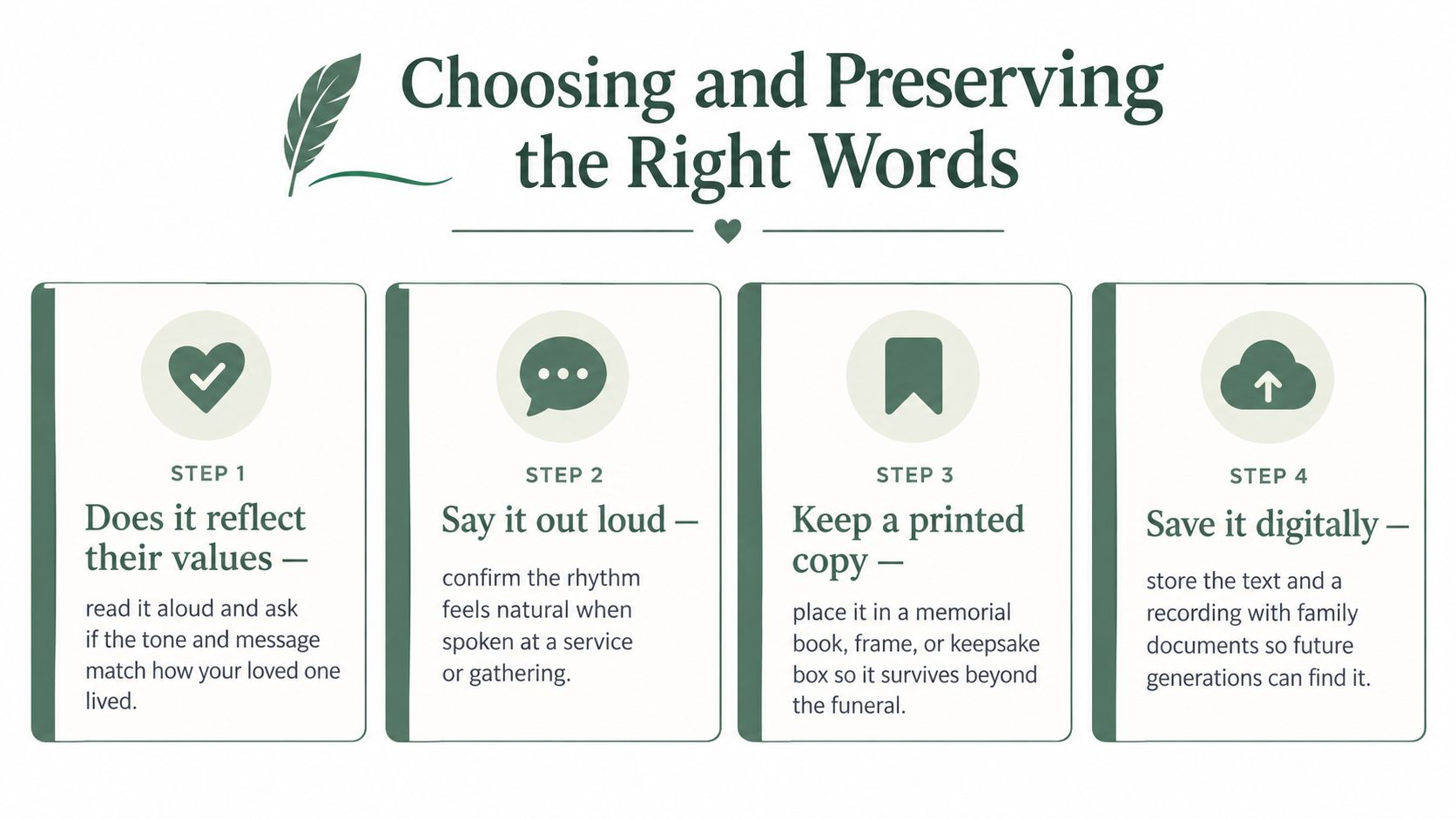
Label the stored file with the title, the source you used, and the date your family selected it. That small note can help future relatives understand why different websites show different attributions or titles. Ask one other family member to review the wording before printing, not to seek perfection, but to avoid a last-minute doubt about the tone or version.
A memorial record can hold the text together with the person's photographs, stories, milestones, and voice recordings. If you want guidance on creating that kind of lasting collection, explore this resource about a digital memorial book. For families who want to preserve the poem alongside a fuller account of a loved one's life, remembers.life offers a place to collect names, photos, stories, milestones, voice recordings, and memories. Visit remembers.life to create a record that keeps the chosen words connected to the person they were meant to honour.