How Long Does It Take to Write a Memoir: Realistic Timelines
Wondering how long does it take to write a memoir? Get realistic timelines, weekly schedules, and practical tips for finishing your life story without burnout.
A focused short memoir can take several months, while a conventional book-length memoir often needs 9–18 months of part-time work once revision is included. The right estimate depends on the project's scope and the writing time you can sustain each week, not just how quickly you can get words onto a page.
You may be at the kitchen table with a notebook, a folder of photographs, or a digital collection of memories, wondering whether this project will take a season or years. The honest answer starts with what you want to preserve: a set of family stories, a record of one chapter of your life, or a full-length memoir.
A useful starting point is about 20,000 words for a short family project and 60,000–90,000 words for a conventional memoir. At a pace of 500 words per week, a 20,000-word draft alone would take about 40 weeks before editing, so a short project isn't automatically quick if writing time is limited (scope-based memoir timeline). A full-length memoir may take six months to a year of active writing for its first draft, with the complete project taking longer once research and revision are included (memoir drafting estimates).
The calendar also needs room for discovery, drafting, revising, and preparing the finished record for family. Those phases involve more than writing: you may check dates, consult relatives, select what belongs, and decide how you want stories preserved. The recommendations below will help you choose a scope and weekly pace that fit your life.
Table of Contents
- What a Realistic Memoir Timeline Actually Looks Like
- The Four Phases Every Memoir Goes Through
- Scope, Schedule, and Stamina: The Three Variables That Decide Your Timeline
- What Slows a Memoir Down the Most
- A Practical 12-Month Chapter-by-Chapter Schedule
- Why Rushing the Memoir Is Usually a Mistake
- Practical Tips for Sticking to Your Memoir Timeline
- Answering Your Memoir Timeline Question
What a Realistic Memoir Timeline Actually Looks Like
A memoir's timeline depends first on what “finished” means to you. If your aim is to preserve family stories rather than produce a publication-length book, you can set a narrower scope and work toward a shorter record. If you want a full-length manuscript, plan for more drafting and substantial revision.
Choose the project before choosing the deadline
A useful distinction is short legacy project versus book-length memoir. A short project might focus on one life period, a family migration, a career, or a set of stories you want relatives to know. A book-length memoir attempts a broader narrative and asks you to make more decisions about structure, detail, and what to leave out.
Don't promise yourself a deadline based only on a word-count calculation. One industry analysis puts a typical memoir at approximately 81,000 words, and estimates that writing at 500 words per day on five days each week would take about 7.5 months for the draft alone. That's a sustained writing schedule, not a complete project timeline.
Match the estimate to your available time
A writer with regular weekday sessions can draft faster than someone fitting memoir work around a job, caregiving, health needs, or family responsibilities. But even a steady schedule doesn't remove the need to check memories, reconsider chapters, or pause when a story feels difficult.
For a conventional memoir, 9–18 months of part-time work is a more useful planning range than a deadline based on drafting speed alone. A shorter project can take much less time if its scope is narrow and you can write consistently. It can also stretch if you write only occasionally or decide to expand it as new memories surface.
The Four Phases Every Memoir Goes Through
A family memoir isn't finished when the last remembered event is on the page. First, you decide what belongs in the story. Then you draft, revise, and shape the material into something relatives can follow and keep.
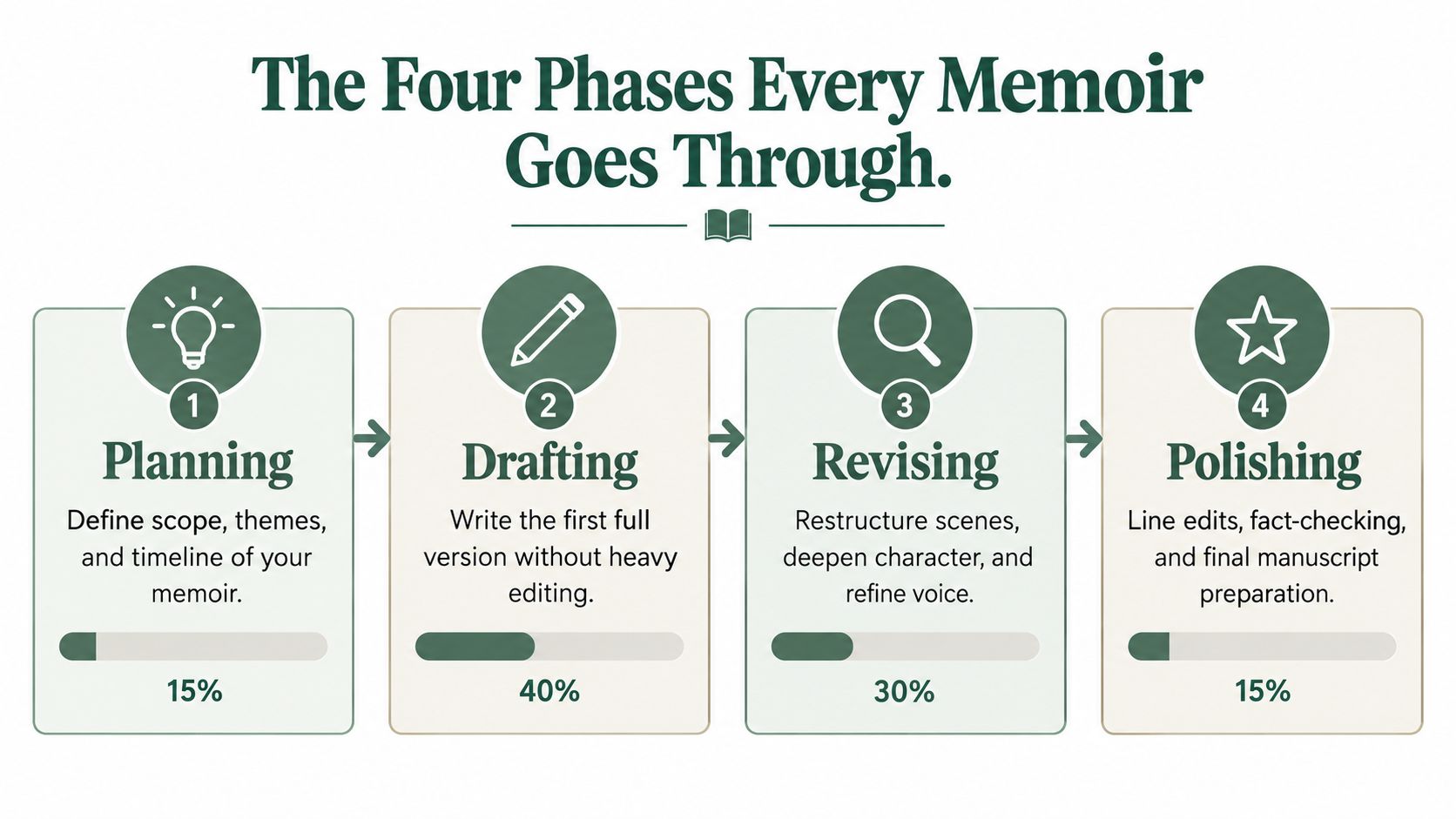
Discovery and planning
In discovery, you gather memories and supporting material. That might mean sorting photographs, noting important dates, talking with relatives, and identifying which experiences connect to the story you want to tell. You're not trying to record everything. You're looking for a focus that gives the project shape.
Drafting and revision
Drafting turns recollections into scenes and chapters. Write what happened, what you remember, and why the moment matters. Don't spend every session polishing earlier pages. You need enough material to see the story as a whole before you can judge its structure.
Revision is where you check details, clarify scenes, cut repetition, and decide whether the order serves the reader. It can take as much time as drafting, or more. One documented account describes about 90 hours of drafting and 60 hours of revision for a manuscript of approximately 70,000 words, a reminder that typing the first version is only part of the work (account of drafting and revision time).
Shape the record for family
A family memoir needs to be readable and usable. Give chapters clear titles, identify people and relationships when context may be missing, and decide whether photographs or documents belong alongside the text. For a practical starting point on organizing memories into a narrative, see guidance on life-story writing.
Scope, Schedule, and Stamina: The Three Variables That Decide Your Timeline
Scope determines how much you plan to write. A short record focused on a particular part of life has a different workload from a memoir covering decades. Schedule is the time you can protect each week. Stamina determines whether that schedule survives difficult memories, interruptions, and the demands of revision.
The table below gives a simple drafting-only comparison. It assumes the same daily writing pace throughout. Treat it as arithmetic, not a promise: it excludes planning, memory retrieval, fact-checking, and revision.
| Scope | Word count | 250 words per day | 500 words per day | 1,000 words per day |
|---|---|---|---|---|
| Short family project | 20,000 | 80 writing days | 40 writing days | 20 writing days |
| Short book-length draft | 60,000 | 240 writing days | 120 writing days | 60 writing days |
| Longer book-length draft | 90,000 | 360 writing days | 180 writing days | 90 writing days |
These totals describe writing days, not calendar days. If you write only on some days, the calendar expands. A structured target of 65,000 words over 100 days requires about 4,600 words per week; drafting at 500–1,000 words per day can take roughly 3–6 months, before research and revision (memoir length and drafting estimates).
That's why daily word-count math often sounds more encouraging than it is. The writer still has to choose episodes, check details, and revise. If you're still collecting memories and deciding on a theme, a simple life review can help you see which stories belong together before you set a firm target.
What Slows a Memoir Down the Most
A memoir usually slips behind schedule for reasons that have little to do with typing speed. The common culprits are research, emotional pauses, expanding scope, inconsistent writing time, and revision. Address those early, and your estimate will be more honest.
- Family research: If you need to check dates, names, or events with relatives, plan for the work to take longer than drafting alone. Conversations don't always resolve conflicting memories, and a useful interview may lead to more questions. A guide to oral-history interviews can help you prepare questions and keep conversations focused.
- Difficult material: Some memories are easy to write down. Others take time to approach, especially if you're deciding what to share and what to keep private. Don't force a daily-word target through material that needs a pause.
- Scope changes: A project that starts with childhood stories can grow into a family history. Decide what the memoir is about, then keep a separate list of stories that don't fit. You can return to them later without letting every discovery reshape the book.
- An unreliable schedule: A target you can meet most weeks is more useful than an ambitious plan that collapses as soon as life gets busy. Even a modest weekly session can move the project forward if you return to it consistently.
- Revision left until last: Writers often budget for the first draft and underestimate the work of checking and restructuring. Leave dedicated time to reread the whole manuscript, not just to correct sentences.
The difference between a short and long project isn't how many chapters you write. More interviews, more source material, or a broader life span can create additional work at every stage. Set the scope before promising a completion date.
A Practical 12-Month Chapter-by-Chapter Schedule
A year is a workable planning frame for a book-length family memoir when you can set aside 2–3 focused hours per week. Treat the schedule as a guide, not a test. If a phase takes longer, adjust the calendar rather than rushing the stories.

Set the shape, then build the chapters
Months 1–3: Discovery and outline. Choose a central theme, list the major episodes, and gather the photographs or documents you already have. Draft a chapter outline and flag the details that need checking. By the end of this period, you should be able to describe what the memoir covers and what it leaves out.
Months 4–6: Draft the opening chapters. Write scenes before polishing them. Use a weekly target that fits your real schedule, and keep notes on names, dates, and questions to verify. At the six-month checkpoint, review whether the outline still fits the story you're writing.
Months 7–9: Complete the draft. Continue chapter by chapter, making only essential changes to earlier material. Protect some sessions for writing new pages instead of repeatedly revising the opening. If you're behind, reduce the scope before trying to double the workload.
Months 10–12: Revise and prepare for family review. Read the manuscript from beginning to end. Check chronology and relationships, cut sections that distract from the central story, and ask a trusted relative to flag confusing references. Build in rest weeks so you can return to the pages with perspective.
Aiming for a full manuscript of 60,000–80,000 words is a planning choice, not a requirement. A shorter family project can use the same phases on a compressed schedule, but don't assume it will take only a few months unless your available writing time and scope make that realistic.
A short, regular writing session can be easier to protect than a marathon. This video offers another perspective on developing a writing routine.
Why Rushing the Memoir Is Usually a Mistake
Speed can help you get a rough draft started. It doesn't guarantee that the record will be accurate, clear, or comfortable to share. A memoir is not only a writing task. It also asks you to decide how to interpret memories, verify details, and choose what belongs in the story.
A memoir intervention involving older adults ran for four weeks and was associated with higher self-reported wise reminiscence, identity fidelity, and subjective well-being than a comparison activity (study of a memoir intervention with older adults). That finding isn't a deadline or a promise about what every writer will experience. It does underline that the value of memoir work isn't measured only by how quickly a manuscript is completed.
Practical rule: Pause when a memory needs careful attention. A humane pace is better than forcing a chapter onto the page before you're ready.
You can omit material that feels too private, mark uncertain details for later checking, or keep a story in a personal archive instead of putting it in the finished memoir. Those are editorial decisions, not failures to finish. If relatives remember an event differently, note the disagreement rather than pretending you can settle it from memory alone.
A family record becomes more useful when you give it time to be considered. Choose a pace that lets you write truthfully and revise thoughtfully, even if that means moving the finish date.
Practical Tips for Sticking to Your Memoir Timeline
You don't need a complicated system to keep going. You need a clear next step, a writing appointment you can keep, and a way to notice when the project is drifting.

- Choose an outline format: Organize chapters by time, or group stories around themes such as work, home, or family.
- Set a weekly appointment: Pick a repeatable time and protect it. A small regular commitment is easier to maintain than a schedule built around ideal weeks.
- Track progress visibly: Mark drafted and revised chapters on a calendar or simple checklist. Seeing what's done makes it easier to choose what comes next.
- Create a writing ritual: Keep your notebook, photographs, and notes together so you can begin without searching for materials.
- Make a plan for sensitive stories: Decide whether to draft, postpone, omit, or keep a passage private. You don't have to settle that question for every memory before you begin.
- Review the project regularly: Check whether the scope, schedule, and outline still fit. Add new stories to a separate list before expanding the manuscript.
If you're stuck on what to write, try a collection of story prompts for adults. Prompts can help you begin a scene, but you still decide which memories serve the story you want your family to keep.
Answering Your Memoir Timeline Question
Can you write a memoir in 30 days? You can produce a raw draft quickly if you write intensively. National Novel Writing Month sets a target of 50,000 words in 30 days, about 1,667 words per day, but meeting a word-count target doesn't complete the work of organizing memories, checking facts, and revising (account of the 30-day writing challenge).
How long should you allow for revision? Don't treat revision as a quick final check. It may take as much time as drafting, so include it when you set your target date.
Should a memoir be shorter? It should be as long as the story needs, not as long as a publishing convention suggests. A focused family record can be meaningful without covering every stage of a life.
How do you choose between a short project and a book? Start with the stories you want to preserve and the weekly time you can reliably give them. A narrow project may take months; a full memoir usually needs a longer commitment. The right timeline is the one that lets you finish without rushing the memories or abandoning the work.
remembers.life provides a life-story workflow for collecting and organizing memories, including scheduled freewriting sessions. If you'd like a structured place to preserve stories for your family, visit remembers.life and start with the memories you most want future generations to know.