A Heart of Gold Stopped Beating: 7 Memorial Lines for 2026
Find 7 tribute lines built on a heart of gold stopped beating, plus usage tips for obituaries, epitaphs and memorial notices.
A family has only a few hours to write a death notice after a sudden loss. Someone searches for a line that honors a generous person without making their life sound interchangeable with anyone else's. “A heart of gold stopped beating” is familiar because it names kindness in simple language. It also softens the directness of death, which can help mourners speak when sharper words feel impossible.
But the best wording depends on where it will appear. An obituary needs clarity. An epitaph needs restraint. A eulogy can open into a story. A legacy document can preserve details that a short notice can't hold. The seven approaches below pair each memorial idea with the format that suits it best. Each includes wording you can adapt, along with a practical way to turn a familiar phrase into a record of a real person.
Table of Contents
- 1. The Sudden Loss Narrative
- 2. The Untold Stories Within
- 3. The Values Legacy
- 4. The Relationship Reflections
- 5. The Life Lessons Archive
- 6. The Timeline of Grace
- 7. The Legacy Letter
- 7-Point Legacy Comparison
- Turning a Memorable Line Into a Lasting Record
1. The Sudden Loss Narrative
The phone call ends. A death notice has to be written today. Everyone knows the facts, but the person's kindness is harder to fit into a few lines. A sudden loss narrative helps with that job. It gives the death notice a clear starting point, then adds one real sign of how this person lived.
For a short obituary line, you might write:
“A heart of gold stopped beating, but the kindness they gave to neighbors, friends, and family continues in the lives they touched.”
This format suits an obituary or memorial notice because it is brief and readable under pressure. It works best when you add one action right after it. Say what the person did. Perhaps they brought meals to a sick friend, welcomed new neighbors, stayed late to help with repairs, or covered someone's basic needs without fanfare. One scene does the work of many adjectives.
A longer obituary, memorial website, or eulogy opener can carry more weight. Start by listing kind acts in plain language. Then ask relatives and friends a practical question: what changed because this person was here? That question often gets better material than “What were they like?” If writing stalls, record a conversation instead. Audio keeps small details, pauses, and turns of phrase that polished writing can flatten.
The guide to preparing for a death can help families handle practical decisions while they gather details for a tribute. Work in stages. Write childhood first. Then work, family life, community, and the final period. If the loss feels overwhelming, one period is enough for today. Reading about coping after a loss can help before you return to writing.
This approach also suits a family memoir or longer legacy record. Open with the familiar line, then move straight into a moment that proves it. The phrase names generosity. The scene makes it believable.
2. The Untold Stories Within
Some of the most important parts of a generous life never appeared in public. A person may have supported a relative through illness, hidden financial difficulty from their children, or made a difficult choice that shaped their character. The untold-story approach gives these private chapters a careful place.
It suits a family history, oral history, or documentary-style memorial more than a brief obituary. A short line might say:
“A heart of gold stopped beating, leaving behind quiet acts of courage that many people are only now learning about.”
The sentence creates an opening, but the record should explain what those acts were. Ask questions that lead to scenes rather than labels. What was happening at the time? Who needed help? What choice did the person make? What did they risk, give up, or learn?
If first-person writing feels too exposed, begin in the third person. “She left home young and supported her younger siblings” may feel easier to write than “I remember how she supported us.” You can change the voice later. The first task is to preserve the memory.
Protecting private material
Not every story belongs online or in a public memorial. Separate material into three groups:
- Shareable stories: Memories that relatives agree can be read by friends and future generations.
- Family-only stories: Personal details that should remain within a defined group.
- Private source material: Journals, recordings, letters, or family conflict stories that need permission before publication.
Keep original notebooks, photographs, and audio files with the written account. The source material may contain a tone or detail that a summary misses. Before sharing anything, ask who appears in the story and whether the account affects their privacy.
The family conflict stories resource can help writers think about difficult memories without reducing a person to either praise or blame. A generous person can have regrets, disagreements, and unfinished work. Including complexity often makes the memorial more truthful.
Use this approach when the family wants descendants to understand not only what the person did, but what they held before their heart of gold stopped beating.
3. The Values Legacy
A life can be preserved through its principles as well as its events. The values legacy asks what the person believed and how those beliefs appeared in ordinary decisions. It suits an ethical will, family mission statement, religious legacy, or longer memorial document.
Begin each paragraph with a plain sentence such as:
- “He believed that nobody should leave a table hungry.”
- “She believed children needed attention more than expensive gifts.”
- “They believed an apology should be offered before pride became a habit.”
Then add an example. A value becomes memorable when readers can see it in action. If the person valued hospitality, describe the extra chair they kept ready. If they valued fairness, describe how they handled a disagreement. If faith shaped their choices, explain the practice or teaching that guided them, while leaving room for relatives who may understand belief differently.
For an epitaph, the idea needs to be compressed:
“A heart of gold stopped beating. A life of kindness still teaches us how to live.”
That line is broad enough for a gravestone, but a values document should be more precise. Rank the principles if several mattered. Compassion, honesty, loyalty, patience, and service may all appear, but readers need to know which one guided the others.
Ask parents and older relatives questions from this collection of interview questions for parents. Record the answers in their own words where possible. A familiar saying can be included, but don't let a quotation replace an explanation of how the person lived.
This approach works especially well for grandchildren and future relatives who may never have met the deceased. They may not remember a voice or gesture, but they can still inherit a practical moral vocabulary. The document should offer guidance, not commands. Write what the person practiced, what they hoped others would learn, and where their actions showed the principle most clearly.
4. The Relationship Reflections
A generous person often made others feel seen. They remembered birthdays, answered late calls, welcomed difficult relatives, or created rituals that made ordinary days feel safe. The relationship-reflection approach preserves how the person loved, not just what they accomplished.
It fits a eulogy, testimonial collection, photo album, or tribute video. A eulogy opener could read:
“A heart of gold stopped beating, and each of us lost a different kind of shelter. To some, she was a sister. To others, a friend, neighbor, mentor, or the person who always answered the phone.”
This opening allows several people to contribute without forcing one definition of the deceased. Ask each contributor the same question: What did this person do that made you feel loved? The answers will reveal patterns. One person may remember a packed lunch. Another may remember a hand on the shoulder during a crisis. A grandchild may remember a weekly ritual that adults barely noticed.
Gathering many points of view
Invite stories from a spouse, children, siblings, friends, colleagues, and neighbors. Don't ask everyone to produce a formal tribute. A short voice note or a few sentences can be enough. Collect photographs with captions that explain the relationship rather than only naming the date.
For example, “Summer holiday, 2018” says little. “She taught the children to collect shells, then carried everyone's wet shoes home” preserves the feeling and the action.
A relationship archive can include letters, cards, recorded memories, and video testimonials. Check that contributors understand who will see the material. Some people will share more openly in a private conversation than in a public comment space.
Use this method when the family wants a memorial that feels communal. The phrase a heart of gold stopped beating then becomes a shared starting point, not the whole tribute. Each relationship adds a different piece of evidence. Together, those pieces show how kindness felt to the people who received it.

5. The Life Lessons Archive
Some mourners want to preserve advice that would otherwise disappear. The life-lessons archive turns experience into guidance for children, grandchildren, and relatives who may need the person's voice later. It works well as a letter collection, video archive, advice book, or digital memorial section.
Avoid listing abstract instructions such as “be brave” or “work hard” without context. Put each lesson inside a story:
“I learned to keep showing up when my first business failed. I didn't feel brave then. I simply had one more person depending on me.”
That form gives future readers both the principle and the situation that shaped it. Include mistakes as well as successes. A person's wisdom becomes more credible when it acknowledges uncertainty, regret, and change.
Organize the archive by themes. Possible sections include family, work, money, friendship, grief, resilience, faith, and everyday happiness. Mix practical guidance with emotional guidance. A recipe, a method for repairing something, or advice about resolving conflict can sit beside reflections on forgiveness.
A simple life review can help families begin with manageable prompts instead of trying to write a complete biography. Ask, “What did you learn when life became difficult?” or “What would you explain to someone facing the decision you once faced?” Invite descendants to add questions. The archive can grow through conversations rather than one large writing session.
For a memorial line, keep the lesson short:
“A heart of gold stopped beating, but the wisdom they shared still guides the family they loved.”
Use the longer format when the person's generosity included teaching. The final record should sound like them. Preserve their expressions, humor, and plainspoken habits. Polished writing has value, but an authentic voice often carries further.
6. The Timeline of Grace
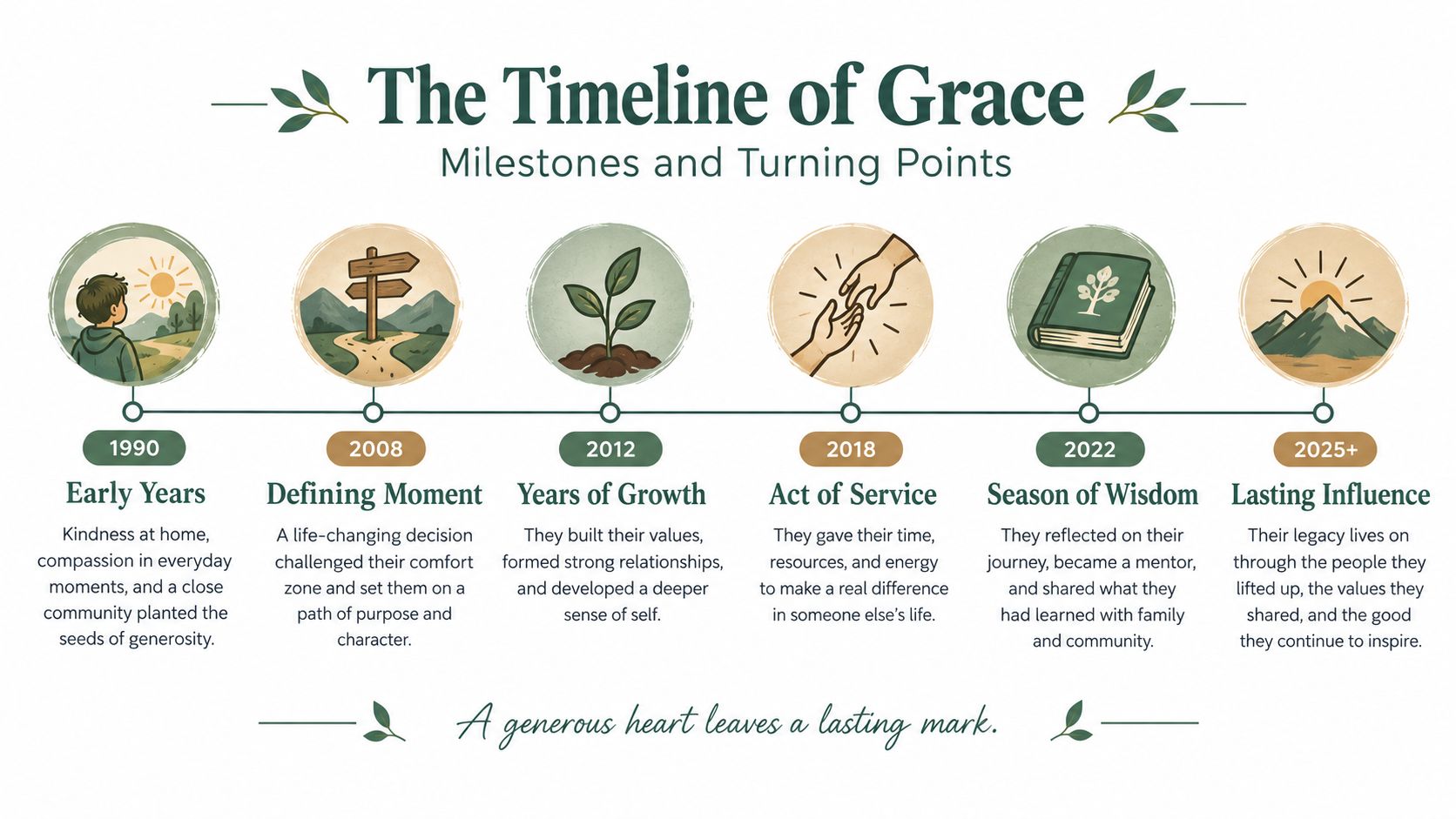
A timeline gives shape to a life without reducing it to a list of dates. The timeline of grace follows milestones and turning points, then asks how each period shaped the person's generosity. It suits a biographical memorial, photo timeline, documentary, or digital life story.
A simple entry might look like this:
- Early family life: A responsibility that taught them to notice other people's needs.
- Working years: A decision that showed persistence or fairness.
- Parenthood: A tradition that made relatives feel welcome.
- Later years: A volunteer role, friendship, or daily practice that extended their care beyond the household.
Don't add a milestone merely because it happened. Add it because it reveals a choice, relationship, change, or continuing value. A new job may matter because it allowed the person to support relatives. A move may matter because it tested their ability to build community. A retirement may matter because it created time for service.
Giving each era a meaning
Ask relatives about separate life periods. Someone from childhood may remember a different quality than a colleague from later years. Add photographs, letters, certificates, recipes, tools, or other objects that anchor each chapter. A caption should explain why the item matters.
A useful closing line for the timeline is:
“A heart of gold stopped beating after a life built through small decisions to help, include, and encourage others.”
The timeline can also show continuity. Perhaps the person's generosity changed form but not direction. A young adult may have helped siblings. Later, they may have supported neighbors, raised children, or mentored coworkers. The record should show development without pretending the person was perfect at every stage.
Use a visual timeline when family members struggle to write paragraphs. Dates and images can prompt memories. Once the milestones are arranged, add a short reflection beneath each one. This format is especially accessible for older relatives and for descendants who prefer to learn through photographs and brief stories.
7. The Legacy Letter
A legacy letter speaks directly to people who may read it years after the funeral. It suits a letter to grandchildren, time capsule, ethical will, or recorded video message. The direct address makes the memorial feel personal, especially when future relatives never had the chance to hear the person speak.
Begin with a clear recipient:
“Dear future family, if you're reading this after my heart of gold stopped beating, I hope you know that our family was built through ordinary acts of care.”
Then tell one story. Explain who helped the person, what they learned, and what they hope future relatives will carry forward. Avoid turning the letter into a list of demands. Future generations need an invitation to understand, not an obligation to imitate every choice.
A letter can include practical details, such as family recipes, the origin of a surname, or the reason a tradition matters. It can also include hopes about relationships, courage, kindness, and belonging. Write as if speaking across a kitchen table. Short sentences often sound more natural than formal declarations.
Consider creating several letters for different stages of life. One might be opened when a child becomes an adult. Another might be read during a wedding, the birth of a child, or a difficult personal transition. A video version can preserve facial expression and voice, while a written copy remains easier to store and revisit.
Before sharing the letter, decide who may read it and when. Date the document. Name the intended recipients. Store the recording and written version together if possible.
This approach is right when the person's greatest gift was encouragement. It gives the words a heart of gold stopped beating a future-facing meaning. The loss remains real, but the letter lets care continue as a conversation.
7-Point Legacy Comparison
| Prompt | Implementation Complexity 🔄 | Resource Requirements ⚡ | Expected Outcomes 📊 | Ideal Use Cases 💡 | Key Advantages ⭐ |
|---|---|---|---|---|---|
| The Sudden Loss Narrative - Capturing Life's Unexpected Endings | High 🔄, emotionally intensive, needs sensitive interviewing | Moderate ⚡, family interviews, time for editing | High impact 📊, meaningful tribute, emotional closure | Memorials, obituaries, eulogies | ⭐ Honors generosity; fosters closure |
| The Untold Stories Within - Revealing Hidden Chapters | High 🔄, deep probing, trust-building required | High ⚡, archival research, private interviews, time | Deeply authentic 📊, comprehensive, nuanced life record | Oral histories, memoirs, family archives | ⭐ Produces honest, multi-layered legacy |
| The Values Legacy - What They Stood For | Medium 🔄, conceptual synthesis and consensus | Low–Moderate ⚡, interviews, reflective writing | Clear guidance 📊, ethical framework for descendants | Ethical wills, estate planning, faith-based legacies | ⭐ Transmits moral compass; aids family decisions |
| The Relationship Reflections - How They Loved | Medium 🔄, gather multiple perspectives, reconcile views | Moderate ⚡, testimonials, photos, possible recordings | Emotional resonance 📊, preserved relational portrait | Family albums, therapy resources, memorial tributes | ⭐ Preserves emotional bonds; models healthy relating |
| The Life Lessons Archive - Wisdom Passed Forward | Medium 🔄, extract lessons from stories without preaching | Low–Moderate ⚡, storytelling, thematic organization | Practical mentorship 📊, actionable guidance for heirs | Advice compilations, mentorship archives, education | ⭐ Converts experience into teachable wisdom |
| The Timeline of Grace - Milestones and Turning Points | Medium 🔄, sequencing and editorial shaping | Moderate ⚡, photos, dates, design/infographic tools | Structured narrative 📊, clear arc and growth patterns | Biographies, timeline infographics, exhibits | ⭐ Clarifies development; engages readers visually |
| The Legacy Letter - Writing to the Future | Low 🔄, simple format, intimate voice | Low ⚡, minimal resources; optionally record video | Intimate connection 📊, personal, time-transcendent keepsake | Letters for descendants, time capsules, readings | ⭐ Direct voice to future; quick to produce |
Turning a Memorable Line Into a Lasting Record
The phrase a heart of gold stopped beating can help a family begin speaking about death. It recognizes kindness without requiring elaborate language. But by itself, it doesn't tell readers what made the person generous, who relied on them, or which habits should be remembered.
Use the short format when time is limited. An obituary line can name the loss and point toward a defining quality. An epitaph needs fewer words and a steady rhythm. A eulogy opener can use the familiar phrase, then move immediately into a scene that shows the person's character. A longer legacy record has room for values, relationships, milestones, private struggles, and advice.
Choose one wording for the obituary or epitaph this week. Keep it simple and accurate. Then schedule one memory-gathering session with a relative or friend. Ask for one specific act of kindness, not a general description. “She was generous” is a starting point. “She kept an extra coat by the door for anyone who needed one” gives future readers something they can see.
If relatives live far apart, invite them to send voice recordings, photographs with captions, letters, or short written memories. A shared digital memorial can hold contributions from several people while the family decides what should remain private. remembers.life offers shared life stories and digital memorials where families can bring together photographs, written memories, milestones, voice recordings, and tributes.
Grief can make large projects feel impossible. Start with one story. Preserve the original recording or handwritten note. Add another memory when the family has the capacity. Over time, a familiar memorial line can become the doorway to a fuller and more honest record of a life.
remembers.life helps families create shared life stories and digital memorials with photos, memories, milestones, voice recordings, and tributes. Use its collaborative space to gather the specific acts of kindness behind “a heart of gold stopped beating,” then begin preserving the story at remembers.life.