8 Family Conflict Stories and Lessons
Explore 8 family conflict stories from memoirs and oral histories, with ethical preservation advice, practical lessons, and reconciliation insights.
What can a family conflict story teach if it doesn't turn private pain into a public verdict? The most useful accounts aren't exposés with a hero and a villain. They're records of decisions, relationships, partial knowledge, and perspectives that changed over time.
Family conflict is also a durable human subject, not a niche theme. Ancient Greco-Roman literature repeatedly returned to sour marriages, domineering fathers, evil stepmothers, and feuding siblings, with Hesiod's Theogony, composed around 700 BCE, among the early family-centered narratives discussed by the University of Toronto's article on domestic strife in ancient texts. Contemporary estrangement data points to the same emotional territory. A 2025 YouGov poll found that 38% of American adults said they were currently estranged from at least one family member.
The eight patterns below treat family conflict stories as ethical case-study frameworks. Each one pairs narrative analysis with practical tactics for recording turning points, preserving multiple voices, protecting living relatives, and deciding what future readers should access. A shared family room, voice recordings, searchable transcriptions, and AI memory chat grounded in saved family content can make remembers.life relevant when contributors need control over what they share.
Table of Contents
- 1. The Estrangement and Reconciliation
- 2. Generational Clash and Cultural Bridge
- 3. The Money and Inheritance Dispute
- 4. The Prodigal Child Returns
- 5. The Sibling Rivalry and Competition
- 6. In-Law Conflicts and Family Integration
- 7. Parenting Disagreements and Child-Rearing Conflict
- 8. Health Crisis and Caregiver Burden
- 8-Point Comparison of Family Conflict Stories
- Preserve the Story Without Reopening the Wound
1. The Estrangement and Reconciliation
What makes an estrangement story credible when the people involved still disagree about what happened? A parent may recall a career dispute as rejection, while an adult child remembers pressure to obey. Both accounts can be sincere. A useful record preserves what each person believed at the time, which events changed the relationship, and what remains unresolved.
Estrangement often develops through repeated relationship breakpoints rather than one defining incident. Respondents identifying sibling estrangement most often named personality conflicts and lies or betrayal, each at 29%, followed by manipulative behavior at 26%, as noted earlier. These findings do not explain an individual family. They offer a framework for examining mistrust, communication failures, and competing interpretations without assigning blame.
Record the turning points, not just the reunion
Interview each contributor separately, using an oral-history interview guide from remembers.life to structure questions without forcing a shared conclusion.
- The first rupture: What happened, and what did you believe it meant?
- The period of distance: What contact continued, and what did relatives misunderstand?
- The opening: Who initiated contact, and what conditions made it possible?
- The new terms: Which boundaries or expectations made contact safer?
- The present relationship: Is reconciliation complete, partial, or still developing?
Record dates, messages, and changes in contact where contributors consent, while distinguishing documented events from later interpretations. Offer private interviews, allow time between recollection and reflection, and do not pressure anyone into a joint recording. Living relatives should be able to review sensitive material, request limits on access, or decline participation. Documentation should preserve disagreement without turning private pain into a public verdict.
Practical rule: A reunion is an event. Reconciliation is a process, and the archive should leave room for both.
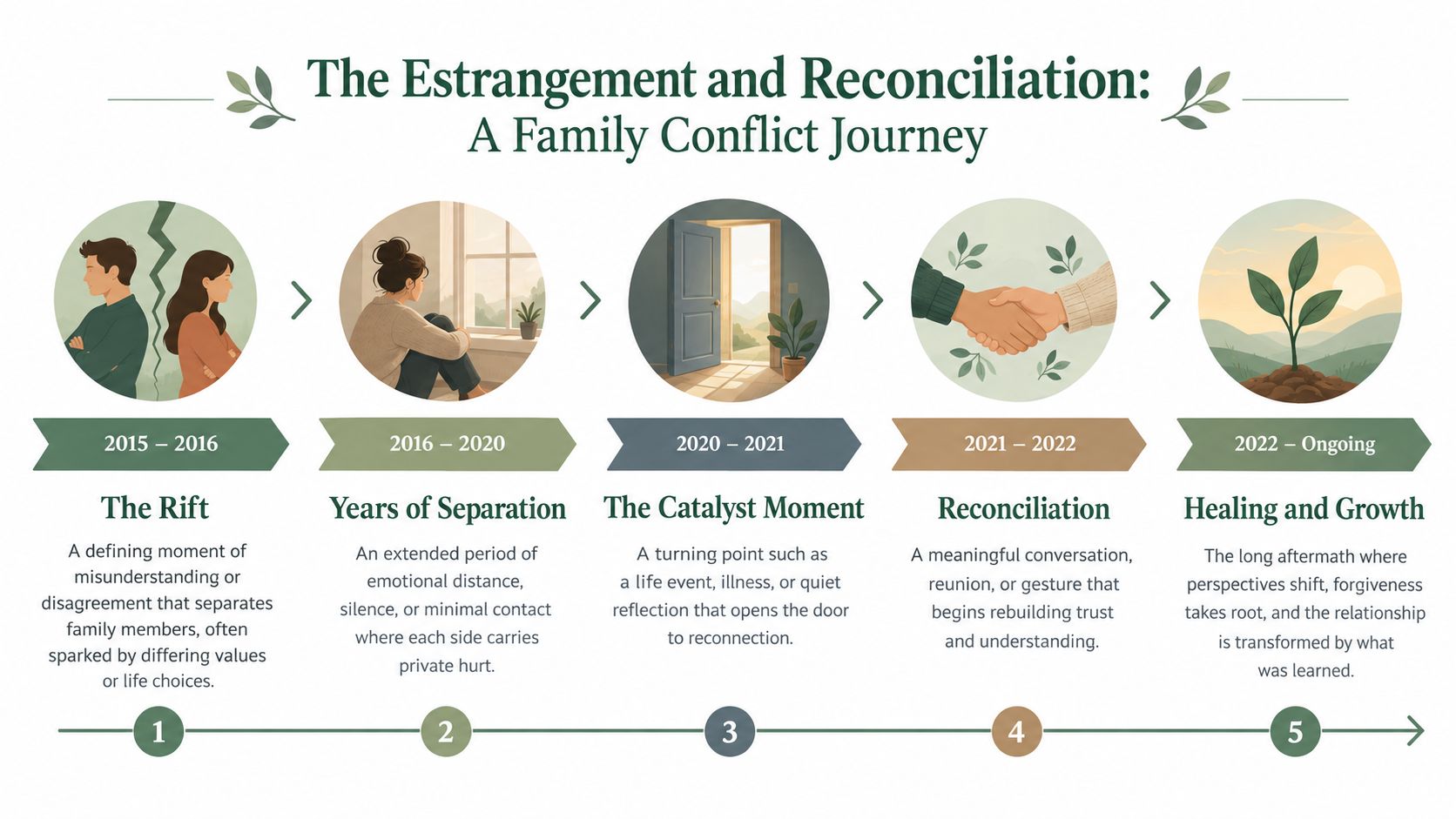
Strategic insight: Preserve earlier interpretations beside later understanding. The contrast can give future readers a more honest account than a polished story of forgiveness.
2. Generational Clash and Cultural Bridge
A generational conflict can look like stubbornness from one side and disloyalty from the other. An immigrant parent may see language retention, religious practice, or a career expectation as protection. A child raised in a different social environment may experience the same demand as a restriction. The story loses meaning when either person is reduced to a stereotype.
Start with context. Record where relatives lived, which languages they used, what traditions mattered, and what pressures shaped their choices. A disagreement about university, marriage, faith, or gender roles can't be understood only through the final argument. The family needs a record of the assumptions each generation inherited.

Preserve the bridge in its original forms
Record contributors in the languages they use, then preserve translations with the original audio. Include recipes, religious objects, holiday practices, clothing, music, and the explanations relatives attach to them. If a family abandoned a custom, ask why. If it revived one, ask who led that change and who resisted it.
A family history documentation guide from remembers.life can support a broader record that includes artifacts and memories, not just a summary of the dispute.
The people involved may disagree about whether compromise represented respect or surrender. Let them say so in their own words. A parent might believe a tradition survived because the children accepted it; a child might believe it survived because the family made it optional. Both interpretations belong in the archive.
A short visual or recorded prompt can help relatives discuss cultural change without immediately debating who was right.
Strategic insight: Treat language, ritual, and historical context as evidence. They show how identity was negotiated, not merely what relatives argued about.
3. The Money and Inheritance Dispute
Money disputes become destructive when families confuse financial facts with moral conclusions. One sibling may believe equal inheritance is fair because each child has the same relationship to a parent. Another may believe a larger share is justified because they provided daily care or absorbed costs. A third may be worried about privacy, debt, or the legal consequences of disclosure.
Build the record in layers. First, identify documents that can be preserved lawfully, such as relevant letters, agreements, account summaries, or property records. Next, record each person's understanding of the circumstances. Finally, explain the reasoning behind the decision, including objections that weren't resolved.
Separate the ledger from the memory
Use neutral descriptions such as “Sibling A understood the arrangement as compensation for caregiving” rather than “Sibling A took more than was deserved.” Date the account, identify whether the speaker witnessed the decision directly, and mark uncertain details as recollection. Don't upload private financial information merely because it makes the story more complete.
If the dispute remains active, pause the family-history project or involve a qualified mediator. A memory archive shouldn't become an informal courtroom, negotiation channel, or substitute for legal advice. Guidance on trusts and wills from remembers.life may help families distinguish legacy planning from the emotional work of documenting a disagreement, but legal questions still require an appropriate professional.
Fairness isn't a single formula. Record the values behind each position before recording the outcome.
A useful account might include the parent's stated wishes, the practical burdens different relatives carried, and the points no one could verify. It can also record what the family learned about communication, expectations, and the need to discuss care and inheritance before a crisis.
Strategic insight: Preserve the decision-making process, not just the distribution. Future relatives may learn more from how the family reasoned than from who received what.
4. The Prodigal Child Returns
The returning family member is rarely the only person whose life changed during the separation. Those who stayed may have managed worry, anger, practical responsibilities, or silence. The person who left may have experienced addiction, recovery, loneliness, financial hardship, geographic distance, or a deliberate need for independence. A responsible family conflict story holds these experiences together without turning return into automatic redemption.
Record the departure before recording the welcome. Ask what the family member hoped to escape, what relatives believed was happening, and how absence changed household routines. Then document the returner's circumstances in their own words, including what they understood only later.
Make reconnection specific
A turning point might be a phone call, a hospital visit, an apology, a recovery milestone, or a small ritual repeated over time. Record what was said only if the speaker wants it preserved. Also record the conditions of renewed contact, such as sobriety, privacy, limited visits, financial boundaries, or agreement not to revisit certain subjects in group settings.
Reconnection can be partial. A family may share meals again while avoiding money. A parent and child may speak regularly but never recover the closeness they had imagined. Don't describe those boundaries as failure. They may be what makes contact sustainable.
Include photographs, letters, and family memory videos with remembers.life only after checking who appears in them and who has access. A returning relative should be able to approve their own account rather than inherit a version written entirely by those who waited.
Strategic insight: Document the terms of reconnection. A second chance becomes a durable legacy when the archive shows the boundaries and choices that allowed it to happen.
5. The Sibling Rivalry and Competition
Sibling rivalry often survives because relatives remember different childhoods inside the same home. One child recalls being protected, another recalls being ignored. Academic or professional success may look like favoritism to one sibling and pressure to another. A family photograph can show shared happiness while concealing unequal expectations.
Record sibling accounts separately at first. Ask each person to identify the event they consider the beginning of the rivalry, the role they believed they occupied, and the moments when another sibling offered support. Avoid asking one sibling to correct another during the first interview. Contradictions should be preserved as contradictions until the family chooses whether to discuss them together.
Include the ordinary years
A rivalry archive shouldn't consist only of accusations. Record jokes, shared work, childhood alliances, holidays, illnesses, and practical help. Those details complicate the idea that a relationship was either loving or hostile. They may also reveal that resentment shifted as parents aged, careers diverged, or family responsibilities changed.
If a family member doesn't want to participate, don't treat silence as confirmation of anyone else's version. Mark the account as incomplete. Living relatives deserve protection from labels such as “jealous,” “favorite,” or “problem child,” especially when those labels came from a conflict rather than an independently documented fact.
Some sibling relationships heal through collaboration. Others become manageable through distance and clear boundaries. The archive should record the current status accurately, without requiring a reconciliation scene.
Strategic insight: Compare memories, not personalities. The useful question is usually what each sibling experienced, expected, and needed, rather than which sibling had the correct character judgment.
6. In-Law Conflicts and Family Integration
Marriage joins family systems, not just individuals. One household may treat frequent visits as affection, while another sees them as intrusion. Holiday schedules, childcare, food, religion, privacy, and loyalty can all expose different assumptions about what family membership requires.
Begin with the two systems before the dispute. Record how each family celebrated, communicated, handled disagreement, and defined hospitality. Then identify the specific incident that made the differences visible. “The in-laws were controlling” is an interpretation. “They arrived unannounced and expected to make the childcare decision” is a recordable event, provided the people involved can respond.
Follow the boundary negotiations
Ask what changed after each conflict:
- Visits: Who decides when and where gatherings happen?
- Parenting: Which decisions belong to the parents, and which traditions can relatives share?
- Holidays: How are competing rituals scheduled or combined?
- Communication: Which topics require a private conversation between partners?
- Repair: What action demonstrated respect after an argument?
Include positive blending, such as a new meal combining both traditions or a grandparent learning a different holiday practice. These moments matter because integration isn't only the absence of conflict. It's the creation of shared habits that neither family had before.
In-law accounts also require careful consent. A spouse may be living but absent from the project, or a relative may be identifiable through a story even if their name is removed. Redact details when disclosure could expose private health, immigration, relationship, or parenting information.
Strategic insight: Document boundaries as negotiated agreements, not evidence that one family won. Future relatives can then see how respect was built through repeated, concrete choices.
7. Parenting Disagreements and Child-Rearing Conflict
Parents can share a commitment to a child's wellbeing while disagreeing sharply about how to pursue it. One may value strict discipline and predictable rules. The other may prioritize autonomy, emotional expression, religious formation, academic achievement, or protection from pressure. The child experiences the consequences of that disagreement, but may interpret it differently later.
Record the dilemma before judging the decision. What did each parent fear? What outcome did each hope to protect? Which facts were known at the time, and which conclusions appeared only after the child grew older?
Give the child a voice without assigning a burden
An adult child may want to describe curfews, school choices, faith practices, or support during a difficult period. They shouldn't be required to reconcile their parents or validate either account. If the child is young, obtain appropriate consent and consider whether the material could embarrass, identify, or harm them later.
A balanced record includes compromise and regret. Perhaps parents divided decisions, changed rules as the child matured, or acknowledged that a chosen approach caused unintended harm. It can also preserve moments when they agreed, worked together, or offered support despite disagreement.
Don't treat later success as proof that one parenting philosophy was correct. A child may thrive while still carrying pain from the way decisions were made. Conversely, a difficult outcome doesn't prove that a parent's intentions were malicious.
A longitudinal study of the Bridges universal family intervention found that reductions in mother-adolescent conflict in ninth grade mediated later outcomes across adolescence, including fewer externalizing and internalizing symptoms and less substance-use experimentation, as described in the published study. The finding concerns an intervention, not any particular family's choices, but it supports documenting conflict as something that can change and influence later experience.
Strategic insight: Preserve values, actions, consequences, and later reflections as separate layers. That structure prevents hindsight from erasing the uncertainty parents faced.
8. Health Crisis and Caregiver Burden
Health-related conflict demands the strongest safeguards because illness can affect memory, capacity, privacy, finances, and emotional stability. Siblings may disagree about treatment, residential care, medication, or end-of-life choices while each believes they're protecting the relative at the center of the crisis. A caregiver who appears controlling may be exhausted. A distant sibling who appears indifferent may lack information or be excluded from decisions.
Consent and timing come first. If the crisis is recent, delay recording until participants can reflect without being pushed into testimony. Distinguish medical facts from family interpretation, and don't publish diagnoses, records, or treatment details without appropriate permission.
Show the care work
Ask who performed which tasks, how decisions were made, and what information was available then. Record the wishes and values the ill or aging person had expressed, while recognizing that a family story isn't a medical directive or legal document. Acknowledge gratitude without creating a saintly caregiver and a villainous relative.
The UK evaluation of the Reducing Parental Conflict programme found that 49% of parents reported an improved relationship six months after completing the intervention and 52% reported improvement at twelve months. The same evaluation recorded parent-perceived positive effects on children at 67% after six months and 73% after twelve months. Those figures concern a structured programme, not healthcare disputes, but they illustrate why a family record can include change over time rather than treating conflict as fixed.

Safety boundary: A family archive should preserve wishes and experience. It shouldn't replace medical, legal, safeguarding, or counselling support.
Strategic insight: Treat care decisions as high-sensitivity records. Limit access, document permission, and preserve uncertainty where the family still doesn't know what happened.
8-Point Comparison of Family Conflict Stories
| Title | Complexity 🔄 | Resources & Time ⚡ | Expected Outcomes ⭐📊 | Ideal Use Cases 💡 | Key Advantages ⭐ |
|---|---|---|---|---|---|
| The Estrangement and Reconciliation | High, multi-year timeline, many turning points 🔄 | Medium–High, multiple interviews, time between sessions ⚡ | Deep emotional insight; documented reconciliation and growth 📊⭐ | Long-standing family rifts needing context and healing 💡 | Powerful legacy material showing forgiveness and perspective shifts ⭐ |
| Generational Clash and Cultural Bridge | Medium, nuance around language, rituals, stereotypes 🔄 | Medium, multilingual recordings, artifacts, contextual research ⚡ | Preserved cultural context; examples of adaptation and compromise 📊⭐ | Immigrant/bi-cultural families preserving heritage for descendants 💡 | Essential record of cultural identity and practical negotiation strategies ⭐ |
| The Money and Inheritance Dispute | High, legal/privacy sensitivity and power dynamics 🔄 | Medium, document collection, possible mediator/legal input ⚡ | Clear record for estate planning; reduced future ambiguity and conflict 📊⭐ | Estate planning, unresolved inheritance or financial disagreements 💡 | Practical guidance that can prevent future disputes and clarify values ⭐ |
| The Prodigal Child Returns | Medium, focused emotional arc with clear departure/return 🔄 | Low–Medium, targeted interviews, capture turning point moments ⚡ | Redemption and resilience narratives; lessons on unconditional love 📊⭐ | Recovery stories, long-absent relatives returning, reunions 💡 | Universally relatable hopeful stories that teach resilience and reconciliation ⭐ |
| The Sibling Rivalry and Competition | Medium, multiple perspectives, risk of bias 🔄 | Medium, separate sibling interviews, childhood context ⚡ | Insight into family roles and personality development; documented evolution 📊⭐ | Families seeking to understand sibling dynamics across decades 💡 | Reveals formation of identity and often includes relatable anecdotes ⭐ |
| In-Law Conflicts and Family Integration | Medium, multiple family systems and boundary negotiations 🔄 | Medium, interviews with both sides, examples of blended practices ⚡ | Record of cultural blending and successful compromises; practical coexistence examples 📊⭐ | Blended families, second marriages, cross-cultural unions 💡 | Documents how families expand, adapt, and negotiate respect/roles ⭐ |
| Parenting Disagreements and Child-Rearing Conflict | Medium, sensitive with child perspectives and regrets 🔄 | Medium, interviews with parents and grown children, timeline mapping ⚡ | Intergenerational guidance; documented shifts in parenting philosophy 📊⭐ | Parents reflecting on upbringing; legacy for adult children and grandchildren 💡 | Practical wisdom for future parents; shows humility and lessons learned ⭐ |
| Health Crisis and Caregiver Burden | Very High, medical, legal, emotional complexity; high sensitivity 🔄 | High, medical records, many stakeholders, time for grieving/support ⚡ | Clear care decisions and legacy documents; recognized caregiver contributions 📊⭐ | Eldercare planning, end-of-life decisions, dementia and chronic illness cases 💡 | Critical guidance for future crises and honoring caregivers; reduces ambiguity in care choices ⭐ |
Preserve the Story Without Reopening the Wound
A useful family conflict story doesn't require every participant to agree. It requires a process that makes disagreement visible without turning vulnerable people into evidence. Start by obtaining informed consent from living contributors. Explain the purpose of the project, who may access the material, whether excerpts might be shared beyond the family, and how long the record is intended to remain available.
Discuss sensitive subjects before recording. Health information, addiction, abuse allegations, financial records, immigration history, sexuality, and identifying details about children may need separate permissions or complete exclusion. Consent should be specific enough that contributors understand what they're agreeing to, not a general request to “tell the family story.”
Record each perspective in its own words. Separate direct memories from interpretations, family lore, documents, and information heard from someone else. If accounts conflict, label them as competing recollections rather than silently selecting the version that best fits the narrator's preferred ending.
Build review and access into the process
Offer participants a chance to review their own recording or transcript. Depending on the project, they might correct factual errors, request redactions, restrict access to certain relatives, or withdraw material before publication. Be clear about what can and can't be removed once copies have been distributed.
Store supporting material responsibly. Keep original audio with transcripts, retain dates and contributor names where permission allows, and use access controls for sensitive files. A shared family room on remembers.life can give relatives a place to contribute memories to linked profiles, while voice recordings and transcriptions can make those accounts searchable. If a family uses AI memory chat, it should be understood as a way to ask questions of saved family content, not as an independent authority or a replacement for a person's testimony.
The archive should also explain its gaps. A missing voice may reflect refusal, safety concerns, death, distance, or lack of access. Don't imply that silence proves agreement. Redaction can be an ethical strength when it protects a living person from exposure.
Family conflict has remained a central storytelling subject across centuries because it reveals power, loyalty, betrayal, responsibility, and succession. Contemporary reporting also describes political differences, generational distance, and holiday pressure as increasingly important contexts for estrangement, including a 2026 report on no-contact patterns and family separation. These developments make neutral documentation more valuable, but neutrality doesn't mean emotional emptiness. It means giving people enough context to understand why the conflict mattered.
A lasting record can preserve complexity without forcing reconciliation. It can show that someone was hurt and still loved, that a decision was defensible and still damaging, or that a relationship became safer through distance rather than renewed closeness. The most responsible family conflict stories don't settle every dispute for future readers. They give those readers the voices, circumstances, boundaries, and evidence needed to form their own understanding.
remembers.life offers shared family spaces, voice recordings with transcriptions, and memory profiles that can organize difficult experiences alongside ordinary family history. Visit remembers.life to begin preserving family stories with consent, context, and control over who can access them.