Oral History Interview Guide to Preserve Family Stories
Learn how to plan, conduct and preserve an oral history interview with consent, questions, recording and archiving tips for lasting family stories.
Your mother is halfway through a story about leaving home when she stops and says, “I can't remember what happened next.” You reach for another photograph, make tea, and wait. A few minutes later, the memory returns, along with the sound of the station, the coat she wore, and the name of the neighbor who came to say goodbye. That moment is why an oral history interview needs more than a list of questions and a recording button.
Family stories often live in voices, gestures, pauses, and small details that never appear in certificates or photo albums. A finished recording can preserve not only what happened, but how a loved one understood it. The practical work matters too: thoughtful preparation, comfortable pacing, clear audio, careful transcription, consent, and a place where relatives can return to the story.
Table of Contents
- Why Oral History Interviews Matter for Families Today
- How to Prepare for an Oral History Interview Without Overthinking It
- Crafting Questions That Invite Stories Not Just Answers
- Recording Day Tips for Clear Audio and Comfortable Conversation
- From Recording to Lasting Legacy With Transcription and Archiving
- Your Next Oral History Interview Starts With One Conversation
Why Oral History Interviews Matter for Families Today
A story can stall when an older relative reaches a missing name, a blurred date, or a painful moment. Give the silence time. Offer a photograph, change the subject, or end the session before fatigue turns the conversation into work. In a later sitting, the missing detail may return. That flexibility is part of what makes an oral history interview useful for families.
A photograph can show your grandfather in his work clothes, but it cannot explain what the job demanded, who taught him the trade, or why he avoided speaking about one winter. A document can confirm where your family lived, yet it cannot preserve the pride in your aunt's voice as she describes making a home there. Oral history preserves perspective, not only evidence.

A family interview is different from an archive project
Professional oral historians may work toward a public collection, institutional standards, or a defined research question. A family interview has a closer purpose. You may be recording a parent's account of migration, a grandmother's memories of work, or the story behind photographs no one can identify.
The work still belongs to a long tradition. Oral history became an established field in 1948, when Allan Nevins conducted his first interview at Columbia on May 18, 1948, an event widely treated as the birth of modern oral history in the United States. Columbia's archive has grown to over 10,000 interviews, showing how one act of listening can become part of a substantial historical record. Columbia's account of the archive's origins places a family conversation within that wider history.
A home recording does not need documentary polish. It needs to be authentic, understandable, and stored safely. Pauses may show uncertainty, grief, or concentration. A laugh may carry more family meaning than a carefully edited answer. Leave those qualities in the recording where they help future listeners understand the person, not just the information.
What future generations receive
A preserved interview can connect memories with photographs, names, dates, and milestones. Relatives may hear a voice they never knew, search a transcript for a place name, or learn that a familiar family tradition began with one practical decision.
The finished record also depends on what happens after recording. Keep the original files, label people and places while memories are fresh, and create a version relatives can access. A guide to preserving a family story can help you build that record for listening, reading, and sharing.
Start with one willing narrator. Plan for several short conversations if energy, memory gaps, or emotion make one long sitting unrealistic. The strongest family histories leave room for unfinished thoughts and return to them with care.
How to Prepare for an Oral History Interview Without Overthinking It
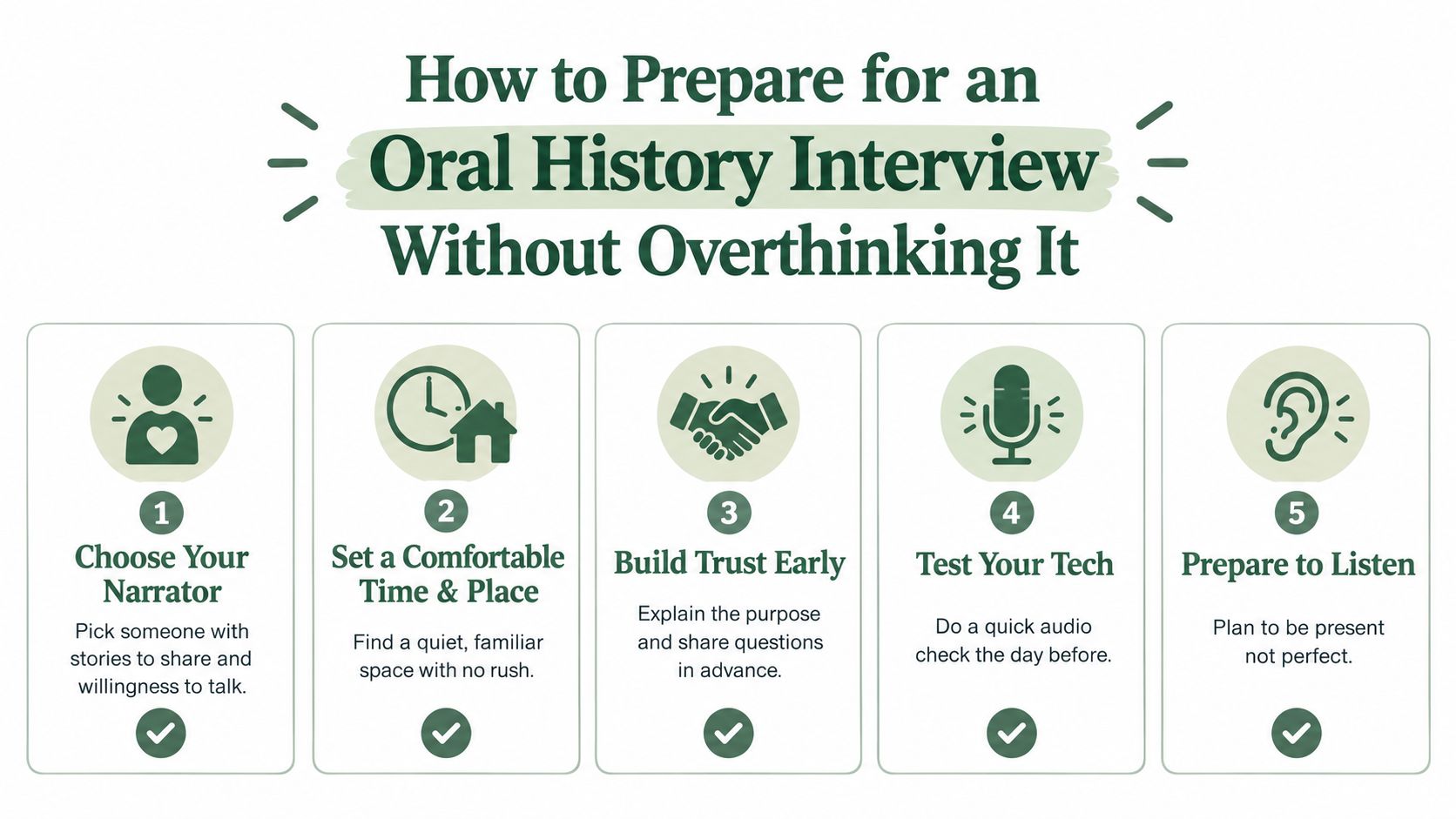
Good preparation reduces pressure without turning the conversation into an examination. Before you decide what to ask, agree on who is being recorded, why you're recording, and how the material may be used.
Make the invitation personal
Choose a narrator who has stories to share and feels willing to participate. Don't present the interview as a test of memory or an obligation to the family. Say what you'd like to learn, explain who may listen, and make it clear that the narrator can pause, skip a subject, or change their mind about sharing a particular passage.
Put the basic agreement in writing. It can be a simple note confirming the purpose of the recording, who will have access, whether photographs may be included, and whether the narrator approves editing or publication. A family archive deserves the same respect as a professional collection, especially when it contains sensitive stories.
Build a light chronology
You don't need a complete genealogy before you begin. Gather the material that will help the narrator recognize people and places:
- Photographs: Mark names and approximate occasions where possible.
- Documents: Collect letters, certificates, diaries, recipes, maps, and work records.
- Family vocabulary: Note nicknames, former addresses, organizations, and recurring stories.
- Life sequence: Sketch childhood, education, work, relationships, homes, turning points, and later years.
- Unanswered questions: Separate what you know from what you'd like the narrator to explain.
The Smithsonian recommends selecting and contacting the narrator, scheduling sufficient time, confirming goals and legal rights, gathering background material, and completing basic biographical research before recording. Its oral history preparation guidance is useful because it treats preparation as a way to reduce missed topics, not as a demand for academic expertise.
Schedule around energy, not your calendar
Older narrators may be comfortable talking for a while and then lose energy suddenly. Arrange a quiet, familiar place with good seating, easy bathroom access, water nearby, and no expectation that the session must end with every question answered.
A long life shouldn't be forced into one sitting. Independent guidance notes that interviews often last one to two hours and can work particularly well when repeated across multiple sessions. The evaluation and training discussion in this open-access article also highlights the need to interpret factual errors, silences, and inconsistencies rather than treating them as reasons to dismiss a narrative.
Test your phone, microphone, storage, and charging setup before the visit. Do a short trial recording in the actual room, play it back through headphones, and check whether voices are clear over the refrigerator, heating system, traffic, or television. Preparation should leave you more present, not more distracted.
Crafting Questions That Invite Stories Not Just Answers
The strongest questions open a door. They don't force the narrator toward the answer you expect.
“Did you enjoy school?” invites a short reply. “Tell me what school was like in your family” creates room for routines, teachers, friendships, embarrassment, ambition, and the practical details of getting there. Ask one question at a time, then let the narrator decide which part deserves attention.

Begin with familiar ground
A gentle sequence helps a narrator settle into the work of remembering. Start with easy context, then follow the relationships and turning points that emerge.
- Childhood: “What was an ordinary day like when you were young?”
- Home: “What did your home sound and smell like?”
- Work: “How did you first learn that job?”
- Relationships: “How did you and your partner meet?”
- Challenges: “What was difficult about that period, and how did you manage it?”
- Traditions: “Which family custom mattered most to you?”
- Change: “When did you realize life was moving in a different direction?”
- Reflection: “What do you wish younger members of the family understood?”
A question guide about interview questions for parents can provide prompts, but don't read through it mechanically. Keep a one-page version nearby with broad themes, names you want clarified, and questions you don't want to forget.
The following video can help you think about the difference between collecting facts and inviting a personal account.
Use silence as a tool
Silence feels longer to the interviewer than it does to the person remembering. If you jump in too quickly, you may interrupt the sentence that was still forming. Keep your expression open, glance at your notes only when needed, and give the narrator time to continue.
Gentle follow-ups work better than interrogation:
Practical rule: Ask for the scene before asking for the conclusion. “Where were you?” and “Who was with you?” often bring back more than “How did you feel?”
When a memory seems inconsistent, don't correct it in the moment unless safety or consent requires clarification. Ask, “What makes you place it around that time?” or “Who else might remember that event?” A narrator's recollection can contain uncertainty while still revealing how the event has been understood across a lifetime.
Know when to change direction
Sensitive subjects need an invitation, not pressure. Explain why you're asking, accept a refusal without showing disappointment, and offer an easy route back to safer material. If fatigue appears, move from detailed chronology to photographs, familiar routines, or a simple closing question.
Your job isn't to prove a family legend wrong. It's to create a trustworthy record of what the narrator remembers, believes, and wants future generations to hear.
Recording Day Tips for Clear Audio and Comfortable Conversation
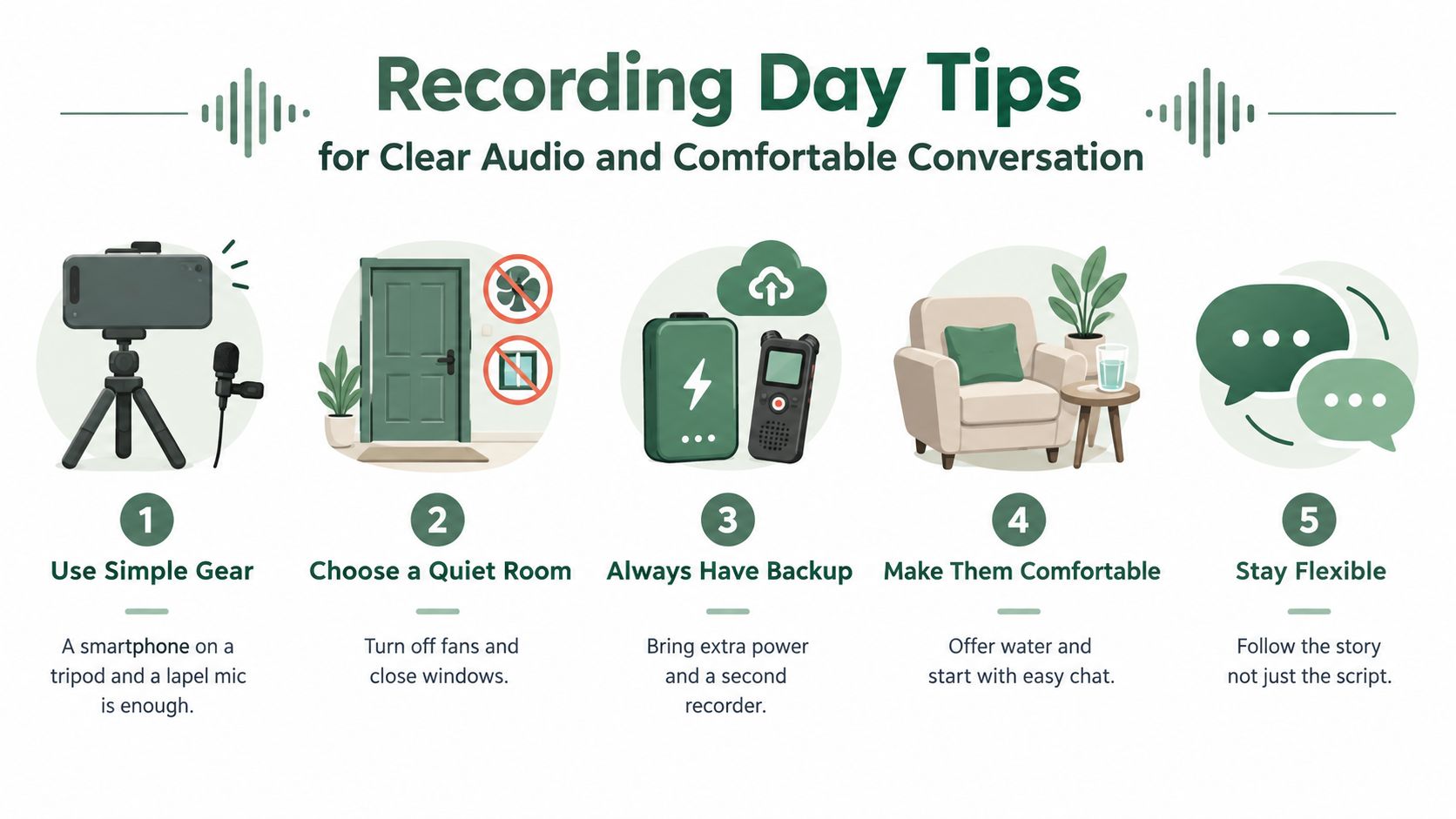
Recording quality depends less on expensive equipment than on distance, quiet, power, and attention. A modern smartphone can work well when it's positioned correctly, but don't place it across the room on a coffee table and expect a clean result.
Use a stable stand and, if possible, a compatible lapel microphone or small external microphone. Put the recording device where it can capture both voices without being handled. Silence notifications, close unnecessary applications, and keep the phone connected to power if the conversation may run long.
Make the room disappear
Turn off fans, televisions, radios, and noisy appliances. Close windows if outside sound is intrusive, but avoid creating an uncomfortable room for the recording. Soft furnishings usually produce a more pleasant sound than a bare kitchen with hard, reflective surfaces.
Create a backup before you begin. A second phone or recorder in the room can protect the conversation if the primary device fails. Confirm battery, free storage, and recording settings, then make a short test and listen to it with headphones. A backup is valuable only if it is recording.
Begin with a spoken introduction. State your name, the narrator's name, the date, the location, and the purpose of the interview. Ask the narrator to confirm that they understand and consent to being recorded. This simple opening gives future listeners essential context and makes the file easier to identify.
Protect the narrator's energy
Start with ordinary conversation before the first formal question. Offer water, check that the chair is comfortable, and explain that the recording can be paused at any time. Watch for shorter answers, repeated phrases, changes in breathing, or visible discomfort. These signs matter more than completing your question list.
Let the narrator set the pace. If a memory gap appears, offer a photograph or a neutral prompt, not a leading answer. If a story becomes emotional, lower your voice, stop taking notes for a moment, and ask whether they'd like to continue.
The best recording day may end with unanswered questions. A comfortable narrator is more important than a completed checklist.
Don't fill every pause with encouragement sounds such as “uh-huh” or “mm-hmm”. Nod instead, and keep your hands still because pens, bracelets, and furniture movement can become surprisingly prominent in audio. The practical guidance on recording life-story audio is a useful reminder that the room and the relationship shape the recording as much as the device does.
From Recording to Lasting Legacy With Transcription and Archiving
The interview becomes a family record through the work that follows. Identify the recording, protect the original, document permissions, and make the material easy to find before memories about the session fade.
Create a master copy of the original audio and leave it untouched. Make working copies for noise reduction, excerpts, or family videos. Use a consistent filename containing the narrator's name, subject, and recording date. Keep a short log of the location, participants, topics, interruptions, and any passages the narrator asked you not to share.
Treat transcription as part of preservation
A transcript makes names and places searchable, supports relatives who prefer reading, and lets you check whether an important passage has been represented accurately. Automatic transcription can reduce routine typing, but family names, dialects, overlapping speech, and emotional pauses still require human review.
Plan for the labor. Methodological guidance commonly estimates that transcribing one hour of oral history audio takes about four hours of work, while interviews are often planned at one to two hours. Guidance on oral history transcription and interview planning provides a distinct reference for these commonly used estimates. If you use an automatic tool, keep the original audio and label the transcript as reviewed, partially reviewed, or unreviewed.
Add context before you share
Record the narrator's preferred name, relationships, places, occupations, and recurring terms. Keep editorial notes separate from the narrator's words. If a date remains uncertain, mark it as approximate rather than correcting the transcript.
A family platform such as remembers.life can bring together a person's timeline, names, photographs, stories, milestones, voice recordings, and automatic transcription. This gives relatives more context than an unlabeled file stored on one person's computer. The family still decides what the narrator has approved for sharing and who can access it. For a readable keepsake, guidance on turning recorded memories into life-story writing can help shape the material while preserving the original voice.
Choose a preservation route
| Option | Best For | Effort Level | Longevity |
|---|---|---|---|
| Original audio plus local copies | Families that want a simple master archive | Low | Depends on regular migration and backup |
| Audio with a reviewed transcript | Relatives who want to search and read | Moderate | Stronger when files and context stay together |
| Private family timeline | Stories connected to photographs, people, and milestones | Moderate | Depends on account access and continued maintenance |
| Edited audio excerpts | Sharing a focused memory at a family gathering | Moderate | Good for access, not a replacement for the master |
| Institutional deposit | Material intended for wider historical research | High | Requires permissions, standards, and submission work |
Keep copies in more than one safe place, and tell another trusted family member where the archive is stored. Review access permissions as family circumstances change. Preservation is a continuing habit of care, not a single upload.
Your Next Oral History Interview Starts With One Conversation
Perfectionism is one of the quietest ways family stories disappear. People wait for better equipment, a complete family tree, the right anniversary, or a weekend with nothing else planned. Meanwhile, an older relative may become less able to speak for long periods, or the details you meant to ask about may become harder to reach.
A useful oral history interview doesn't require a professional archive, a flawless chronology, or a narrator who remembers every date. It requires attention, consent, patience, and a reliable way to keep what was shared. A memory gap isn't a failed interview. A pause isn't wasted time. Sometimes the most valuable material is the explanation of why one event is remembered clearly and another remains uncertain.
Use a simple seven-day start
Give yourself a small assignment:
- Choose one person who is willing to talk.
- Schedule one hour at a time when they feel rested.
- Prepare five prompts about home, work, relationships, change, and tradition.
- Gather a few photographs or documents that may help the conversation.
- Test your recording setup in the room where you'll sit.
- Record the introduction and conversation without trying to cover everything.
- Save, label, and back up the file while the details are still fresh.
The first session may reveal what deserves a second conversation. That is a strength, not a problem. Repeated, shorter sessions often give older narrators more space to rest and return to a subject with new associations.
Your family doesn't need a perfect documentary. It needs a living record that keeps a voice attached to a name, a face attached to a place, and a story available to people who haven't been born yet. Begin with the question you've been meaning to ask, then listen long enough for the answer to become a story.
remembers.life gives families a place to organize names, photographs, stories, milestones, voice recordings, and searchable automatic transcriptions in a person's timeline. Start preserving your next oral history interview by visiting remembers.life, choosing one narrator, and creating a record future generations can return to.