Family History Documentation: A Guide for 2026
Learn how family history documentation can preserve your stories for future generations. Discover practical tips and tools to get started.
You're sorting through a box of photographs when your mother pauses over one image and names everyone except a child standing at the edge. She remembers the dress, the weather, and the argument that happened before the picture was taken, but she can't recall the child's name. You mean to ask later. Later, the detail is gone.
Family history documentation begins in moments like this. It isn't only about tracing ancestors through databases or assembling an impressive family tree. It's the practical work of preserving voices, relationships, decisions, places, and ordinary experiences before memory and context disappear. A useful system lets you act now, even if you never complete every branch of your family tree.
Table of Contents
- Why Preserving Family Stories Matters More Than Ever
- Planning Your Family History Documentation Project
- Conducting Meaningful Family History Interviews
- Choosing the Right Recording Formats and Tools
- Organizing and Preserving Your Family Archives
- Sharing Family Stories with Future Generations
- Overcoming Common Family History Documentation Challenges
Why Preserving Family Stories Matters More Than Ever
At a family gathering, an older relative may be the only person who can explain why a photograph was taken, how the family reached a particular town, which recipe belonged to a celebration, or why two relatives stopped speaking. Once that explanation is lost, the photograph survives, but much of its meaning disappears with it.
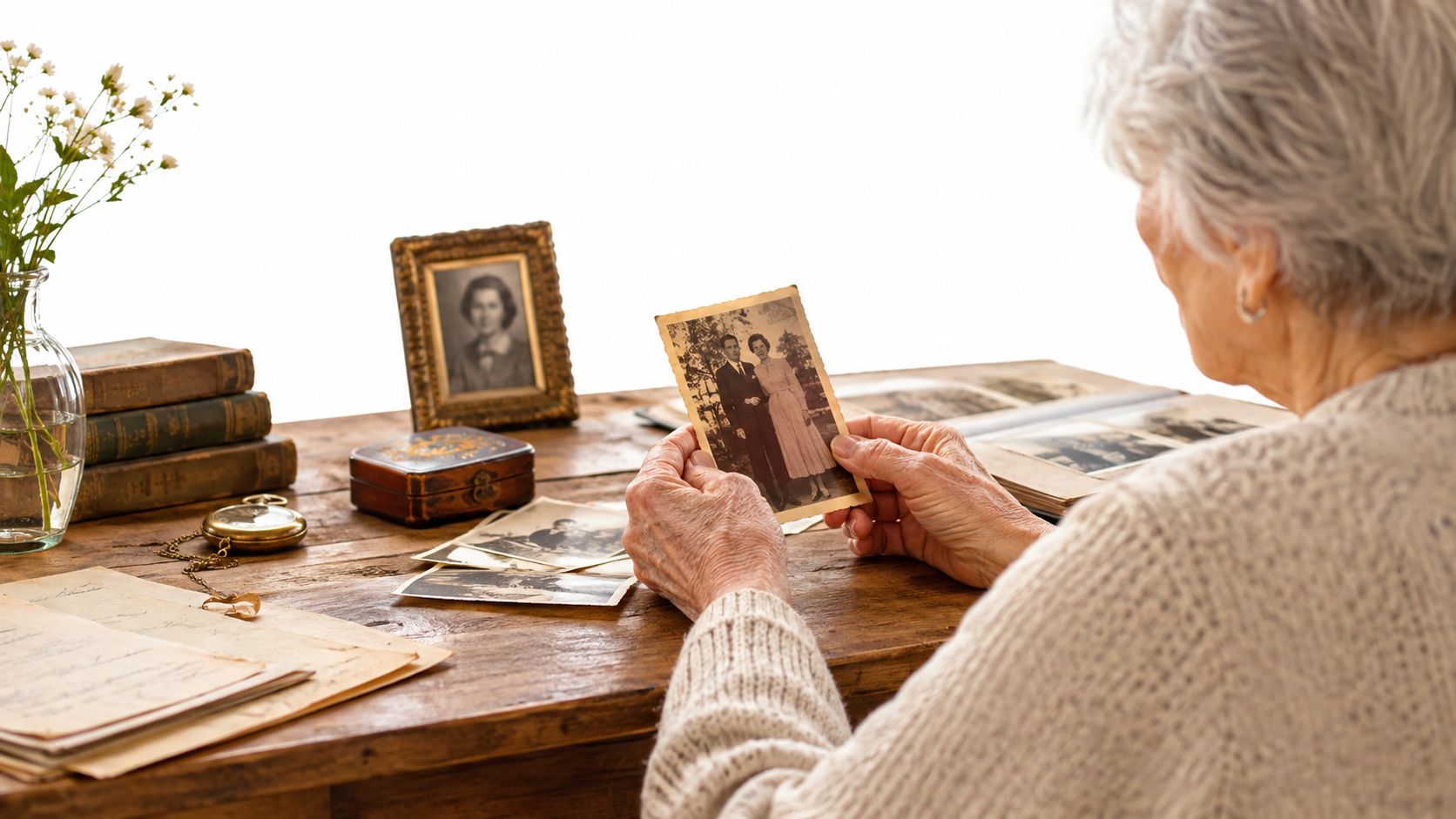
The scale of modern family-history services shows how much information families are trying to preserve. FamilySearch's 2025 report describes more than 297 million website visits, records from more than 170 countries and principalities, and the addition of more than 2.2 billion searchable names and images in one year, bringing its total to more than 22.7 billion records (FamilySearch's 2025 report). Your family does not need a project of that scale. The figures show that preserving identity, relationships, and personal evidence has become a substantial international effort.
Ordinary lives deserve careful records
Famous families rarely have a monopoly on meaningful history. Future relatives often want the details that seem too ordinary to document: how someone found work, what a first home looked like, which relatives provided help, what played in the kitchen, or how the family managed a difficult move.
These details give names and dates human meaning. A birth record establishes when someone entered the world, while an interview may reveal who waited outside the hospital, what the family feared, and what changed afterward. Documentation preserves context, not just evidence.
Family information also becomes fragile when people rely on memory without a consistent place to record it. Research involving 29,276 patients found family history information in clinical notes for 90.3% of patients, while 99.8% had information in a patient-provided intake form (clinical research on family history documentation). In a family archive, the same gap appears when everyone remembers a story but nobody writes it down. The practical equivalent of an intake form is a shared list of names, dates, photographs, and unanswered questions prepared before the next visit or reunion.
Practical rule: Preserve the explanation beside the artifact. A photograph without names, place, date, and story is only partially preserved.
Start with what is within reach. Choose one relative, one box, or one family story. Record what you can identify, label what remains uncertain, and keep everything in a reliable place that another family member can find. A simple system used now will preserve more than an ambitious plan postponed indefinitely.
Planning Your Family History Documentation Project
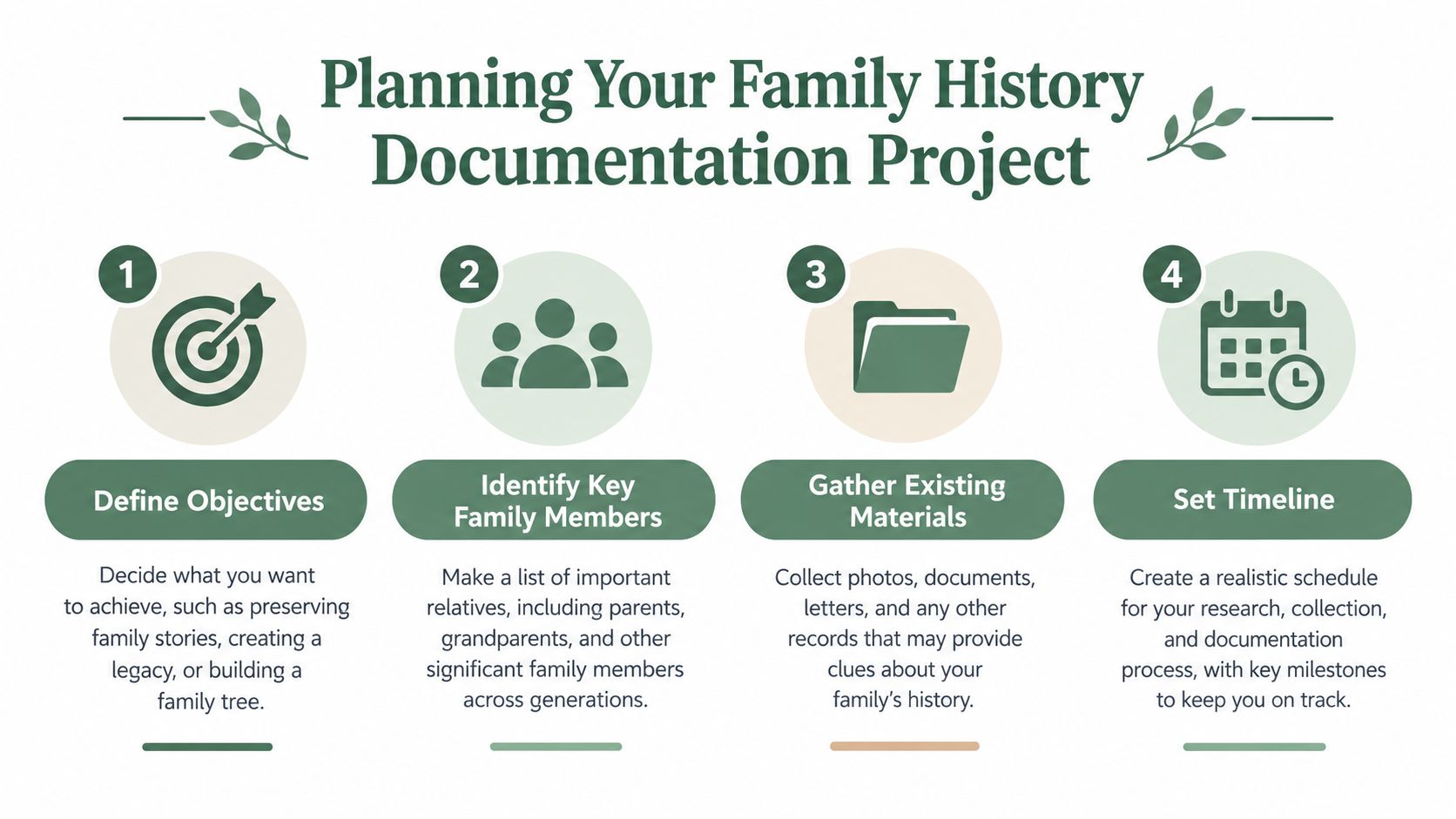
A successful project starts with a narrow promise you can keep. “Document the whole family” is too broad to guide action. “Record my father's memories of his first job and scan the photographs from that period” gives you a clear subject, a manageable collection, and an obvious first conversation.
Begin by writing down what you want the archive to do. You might want to preserve oral history, identify people in photographs, document migration, create a health-related family record, or leave children and grandchildren a coherent account of their background. These objectives can coexist, but they shouldn't compete for attention during the first stage.
Start with people and materials
Prioritize relatives who hold memories that aren't written elsewhere, especially people who can explain older photographs, family relationships, cultural practices, or major changes in location and work. Don't treat age as the only criterion. A younger relative may be the person who understands a community's traditions, digitized a collection, or knows the history of a branch that older records overlook.
Before arranging interviews, gather the material you already have:
- Photographs: Put unidentified images in a temporary folder or envelope, and don't write directly on originals.
- Papers: Collect letters, certificates, diaries, newspaper clippings, recipes, school records, and military documents.
- Objects: Note who owned jewelry, tools, clothing, instruments, furniture, or religious items.
- Digital files: Search old phones, computers, memory cards, email accounts, and shared folders.
- Names and questions: Create a list of people, places, nicknames, and mysteries that need clarification.
A simple relationship chart will prevent confusion. A family tree and pedigree guide can help you map parents, children, siblings, partnerships, and step-relations without forcing uncertain information into a finished tree.
Set a working rhythm
Choose a rhythm that fits your actual life. One scheduled conversation, one scanning session, or one evening of labeling can maintain momentum. The project should survive busy periods, travel, illness, and family obligations, so avoid a plan that depends on constant enthusiasm.
Make a basic inventory with columns for item, owner, people shown, date, place, format, condition, source, privacy level, and next action. This turns a vague collection into a series of decisions. Set aside sensitive material for separate review rather than publishing it automatically.
The best budget is the one that removes a specific obstacle. You may need a phone stand, an external microphone, archival folders, a scanner, or professional conversion for obsolete media. Don't buy everything before you know what you have. First identify the material most at risk and the conversations most likely to be lost.
Conducting Meaningful Family History Interviews
A relative may agree to talk, then tire quickly once the questions begin. A useful interview respects that limit. Prepare enough to give the conversation direction, then leave room for memories to take an unexpected path.
Before meeting, send a short explanation of what you hope to discuss, how you will record it, who may hear it, and whether the speaker can pause, correct, or remove material. Choose a familiar room with comfortable seating and little background noise. If the person tires easily, schedule several shorter conversations instead of one demanding session.
Ask for scenes, not summaries
Closed questions often produce brief answers. Open prompts help the speaker recall places, routines, relationships, and sensory details.
Try questions such as:
- “What did a normal weekday look like in that house?”
- “Who lived nearby, and how did people help one another?”
- “What happened just before the family moved?”
- “Which traditions did you keep, and which did you change?”
- “What did you expect your working life to be like?”
- “Who taught you that skill?”
- “What do people usually misunderstand about that period?”
- “What would you want a grandchild to know about it?”
If a relative says, “We were poor,” ask what that meant in everyday life. Did the family share rooms, grow food, repair clothing, borrow tools, or move frequently? Follow-up questions turn a broad label into an account that future readers can understand.
A self-administered questionnaire can help a relative gather thoughts before the conversation. Clinical guidance recommends collecting information before the visit, refining it through an interview, and recording a three-generation pedigree. That approach also suits personal archives. Give the participant private preparation time, then use the interview to clarify names, dates, relationships, and meaning (clinical family-history documentation guidance).
Protect trust when memories conflict
Memory is not a courtroom transcript. Two relatives may describe the same event differently, and both accounts may hold important truth. Record who told you each detail, preserve uncertainty, and avoid combining conflicting versions into one polished account.
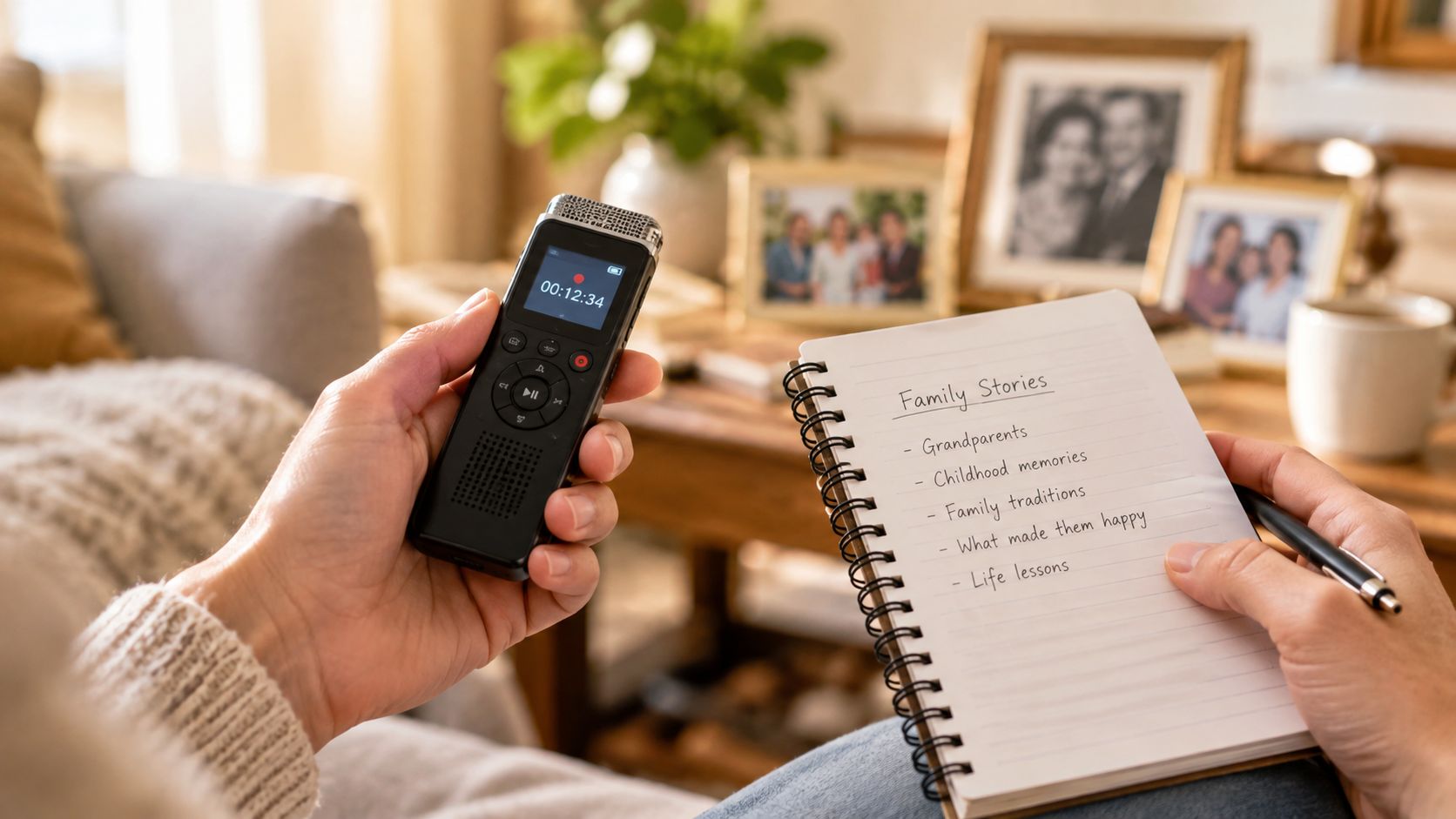
Listen actively. Keep your phone or notebook from becoming a barrier, allow pauses, and repeat names or places for confirmation. Emotional moments need space. Ask whether the person wants to continue, take a break, or change subjects.
A recording is not permission. Ask before recording, explain how the file will be stored, and agree on who may access sensitive stories.
Documentation can take longer than expected. One study found that entering family history information averaged 15 minutes, with a range from 3 to 45 minutes, depending on the situation (research on family history documentation time). For family storytelling, allow time for introductions, recollection, clarification, and decompression. A middle-aged organizer with limited evenings will preserve more by planning a manageable series of conversations than by waiting for a full day of uninterrupted research.
This recording of a family interview shows how a quiet room and an unhurried pace keep the speaker talking freely. Use it as a reference for setup rather than a format to copy. The most useful recording is one in which the person feels comfortable and can be understood later.
Choosing the Right Recording Formats and Tools
The right format depends on the person, the setting, and how the archive will be used. A technically advanced recording that makes someone self-conscious can be worse than a simple, clear conversation captured on a familiar device.
| Format | Best suited to | Main advantage | Main trade-off |
|---|---|---|---|
| Smartphone audio | Informal interviews and quick recollections | Familiar, accessible, easy to share | Handling noise and inconsistent placement can reduce clarity |
| Dedicated audio recorder | Planned interviews and archival voice capture | Consistent sound and physical controls | Requires preparation, file transfer, and charging |
| Video | Demonstrations, gestures, objects, and expressive storytelling | Preserves voice, appearance, movement, and surroundings | Lighting, framing, privacy, and file size require more care |
| Written notes | Sensitive conversations or situations where recording feels intrusive | Low technical barrier and easy annotation | Tone, pauses, and exact wording are lost |
A smartphone often works well if you place it on a stable surface close to the speaker, silence notifications, and make a short test recording. Don't hold it in your hand throughout the conversation. Movement creates handling noise and distracts both people.
For audio, a dedicated recorder with an external microphone can improve consistency in a quiet room. Ask the speaker to state their name, the date, the location, and the subject at the beginning. That spoken identification remains connected to the file even if the file is later separated from your notes.
Choose video for meaning, not decoration
Video earns its complexity when appearance or movement carries information. Record someone demonstrating a family recipe, showing how a tool was used, identifying a scene, or explaining an item they inherited. Position the camera at eye level, keep the background uncluttered, and check that the face isn't backlit by a window.
Written notes still have an important role. Use them to capture names, spellings, emotional reactions, follow-up questions, and references to documents. If a relative refuses recording, respect that decision and write a careful account afterward, clearly marking what is remembered and what is your interpretation.
For a more focused approach to voice-based memories, use this guide to recording life stories as audio. The essential standard is not studio polish. It's intelligibility, consent, accurate context, and a file that can be opened again.
Build preservation into the first recording
Create a consistent file format and naming system from the start. A name such as 2026-09-25_Smith-Eleanor_Childhood-interview_audio tells you when, who, what, and how the file should be understood. Keep an untouched original, then make a working copy for trimming or transcription.
Store recordings in more than one place, including a local copy and a separate backup. Don't rely on a single cloud account, phone, memory card, or family member's laptop. Before sharing, remove details that the speaker asked you to keep private and record any access restrictions in your archive notes.
Organizing and Preserving Your Family Archives
Organization should answer a future question quickly: “Where is the recording in which Aunt Elena explains this photograph?” If your system only makes sense to you today, it isn't finished. Another relative should be able to understand the folder names, file labels, and basic rules without needing a personal tutorial.
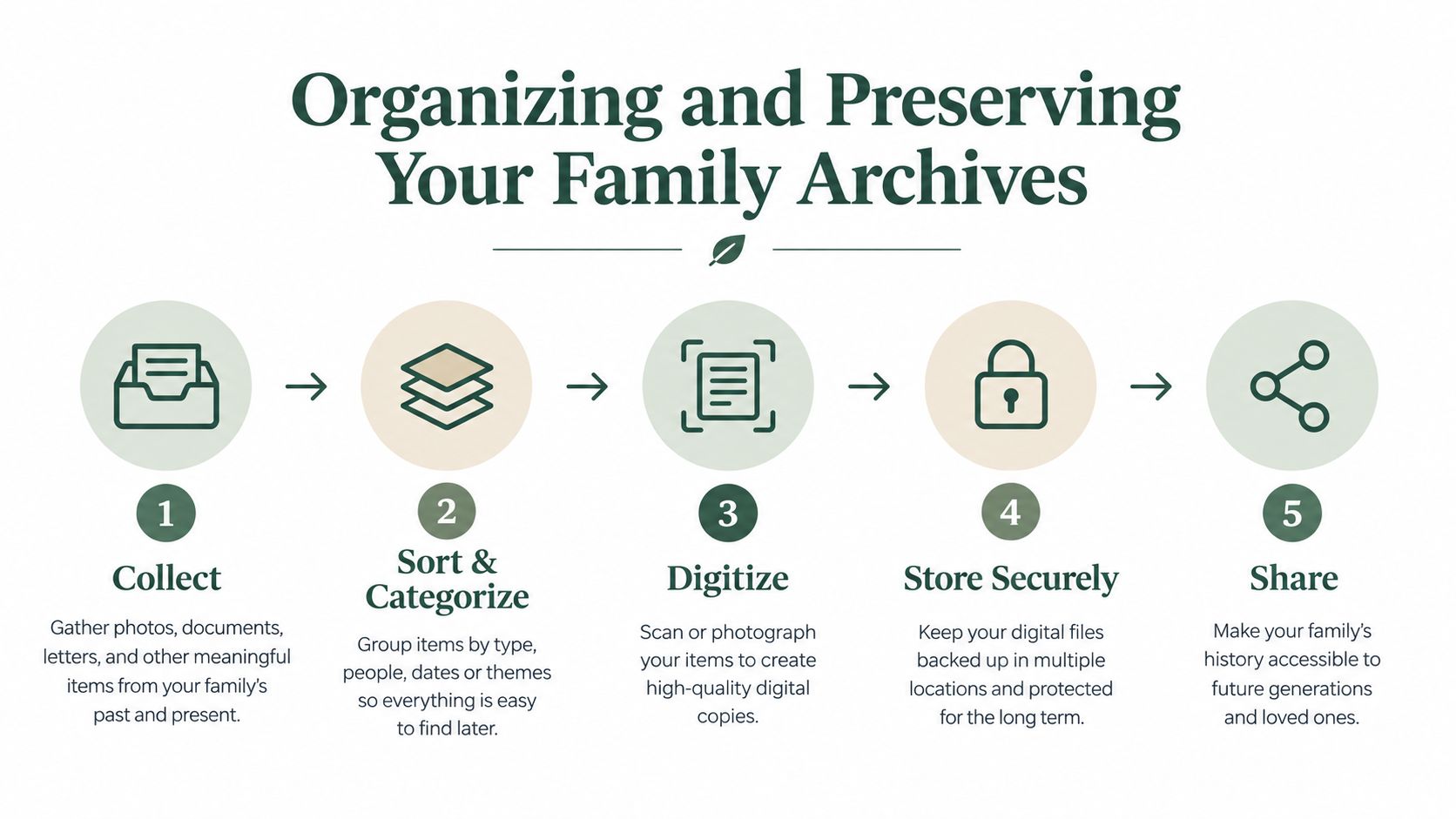
Begin with an intake area. Every new photograph, scan, recording, and document goes into one temporary location before you sort it. This prevents files from disappearing across random desktop folders and gives you a clear boundary between unprocessed material and preserved material.
Use a system that records context
A practical folder structure might look like this:
01_Administration02_Photos03_Documents04_Audio05_Video06_Research07_Transcripts08_Backups09_Sharing-copies
Within each folder, use consistent names. Include the date when known, the main person or family group, a short description, and the source. For uncertain dates, use a note such as circa in your catalog rather than inventing precision.
A separate catalog can hold information that doesn't belong in the filename. Record who supplied the item, what they said about it, the original location, restrictions, technical details, and related files. If a document concerns several people, don't make multiple ambiguous copies. Keep one master file and list all connected people in the catalog.
The family photo organization guide can help you turn a mixed collection into labeled groups without discarding originals.
Digitize carefully and preserve the originals
Scan photographs, letters, certificates, and clippings at a quality appropriate to the material and your intended use. Keep a high-quality master and create smaller access copies for email, phones, or presentations. Don't edit the only copy. Cropping, color correction, and restoration should happen on a duplicate.
Digitization improves access but doesn't replace the physical artifact. Digital files can become unreadable, storage devices can fail, and services can change or disappear. Keep important originals in stable, protective materials away from direct light, damp areas, extreme heat, and poorly controlled storage spaces. Handle photographs and papers with clean, dry hands, and avoid aggressive cleaning.
Make backups understandable
A backup is only useful if someone can identify it and restore it. Keep copies in separate locations, check that files open, and document the software or device needed for unusual formats. Review the archive periodically and migrate important material when a format or storage method becomes difficult to access.
You can also create a physical finding aid. A printed inventory stored with the collection tells relatives what exists, who contributed it, and where digital copies are held. Sharing isn't the last step of preservation. It's a test of whether your system is usable by someone else.
Sharing Family Stories with Future Generations
An archive that nobody can access becomes a private storage problem. Sharing gives family history a social life, but it doesn't require publishing every detail or producing a formal book. The right format depends on the audience, the material, and the level of privacy the family has agreed to.
Children may connect with a short illustrated story about a great-grandparent's home, favorite activity, or journey. Teenagers may respond to scanned photographs, short audio excerpts, or a map with recorded explanations. Adults may value a carefully sourced narrative, a collection of interviews, or a searchable archive with documents attached.
Give each story a clear shape
A useful family story usually needs more than a name and date. Add the setting, the people involved, the problem or decision, what happened, and why the memory matters. Keep the narrator visible. “Grandmother lived in the village” is a fact. “She walked to the market before sunrise because the family depended on what she could sell” gives the fact human significance, provided the narrator or source supports it.
A family history book, private digital album, audio collection, or small website can all work. Choose one format that your relatives will open. The guide to writing family history can help you turn notes and interviews into readable chapters without flattening uncertainty or disagreement.
Invite participation instead of assigning an audience
Ask relatives to identify photographs, add memories, correct names, or contribute their own recordings. A shared process often reveals details that one researcher would miss. It also gives younger family members a practical role, such as scanning, editing transcripts, designing a book, or interviewing someone about a skill.
Digital legacy planning belongs in the same conversation. Families increasingly keep photographs, stories, scans, and voice or video memories in cloud services, yet ownership, access, and transfer are often unclear. Guidance on the genealogy and information technology market highlights the overlap between family history, cloud storage, mobile access, sharing, privacy, and incomplete records.
Decide who may see each item, who may manage the archive if you're unavailable, and how relatives can obtain copies. A private family room, a printed book, or a designated archive steward can each be appropriate. The important decision is deliberate access, not accidental exposure.
Overcoming Common Family History Documentation Challenges
Most family history projects don't fail because the researcher lacks curiosity. They stall because the work has no boundary, the family disagrees about privacy, or the person with the memories keeps being asked to “find a time” without a specific invitation.
Start with the smallest useful outcome. A single recorded conversation, a labeled photograph folder, or an inventory of inherited documents creates a result you can protect. Once that exists, you can decide what deserves the next session.
When time is the main obstacle
Use a short recurring appointment rather than waiting for a free weekend. Prepare questions in advance, send photographs before the conversation, and end while the person still has energy. If you can't meet, invite an audio message, written response, or photograph identification by email.
Keep a task list divided into capture, describe, preserve, and share. This prevents research from consuming all available time. Endless searching can feel productive while leaving the family's living memories unrecorded.
Capture first, investigate second. A remembered story can disappear before a missing certificate is ever found.
When records are missing or destroyed, don't treat the absence of official evidence as the absence of family history. Oral testimony, letters, photographs, school materials, religious records, community references, workplace documents, and carefully attributed recollections can help establish identity and relationships. Families whose records were erased, misclassified, never created, or made inaccessible need preservation methods that value testimony and surrogate evidence, not only searchable databases. The discussion of preserving truth when records are lost or erased addresses this overlooked reality.
When relatives disagree or decline
A relative can refuse an interview, restrict access, or ask you not to share a story. Respect that boundary. You can preserve a private note that a conversation was declined, but you shouldn't pressure someone into becoming a source.
Conflicting accounts deserve labels, not forced resolution. Record each version with the speaker, date, and context. Distinguish “Mara remembers” from “the birth record states” and from “this remains uncertain.” That habit protects trust and makes the archive more honest.
Sensitive subjects require particular care. Ask what the person wants recorded, offer to stop, and avoid turning trauma into a dramatic centerpiece. Some stories should remain restricted until specified relatives agree otherwise. A family archive can acknowledge silence without demanding disclosure.
When distance complicates participation
Remote interviews work when you reduce technical demands. Test the connection, use headphones if they improve clarity, and send a photograph or topic in advance. For relatives who dislike live calls, create an asynchronous exchange. You can send a question, receive a voice message, ask one follow-up, and file the result with its context.
A shared archive should include simple contribution rules. Ask contributors to name people and places, identify whether a statement is firsthand, and avoid uploading private material without consent. If you use a platform such as remembers.life, it can hold a loved one's biography, photographs, milestones, stories, video clips, and voice recordings in a timeline, invite family contributions in a shared family room, transcribe recordings, and provide an AI chat feature that answers from the saved family content. Treat any platform as one part of the preservation system, and retain independent copies of important files.
Keep the project alive
Mark progress visibly. Finish a small collection, send a recording to the people who contributed, or hold a family listening session. Invite someone else to take responsibility for the next piece so the archive doesn't depend on one exhausted organizer.
High-quality documentation also depends on asking precise questions. Clinical genetics guidance recommends a three-generation pedigree that records birth information, death details, disease status, diagnosis or onset, ancestry, and relevant family circumstances. In one oncology quality study, documentation included first-degree relatives with cancer in 77.4% of records, second-degree relatives in 61.5%, and age at diagnosis for all relatives with cancer in only 30.7% of records (oncology documentation quality study). The practical lesson applies to personal archives: use prompts, identify sources, and don't assume that an important detail will appear without being requested.
You don't have to finish your family history. You need to leave a trustworthy trail that others can continue.
remembers.life helps families create memory profiles with biographies, photographs, stories, milestones, voice recordings, and video clips, while inviting relatives to contribute to a shared family archive. Visit remembers.life to start preserving one person's story and turn today's conversation into a record future generations can use.