Memoir Discussion Questions: 8 Prompts That Work
Explore 8 memoir discussion questions and prompts to spark family stories, record memories, and start meaningful memoir conversations today.
You're sitting beside a parent with an old photograph between you. They name the people in it, mention a house you've never seen, then move on. You know there's a story there, but “Tell me about your life” feels too big, and you don't want the conversation to feel like an interview.
Great memoirs rarely start with dates. They start with a thoughtful question, a quiet room, and someone ready to listen. Memoir discussion questions give you a manageable starting point, whether you're collecting family memories, drafting your own memoir, or helping someone describe what they want future generations to understand.
Choose a framework by the kind of conversation you want:
- Casual family chats: Try StoryCorps-style questions, photo-led reminiscence, or a Proust-inspired character portrait.
- Structured memoir writing: Use life chapters, recurring writing prompts, or a service-history interview.
- Legacy preservation: Explore wishes, values, and letters intended for particular loved ones.
The questions below are suggested adaptations, not quotations from official questionnaires. They offer practical ways to begin without implying that every framework has been individually proven to produce a particular result.
Ask permission before recording, and let the storyteller decide what stays private. A useful keepsake doesn't need to contain everything. It needs to preserve something meaningful in the person's own voice.
Table of Contents
- 1. StoryCorps Great Questions
- 2. Life Story Interview Framework
- 3. Life Review Reminiscence Prompts
- 4. The Conversation Project Starter Kit
- 5. StoryWorth Weekly Prompts
- 6. Veterans History Project Interview Guide
- 7. Proust Questionnaire
- 8. Ethical Will and Legacy Letter Prompts
- Memoir Discussion Questions: 8-Point Comparison Guide
- Turn Your Conversations Into a Lasting Keepsake
1. StoryCorps Great Questions
Best for a relaxed conversation between people who know each other. Use this approach when you want stories about relationships, everyday life, and turning points rather than a recital of dates.
At a holiday gathering, for example, you might invite your mother into a quieter room and ask about someone who made her feel welcome when she was young. That gives her a person and a situation to describe, without requiring her to summarize her childhood.
The underlying interviewing technique matters more than an impressive question list. Montana State University's oral-history interviewing guidance recommends open-ended prompts, a flexible chronological framework, and focused follow-ups rather than leading or multipart questions.
Ask for a scene, then follow it
Try these original prompts separately:
- A relationship: Tell me about someone who understood you when you were young.
- An everyday memory: Describe an ordinary evening in the home where you grew up.
- A turning point: What happened that changed the direction of your life?
Follow the answer rather than jumping to your next prepared topic. Ask who else was there, what happened next, or what the room looked like. Save interpretation for after the person has described the event.
Recording rule: Let the storyteller finish before filling a silence. You're collecting their account, not demonstrating how much you already know.
For more starting points, browse these questions to ask family and select the ones that fit your relationship.
Before recording, silence notifications and make a short audio test. Afterwards, label the file with the participants' names, the recording date, and a descriptive topic. Keep a transcript beside the original audio so future readers can find the story without losing the speaker's voice.
2. Life Story Interview Framework
A memoir draft can contain plenty of events and still leave its writer asking, “What holds this together?” A life-story interview offers a practical answer: organize experiences into chapters, then explore the scenes and decisions that give each chapter meaning.
For a McAdams-style adaptation, treat the following as original writing exercises rather than a reproduction of the named interview. Begin with the storyteller's own chapter titles, not categories imposed by a relative.
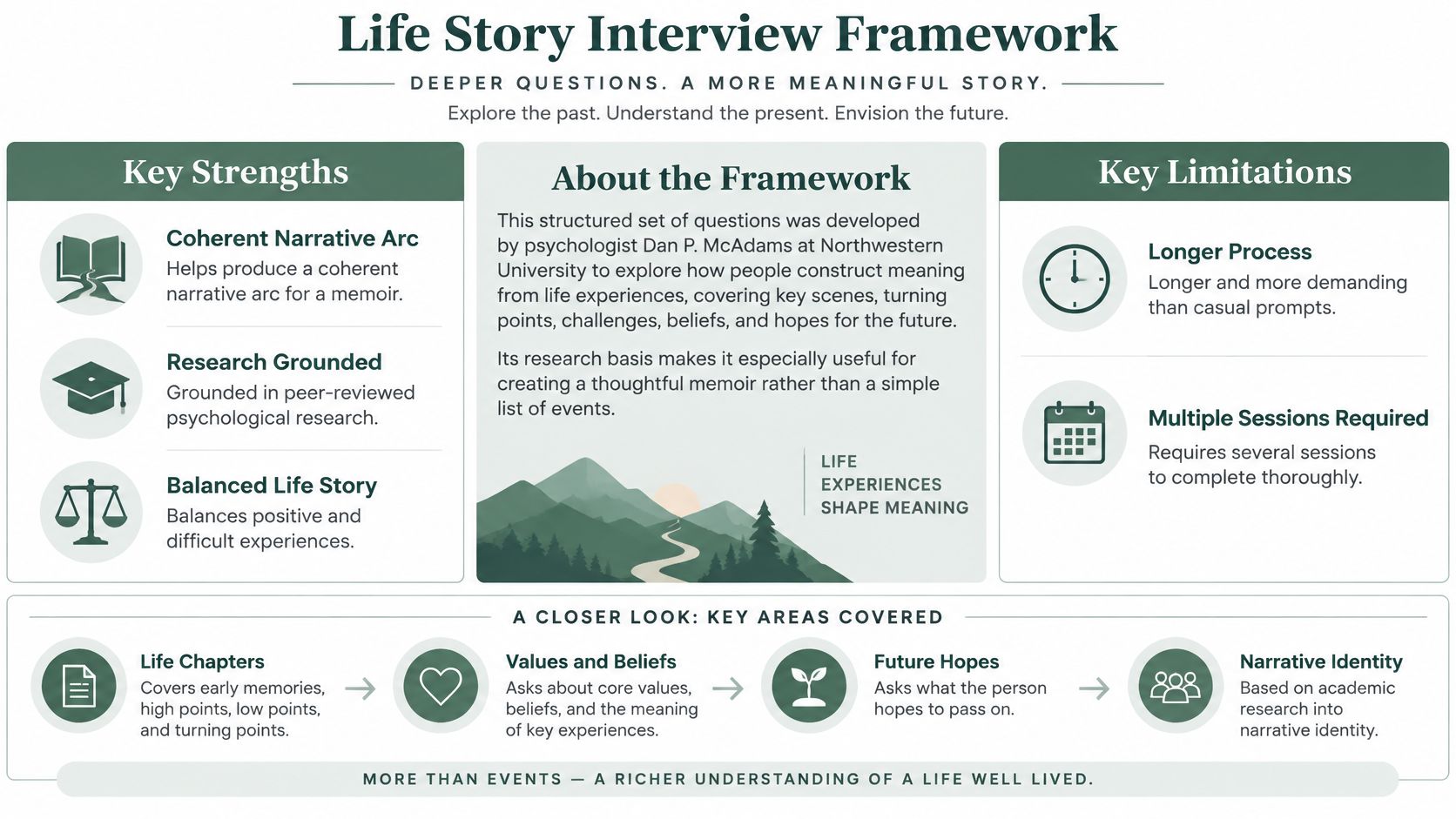
A retired teacher, for example, might call an early chapter “Learning to Speak Up” rather than “School Years.” That title gives you something specific to explore while leaving room for uncertainty or contradiction.
Build chapters around lived moments
- Name the chapter: What would you call this period of your life?
- Find its central scene: Which moment best represents that chapter?
- Explore its meaning: What do you understand about that experience now?
Keep the event and the later interpretation distinct. A person might remember feeling defeated at the time while now seeing the same experience as a change in direction. Preserve both perspectives rather than smoothing them into a tidy lesson.
A meta-analysis of controlled reminiscence studies found that life review had a greater effect on psychological well-being than simple reminiscence. That supports the distinction between recalling an event and considering its place in a life, but it doesn't establish results for this particular exercise.
Use an oral-history interview approach to gather the raw material. Then create a chapter outline, placing recordings, photographs, and draft passages under the storyteller's chosen headings.
3. Life Review Reminiscence Prompts
Bring out a photograph, a familiar recipe, or an object with a story attached. Instead of asking someone to search their entire past, invite them to begin with what's in front of them.
Reminiscence means recalling experiences. Life review adds reflection about how those experiences connect with relationships, identity, and meaning. A photograph-led conversation can include both, but there's no need to force a lesson from every memory.

A family caregiver might bring a parent's old mixing bowl to a visit and ask what they remember making in it. If the conversation moves from cooking to a neighbor who regularly came for supper, follow that connection.
Let the object open the conversation
- Begin with recognition: What do you remember about this?
- Invite sensory detail: What sounds or smells belong to that memory?
- Offer reflection: What does that part of your life mean to you now?
A systematic review of life-review and reminiscence interventions synthesized 32 studies incorporating 37 randomized controlled trials and 2,353 older adults, finding significant improvements in quality of life and life satisfaction compared with control conditions. Those findings concern structured interventions, not a guarantee that an informal family conversation will produce the same benefits.
Keep the conversation comfortable and let the person choose where to go. If they can't recall a name, don't turn the visit into a test.
Use these simple life-review ideas to prepare an invitation rather than a rigid agenda. Photograph the object, record its owner's explanation with permission, and mark uncertain names or dates as uncertain in your notes.
4. The Conversation Project Starter Kit
Best for discussing what matters when care, illness, or the future feels difficult to talk about. For a Conversation Project-inspired session, keep two purposes separate: understanding someone's wishes and preserving their personal story.
The sample questions below are original suggestions, not wording from the official Starter Kit. If you're using the kit itself, consult its current materials rather than treating a memoir adaptation as a substitute.
A daughter and father might begin at the kitchen table with memories of what has made home feel safe. Only with his agreement would they move toward what comfort and support should look like if he becomes unwell.
- Start with daily life: What makes a day feel worthwhile to you?
- Explore support: What would you want us to understand when helping you?
- Clarify privacy: Which parts of this conversation may I write down?
Don't assume that permission to discuss a preference includes permission to publish it in a family keepsake. Ask separately about recording, storage, and sharing.
A meaningful answer can belong in a private care conversation without belonging in the family memoir.
Research on reminiscence interventions for loneliness found that format and facilitation mattered, with stronger effects in professionally facilitated and group-based sessions. It doesn't establish benefits for this starter-kit adaptation or justify pressing a relative into deeper disclosure.
Keep practical care notes distinct from edited stories. Record when the conversation happened, ask what the person wants reviewed later, and don't treat a memoir transcript as a replacement for appropriate medical or legal documentation.
5. StoryWorth Weekly Prompts
A blank document titled “My Life Story” can feel like homework. A recurring question about a particular experience gives the writer a smaller task: describe this meal, this friendship, this decision.
For a StoryWorth-style writing rhythm, focus on the recurring-prompt method rather than assuming particular subscription features, response formats, or book options. Check the service's current details separately if you're considering it.

A grandparent who enjoys writing might start with a recipe they've made for years. Their first response could describe ingredients; a personal follow-up can invite the people, occasions, and small mishaps surrounding the dish.
Turn a short answer into a complete memory
Begin with “Which meal reminds you of home?” After reading the response, ask about the person who prepared it or a particular occasion when it was served. Don't send every follow-up at once.
- Make room for preference: Offer a choice of topics instead of assigning an uncomfortable memory.
- Keep the original: Save the unedited response before correcting spelling or arranging paragraphs.
- Add context: Attach a recipe card or photograph and identify its connection to the story.
Use story prompts for adults when the writer wants a different direction. A question about work may suit them better than a question about childhood.
Choose a regular writing time, but don't turn a missed response into a failure. When several answers are ready, arrange them by theme and let the writer approve the sequence. Keep a digital master alongside any printed keepsake, including captions and permission notes.
6. Veterans History Project Interview Guide
“What did you do during the war?” may be much broader than a relative wants to answer. For a Veterans History Project-style interview, begin with the person's life around service rather than expecting an account centered on combat.
The framework below is a suggested family adaptation, not an official submission guide. If you intend to contribute material to the named project, verify its current eligibility, consent, recording, and submission requirements directly.
A granddaughter interviewing her grandfather could start with his home life before service. He may want to discuss training, friendships, daily routines, or returning home, and he should decide which experiences remain private.
Follow the person's chosen boundaries
- Before service: What was your daily life like before you joined?
- During service: Describe a routine you remember clearly.
- Returning home: What felt different when you came back?
Ask for basic identifying details with permission, including the name they want used and the service information they're comfortable recording. Where a date or place is uncertain, mark it for later checking rather than interrupting the story.
Permission before detail: Being willing to discuss service doesn't mean someone has agreed to describe danger, injury, loss, or other painful experiences.
Test the microphone before beginning and avoid talking over the answer. If distress emerges, stop recording and offer a choice: pause, change subjects, or finish for the day.
For preservation, keep the original audio, an approved transcript, and photographs with clear captions. Distinguish the veteran's account from later editorial notes so descendants can tell whose words they're reading.
7. Proust Questionnaire
Best for a character portrait rather than a chronological life story. A Proust-inspired questionnaire invites someone to describe what they admire, enjoy, fear, or value.
Use it as a light opening, not a test with answers that need defending. At a birthday gathering, relatives might respond to the same prompts individually, then choose which answers they want to share.
These are original adaptations rather than quotations from a historical questionnaire:
- Admiration: Which quality do you value most in a friend?
- Contentment: What does an enjoyable ordinary day look like for you?
- Identity: Which personal quality has stayed with you through change?
- Aspirations: What would you still like to learn?
A brief answer can become a doorway into a story. If someone values patience, ask them to describe a person who showed it. If they name gardening as a pleasure, invite them to recall a particular garden.
Compare answers without demanding agreement
An older relative may hope a story teaches a lesson while a younger listener finds a different meaning in it. Research on memories shared across generations found differences in how older and younger family members valued transmitted memories.
Ask what the storyteller hopes you'll understand, then explain what you heard. Leave room for clarification without insisting on a shared interpretation, especially around migration, religion, or family expectations.
Preserve the completed answers with a portrait and the recording date. If someone revisits the questions later, save the new responses beside the earlier version rather than replacing them. A change in outlook can belong in the record too.
8. Ethical Will and Legacy Letter Prompts
A legacy letter answers a different question from a conventional memoir: What do you want someone you love to carry forward? For an ethical-will-style exercise, focus on values, lessons, gratitude, and hopes rather than trying to summarize every event.
Keep this personal writing separate from documents addressing property or formal instructions. The prompts below are writing suggestions, not legal guidance.
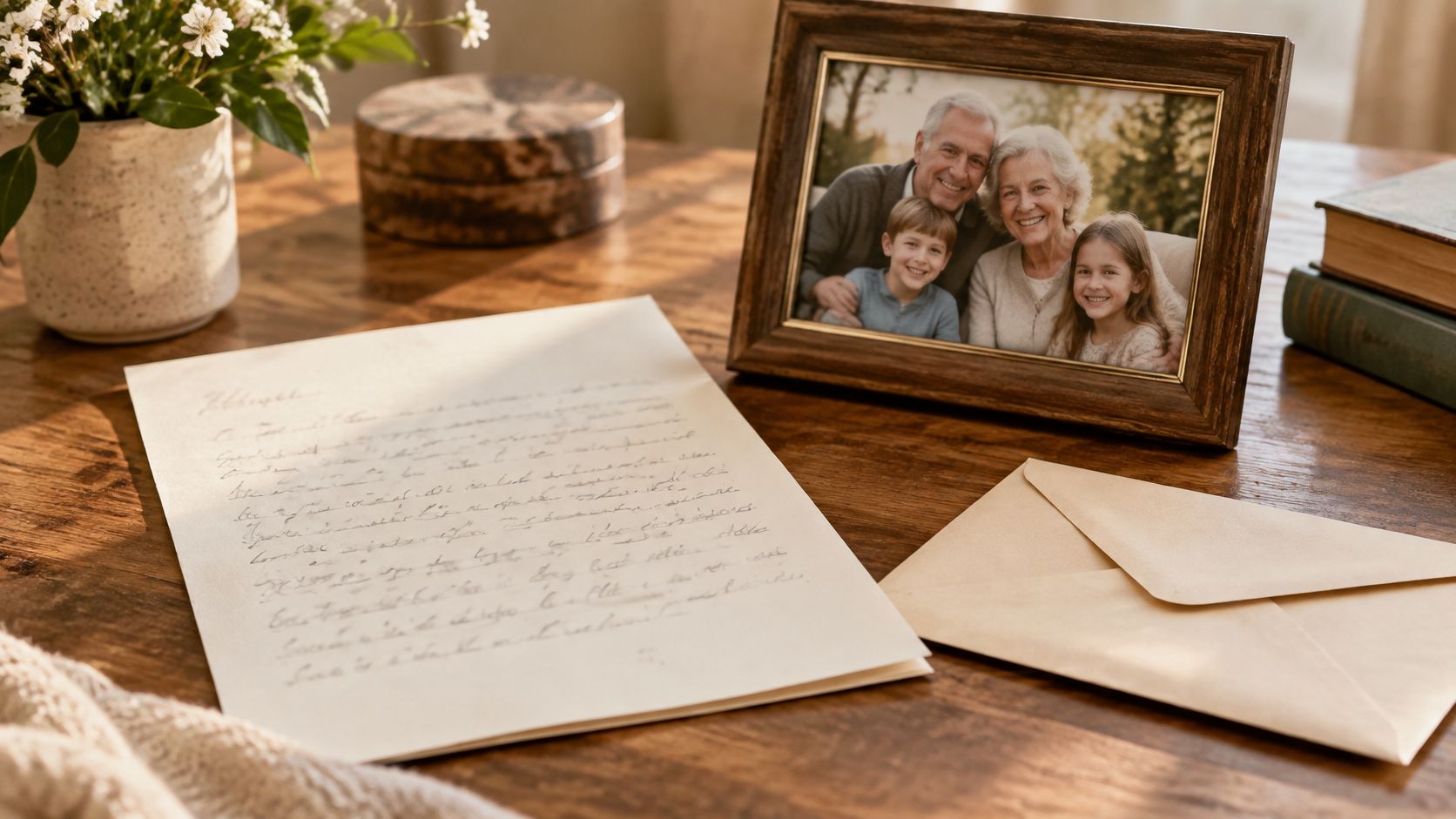
A parent writing to an adult child might begin with an ordinary memory of that child showing kindness. From there, the letter can explain why kindness matters to the writer, without becoming a list of instructions about how the child should live.
Pair each value with an experience
- A lesson: What did you learn through an experience you wouldn't choose again?
- Gratitude: Who helped you become the person you are?
- A hope: What do you hope your family feels free to do differently?
- A remembrance: What would you like your grandchildren to understand about you?
Write to a particular reader if that feels easier than addressing future generations. Use your usual vocabulary, including familiar expressions, rather than adopting a formal voice that doesn't sound like you.
Don't require reconciliation, forgiveness, or a positive ending. A writer can acknowledge a difficult relationship without explaining every private detail.
Before preserving the letter, decide who may read it and when. Ask permission before including another living person's sensitive story. Save the approved text with a photograph, and consider recording the writer reading it aloud so the keepsake includes their voice as well as their words.
Memoir Discussion Questions: 8-Point Comparison Guide
These eight frameworks serve different purposes, from an easy family conversation to a carefully shaped written legacy. The table compares the preparation each takes, the kind of material it can help gather, and the setting where it fits best. Treat outcomes as possibilities, shaped by the storyteller's comfort and the time you have.
| Approach | 🔄 Complexity & Resources | 📊 Expected Outcome | ⭐ Ideal Use Case | 💡 Key Advantage |
|---|---|---|---|---|
| StoryCorps Great Questions | Low setup; attentive listening and follow-up questions help | Recorded conversations with personal stories for family archives | Casual interviews with relatives or friends | Adaptable prompts encourage meaningful storytelling |
| Life Story Interview Framework | More preparation; often works across several sessions with thoughtful facilitation | A reflective account that connects life events and their meaning | Structured memoir writing or exploring life themes | Balances positive and difficult experiences |
| Life Review Reminiscence Prompts | Low to moderate; short conversations can draw on photos, objects, or music | Personal memories and reflections gathered at a comfortable pace | Older adults, memory-care activities, or family visits | Gentle prompts can support identity and wellbeing |
| The Conversation Project Starter Kit | Low; a calm setting and time for discussion | A record of care preferences, values, and end-of-life wishes | Family conversations about future care | Offers a practical starting point for a sensitive topic |
| StoryWorth Weekly Prompts | A recurring written prompt answered at a weekly rhythm; check the service for current formats | A sequence of written responses shaped by the prompts | Families who want a manageable, guided writing routine | A steady pace can make memoir writing feel more approachable |
| Veterans History Project Interview Guide | Moderate; calls for a structured interview and suitable recording setup | A documented account of military service, potentially preserved in a national archive | Recording a veteran's experiences | A chronological guide supports respectful interviews |
| Proust Questionnaire | Very low; brief answers can be gathered in one sitting | A concise view of personality, values, and preferences | Family gatherings or a memoir introduction | Quick questions make answers easy to compare |
| Ethical Will and Legacy Letter Prompts | Low to moderate; requires reflection and writing time | A personal letter expressing values, lessons, or hopes | Sharing guidance with children or grandchildren | A flexible format creates a direct family legacy |
For a relaxed chat, StoryCorps prompts or the Proust Questionnaire offer an easy starting point. For a fuller account, life-story interviews and reminiscence prompts help organize memories over time. Care conversations and legacy letters focus on what a family may need to understand or carry forward.
The table describes methods, not guaranteed results. A recording preserves spoken words; a written response gives the storyteller time to reflect. With permission, record conversations and identify the speaker and topic. For written answers, keep the original response and note which prompt invited it. These small details help turn collected stories into a keepsake that relatives can understand and revisit.
Turn Your Conversations Into a Lasting Keepsake
You don't need to collect an entire life before preserving something worthwhile. Pick a framework, ask three questions this week, and record what you hear with permission. Begin with a topic the storyteller welcomes, not the one you're most anxious to uncover.
A useful family archive includes context as well as content. A voice recording needs names and a topic; a photograph needs a caption; a transcript needs a clear connection to its original recording. Give future relatives enough information to understand what they've found without having to guess.
Preserve the voice and the boundaries
After the conversation, ask the storyteller whether anything should be removed, corrected, or kept private. Read uncertain passages back to them rather than filling gaps without checking. If relatives remember an event differently, preserve those accounts as separate perspectives instead of editing them into artificial agreement.
- Keep original material: Retain the recording and first written response alongside edited versions.
- Add readable context: Identify speakers, places, objects, and approximate dates where known.
- Record sharing wishes: Note whether a story is private, family-only, or approved for wider sharing.
- Create a separate backup: Don't make a printed book or a single device your only copy.
Then choose a small, finished keepsake. You might pair a recipe with its story, arrange a life chapter around a photograph, or place a legacy letter beside an audio reading. Finishing a modest collection gives you something to share while leaving room for later conversations.
Remember the listener's part, too. Tell your relative what stayed with you and ask whether you understood their meaning. You don't have to agree about every memory to preserve it respectfully.
Memoir discussion questions are invitations, not demands for a complete account. A skipped topic, an unfinished answer, or a request to stop recording should remain the storyteller's choice. If a conversation becomes distressing, protect the relationship before the recording.
When you're ready, use remembers.life as an option for gathering family stories and memories into a record for future generations. Start with the material you've already collected, keep the person's wording recognizable, and organize it around the experiences they want remembered. The goal isn't a flawless life story. It's a record your family can return to with understanding and care.
remembers.life offers story-gathering prompts and a place to create a record of life's stories, memories, and experiences for future generations. Visit remembers.life to begin with a family memory, then use a question from your chosen framework to invite the next story.