Oral History Consent Form: A Practical Guide and Template
Get a ready-to-use oral history consent form with annotated clauses, legal and ethical guidance, and variations for research, family, and public use.
You're usually not thinking about paperwork when a parent, grandparent, or community elder says, “Go ahead, record this now.” You're thinking about getting the story right, keeping the moment comfortable, and making sure the interview isn't lost. That's exactly when an oral history consent form matters most, because the form is what turns a heartfelt recording into something the narrator understands, approves, and can live with later.
A good form is not a bureaucratic afterthought. It sets expectations about privacy, access, editing, archiving, and whether the recording stays in the family or becomes public. In practice, the form becomes part of the relationship, especially when the recording may be reused years later in an archive, a public exhibit, or online.
Table of Contents
- Why an Oral History Consent Form Matters More Than a Signature
- Core Elements Every Consent Form Should Include
- Annotated Template Clauses You Can Adapt Today
- Copyright, Licensing, and Access Permissions Explained
- How to Walk Through the Form With the Narrator
- Privacy, Anonymity, and the Limits of Redaction
- Variations for Research, Family, and Public Use
- Storing, Updating, and Enforcing the Agreement Over Time
- Quick Reference Checklist Before You Sign
Why an Oral History Consent Form Matters More Than a Signature
The recorder has stopped after an important interview. The narrator is tired, relatives are already discussing the story, and everyone assumes they understood what could happen next. Months later, one person expects a private family archive while another prepares the recording for a public website. A signed name cannot resolve terms that were never discussed.
A useful oral history consent form records the narrator's decisions in plain language. It explains the project, foreseeable uses, privacy risks, access conditions, editing rights, and the narrator's ability to decline questions or pause participation. It also separates permission to record from permission to share. A narrator may approve a recording for close family members while refusing online publication, searchable transcripts, or exhibition use.
The broader history of documented, voluntary participation in research involving human beings helps explain why written consent matters. U.S. developments included informed-consent and human-subjects protections associated with the NIH policy in 1953, the Belmont Report in 1979, and later revisions to the Common Rule (LSU OHRP/IRB introduction).
Consent as a Continuing Relationship Throughout the Project
Oral-history practice treats consent as an ongoing exchange shaped by mutual understanding, privacy, access, shared authority, and rolling consent, as described by the Oral History Association (OHA Principles and Best Practices). Revisit the agreement when the project changes, the audience expands, or a planned use becomes more public than the narrator first expected.
Partial anonymization requires particular care. Removing a name may still leave a person identifiable through family relationships, distinctive events, location, voice, photographs, or searchable context. A form should state what anonymization can and cannot protect, then let the narrator choose among specific access levels rather than offering a vague promise of confidentiality.
For family projects, write the difference between private access and public release directly into the agreement. A relative preserving a parent's memory may accept viewing by named family members but reject publication or online indexing. If the narrator wants a plain explanation of the interview before discussing permissions, this overview of what an oral history interview is provides useful context. For help reviewing wording for a family or community project, Hire Paralegals can provide practical drafting support.
Core Elements Every Consent Form Should Include
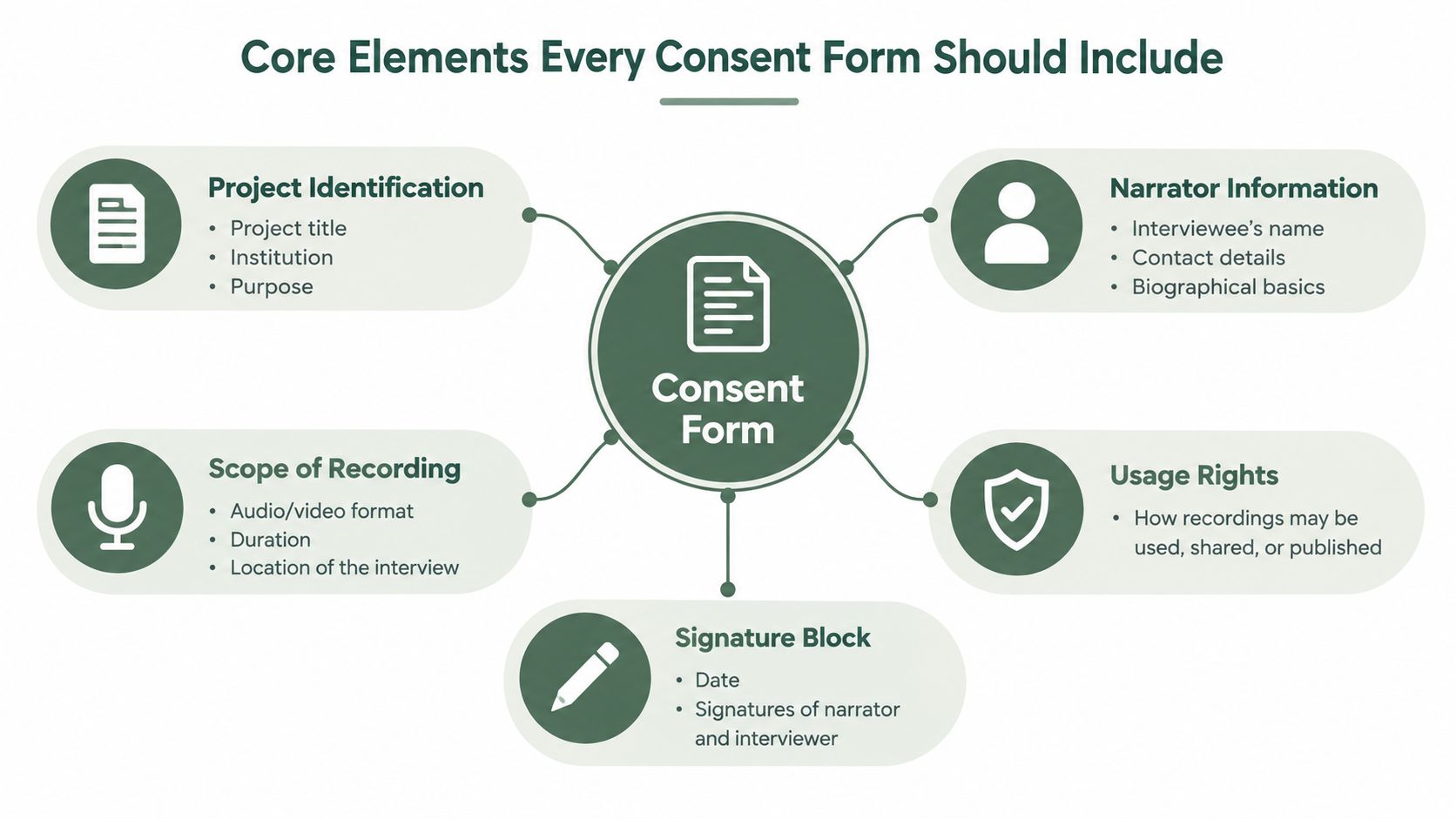
A narrator should understand the first page without guidance. Start with project identification: name the project, sponsor or institution, interview purpose, narrator, interviewer, and date. State where the recording will be stored. These details establish who is requesting participation, why the interview is being made, and who will manage the resulting materials.
Define the scope of recording in concrete terms. Specify whether the session includes audio, video, photographs, documents shown during the interview, or a transcript. Describe intended audiences and foreseeable uses, including preservation, quotation, exhibition, publication, transcript creation, and online sharing. Explain foreseeable risks, especially loss of privacy, so the narrator can assess what may happen after the interview ends.
A form gets clearer when it separates recording, access, and use. Those are related decisions, but they are not the same decision.
The form should turn those distinctions into visible choices. Give the narrator separate options for access restrictions, embargo periods, transcript review, and permission to decline questions or pause the interview. The Oral History Association's 2022 best-practice guidance supports review of the recording or transcript before public release and treats preservation, access, and use as distinct decisions (OHA 2022 best-practice PDF).
For family-history projects, write the audience plainly. A narrator may approve access for named relatives while withholding permission for public release, online indexing, or broader publication. Name every organization or person receiving rights, use large print when needed, and explain how the narrator can raise concerns later. A signature should confirm that the narrator understood each clause, and the form should be designed to make that understanding possible.
Annotated Template Clauses You Can Adapt Today
A good consent form reads like a set of real choices, not a ceremonial signature page. I want a narrator to see, line by line, what can stay private within a family, what can sit in an archive with limits, and what can be released publicly. That usually means shorter clauses, clearer labels, and enough room to mark exceptions.
Start with a simple clause set
Project purpose
“I understand that this oral history project records personal memories and reflections for preservation, research, education, family history, and related uses.”
This gives the interview a stated purpose without locking everyone into one narrow outcome.
Format and scope
“I consent to being recorded in audio, video, photograph, or transcript form, as applicable to this interview.”
Use this to name the actual record being created. A narrator may be comfortable with audio and transcript, but not video or still images.
Intended uses
“I understand that the recording, transcript, excerpts, and related materials may be edited, quoted, published, exhibited, reproduced, or shared online, subject to any restrictions I list below.”
This clause should stay specific. It prevents later sharing from being treated as something the narrator never had a chance to consider.
Access tier
“Access may be limited to private family viewing, password-protected sharing, archival deposit, or public release, depending on the choices marked below.”
The form serves as a decision tool here. Private family access is not the same as public release, and the wording should make that distinction impossible to miss.
Add the clauses people forget
Transcript review
“I may review the transcript or recording before public release, and any corrections or limitations will be recorded in writing.”
This helps when names, dates, or family relationships need checking before anyone else sees the material.
Privacy and identification
“I may choose to be identified by name, identified in part, or described more generally, with the understanding that complete anonymity may not be possible if details in the interview are recognizable.”
That sentence handles a hard truth. Partial anonymization can reduce exposure, but it does not erase context.
Withdrawal and restrictions
“I understand how to request changes, who receives that request, whether a substitute decision-maker may be named for later administration, what deadlines apply, and whether any material becomes final after a certain point.”
A withdrawal clause works only when the steps are plain.
Third-party content
“I will identify any photographs, documents, music, or people mentioned during the interview that may require separate clearance.”
That protects both the collecting project and the narrator's family.
Copyright, Licensing, and Access Permissions Explained
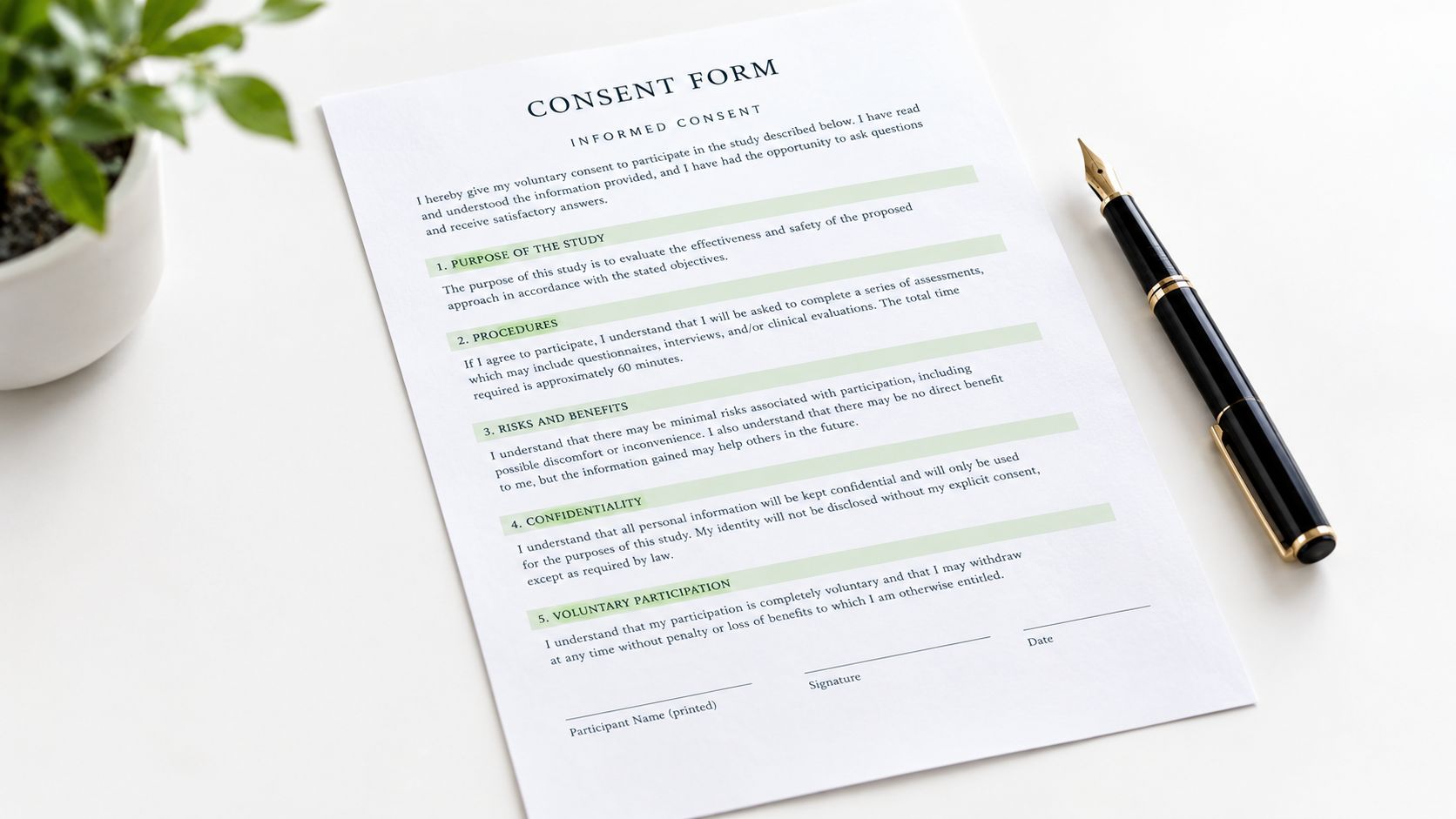
Homemade forms usually get sloppy here. They say "I give permission" and stop, which hides several separate legal decisions inside one vague sentence. Treat the rights section as a set of granular choices, not a single signature.
Separate the rights before you sign anything
An oral history interview can involve the narrator's spoken words, the interviewer's questions, photos or documents shown during the session, and third-party material mentioned or reproduced in the recording. The Oral History Association's principles and best practices note that both narrators and interviewers may need releases, and that a release can cover reproduction, distribution, public display or performance, and derivative works (OHA principles and best practices).
That is why copyright language needs precision. The form should say whether the narrator assigns copyright, grants an exclusive or nonexclusive license, dedicates the material to the public domain, or uses a Creative Commons license. It should also specify territory, duration, media, sublicensing, commercial use, attribution, editing, and royalties if any are involved. If the narrator keeps the ability to use their own story, the form should say that plainly.
Practical rule: if the archive, the family, and the public may all use the interview later, spell out who can do what now, not after a dispute starts.
Choose the permission model with the future in mind
| Option | What It Grants | Best Fit |
|---|---|---|
| Copyright assignment | Ownership moves to the receiving party | Institutional projects that need maximum control |
| Nonexclusive license | Permission to use while the narrator keeps ownership | Family archives and flexible community projects |
| Public domain dedication | Broadest public use without permission barriers | Projects that want maximum openness |
| Creative Commons license | Defined reuse terms with attribution or other limits | Public-facing projects that want clear sharing rules |
The difference between ownership and access matters. A narrator might allow the archive to preserve and display the interview, but still want limited commercial use or controlled editing. Those are separate choices, and a good form should not blur them together.
Access deserves the same granularity. Private family access and public release are different permissions, and a recording can move from one to the other years after the narrator has died. A digital legacy planning guide can help families think through that transition, and the rights language has to anticipate it. If the form only says "I give permission," nobody knows which of those futures the narrator agreed to.
How to Walk Through the Form With the Narrator
A consent form can be excellent on paper and still fail if the conversation around it is rushed. People agree more readily when they have time to hear the clauses, ask questions, and correct assumptions.
Slow down the room
Choose a quiet setting, not a hallway or kitchen corner where relatives are moving in and out. Read the form in plain language, or read each clause aloud if the narrator prefers that. If the narrator is hard of hearing, tired, or more comfortable in another language, arrange translation or an accessible version in advance. A form that can't be understood in the room isn't informed consent.
Then ask direct questions. What does the narrator hope happens with the recording? Who else is mentioned, and should their names or details be protected? Does the narrator want pseudonymity, embargo, or family-only access? Those questions often reveal whether the written choices match the person's intent.
Watch for pressure, fatigue, and vulnerability
If the narrator seems frail, confused, or under pressure from family members, slow the process down or bring in a witness, advocate, or trusted support person. Consent needs to be freely given and grounded in understanding, not family momentum or politeness. That principle aligns with oral-history ethics that treat consent as an active, informed choice rather than a perfunctory signature (OHS informed-consent guidance).
For interview technique itself, a guide to better interviews can help with pacing and question flow, but the consent conversation still needs its own rhythm. Keep it unhurried. The narrator should feel that they're making decisions, not being processed.
If you already have a working interview outline, the companion oral history interview guide can help you match the paperwork to the actual recording session.
Privacy, Anonymity, and the Limits of Redaction
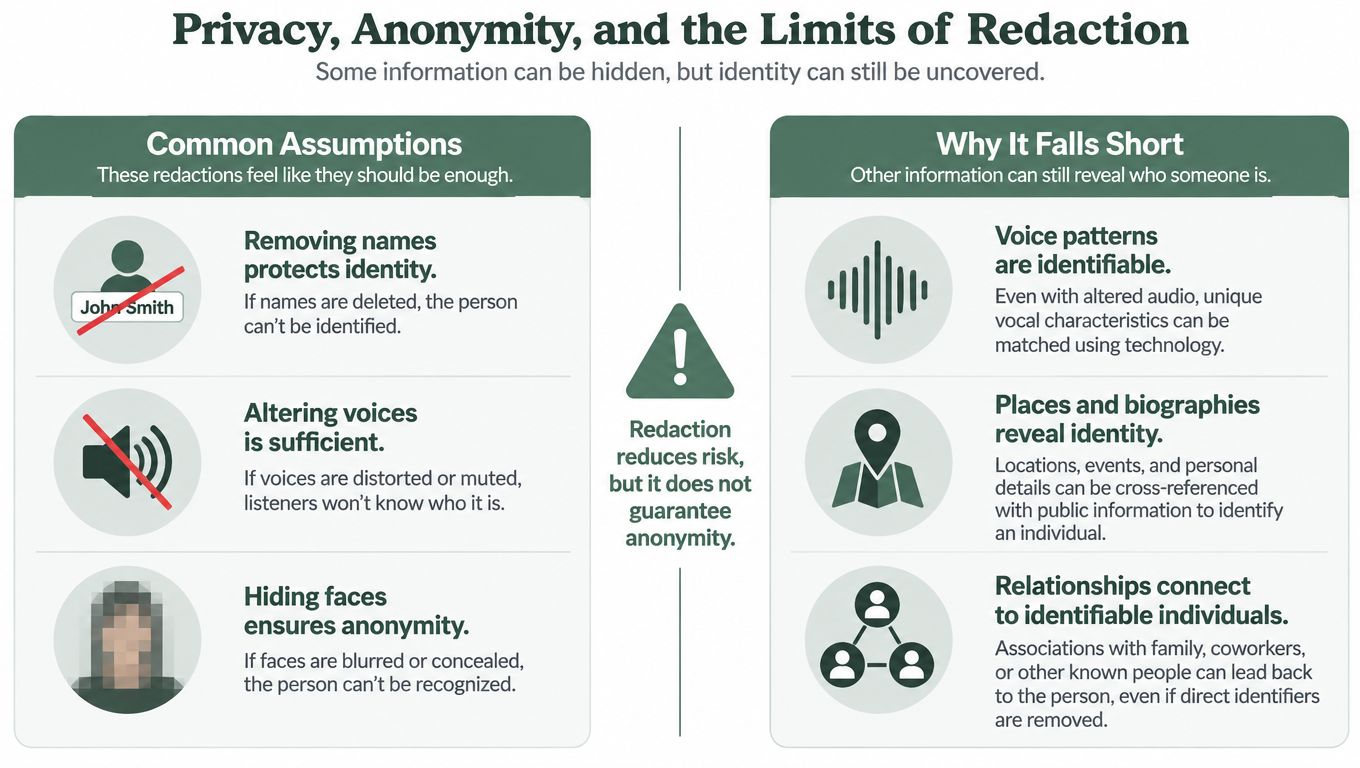
Many people assume that if they remove a name, blur a face, or alter a voice, the story becomes anonymous. That assumption is too simple for oral history, because a narrator's voice, biography, places, and relationships can still reveal who they are.
Why redaction doesn't solve everything
Oral histories are harder to anonymize than ordinary research data because they combine audio, visual cues, and lived detail. The Open.Oral-History project has described missing or inadequate consent forms, privacy restrictions, copyright, and anonymization as recurring barriers to digital access, which is exactly why a form has to be more granular than a generic release. A story about a small town, a family business, or a distinctive life event can remain identifiable even after names are removed (IFLA oral history guidelines).
Use tiered permissions instead
A better form separates private family viewing, password-protected links, public publication, downloadable files, transcripts, excerpts, search indexing, and AI processing. It should also ask separately about photographs, translations, and future technological uses. That way, the narrator can allow one kind of sharing and refuse another without having to choose between total secrecy and total exposure.
Practical compromise: let the family keep the story, but block public indexing or downloads if the narrator wants the recording to stay close to home.
Embargo periods help when the narrator wants to wait before public release. Redaction helps when a specific name or detail should be withheld. Neither one eliminates risk completely, and the form should say that.
If you're building a public-facing privacy notice or policy to accompany the form, the privacy policy guide for developers is a useful reference point for thinking about clarity, access, and data handling language.
Variations for Research, Family, and Public Use
The same form language doesn't fit every project. A university archive, a family collection, and a podcast all need different levels of specificity, even when they share the same core clauses.
Academic and institutional research
Research settings usually need the clearest alignment with institutional policies, repository rules, and any ethics review process in play. The form should identify the sponsor, archive destination, review rights, retention expectations, and any publication pathway. It should also be explicit about whether the interview can be quoted, deposited, or made searchable.
The one thing to avoid here is ambiguity about future use. If the institution wants archival preservation and reuse, the narrator should understand that from the start, not after the session is already filed away.
Private family archives
Family projects tend to need the most flexibility and the most emotional sensitivity. People often want the recording to stay available to relatives, but not become searchable by the public. That means clauses for family-only access, embargoes, selective redaction, and succession planning if the original collector is no longer around.
Public-facing projects
Community exhibits, podcasts, memoir-adjacent publications, and websites need the strongest rights language and the clearest audience disclosure. Public release changes the stakes, because the interview may be edited, excerpted, indexed, or reused in ways that feel different from a private keepsake. The form should leave no doubt about whether the narrator is approving public distribution or only a narrower audience.
A practical way to choose is to ask one question up front. Do you want this recording to be a family memory, a research asset, or a public story? The form should follow that answer, not force every project into the same mold.
Storing, Updating, and Enforcing the Agreement Over Time
Treat the signed form as a living project record alongside the media it governs. Keep it retrievable, clearly dated, and connected to the permissions that staff must apply years after the interview.
Keep the agreement separate and versioned
Store the signed form separately from the audio, video, and transcript, while recording the related file or collection identifier. Add the signing date, version, and any later amendment so staff can determine which wording applied when the narrator agreed. This record becomes especially useful when restrictions change or a new use is proposed.
Embargoes require operational controls as well as clear wording. If an interview is closed until a stated point, the repository should record that restriction and prevent premature access. Review permissions when responsibility moves between family members, archivists, or institutions. A clause has little practical value if nobody is assigned to enforce it.
Re-consent when the use changes
Revisit consent if the narrator dies, the archive changes hands, or technology introduces an unanticipated use, such as machine transcription or voice cloning. A material change in purpose, audience, or distribution calls for renewed permission where feasible. Maintaining trust over time requires treating consent as an ongoing relationship, a principle reflected in the LSU OHRP/IRB introduction.
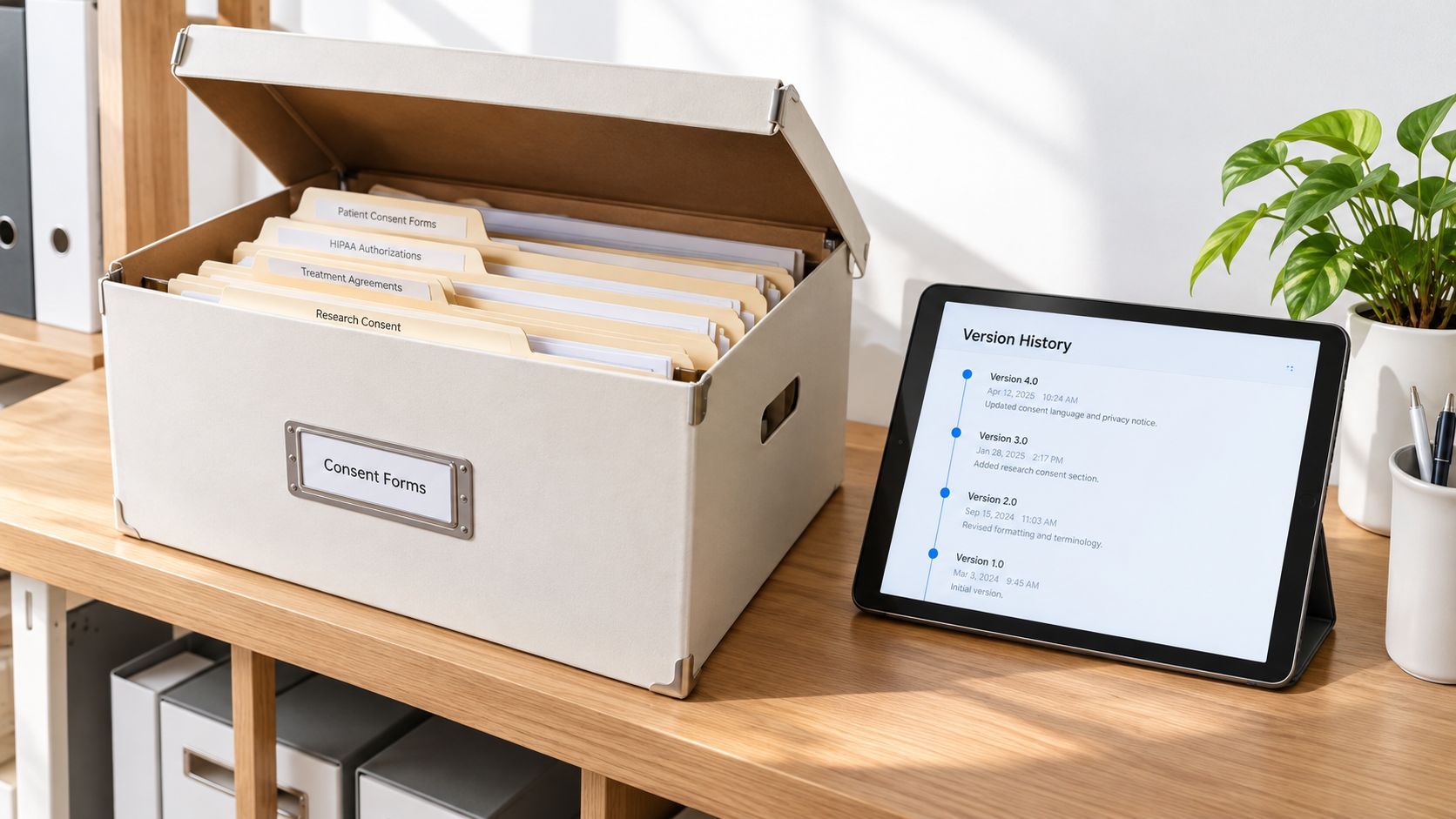
Cloud storage can simplify access and backup, but its settings must match the agreement. The cloud storage for families guide reinforces the need to configure sharing, downloads, and recovery around the narrator's choices. Private family access should remain distinct from public release, even when both use the same storage system. Keep an audit trail for permission changes, and record who approved each update.
Quick Reference Checklist Before You Sign
Before the interview, check whether the form names the project, sponsor, narrator, interviewer, and date. Confirm that it says what will be recorded, audio, video, photos, documents, or transcripts, and that it explains the purpose in plain language. If the narrator can't understand the document quickly, it isn't ready.
Use this decision tree
- If the narrator wants family-only sharing, choose a form with restricted access, no public indexing, and clear rules for downloads.
- If the narrator wants an archive to preserve the recording, add preservation language, repository details, and a clear access tier.
- If the narrator wants public release, specify publication, exhibition, online use, and editing permissions in writing.
- If the narrator wants control over reuse, use a nonexclusive license or similarly limited permission, not a vague blanket release.
After the interview, store the signed form separately from the recording and keep the version date visible. If restrictions, audiences, or technology changes later, revisit the permissions instead of assuming the first signature covers everything. That's especially important when the story may move from a private family collection into a public archive.
A final check is simple. The narrator should know who can hear the story, who can read it, who can quote it, and who can't. If any one of those answers is unclear, the form still needs work.
If you want a family story preserved with the same care you'd give a public archive, remembers.life helps you create a lasting record that respects privacy, consent, and future use. Visit remembers.life to start shaping a thoughtful memory record that your family can trust for years to come.