What Is an Oral History Interview and How It Works
Learn what is an oral history interview, how it differs from a casual conversation, and how to record, preserve, and share a loved one's memories
An oral history interview is a planned, recorded, in-depth conversation built to preserve one person's firsthand memories as primary evidence for the future. The practice emerged formally in the 1940s and became more widely recognized in North America during the 1960s and 1970s.
Perhaps you're sitting at your parent's kitchen table with a phone between you, a short list of questions in your hand, and the uneasy feeling that this conversation may never happen in quite the same way again. Your parent remembers the old neighborhood, the first job, the family disagreement nobody wrote down. You want to listen, but you also want to preserve the voice, pauses, laughter, and uncertainty that make the story theirs.
That's where an oral history interview differs from asking someone to “tell you about the past.” The interview is planned, recorded, documented, and prepared for future listening or research. It can become a family keepsake, a community record, or a primary source that helps later generations understand how someone experienced a particular time.
Table of Contents
- What Is an Oral History Interview
- How an Oral History Interview Is Structured
- How It Differs from Other Interviews
- Preparing and Recording a Strong Session
- Ethics, Consent, and Who Controls the Story
- AI, Transcripts, and Trusting the Record
- Preserving and Sharing the Interview for the Long Term
- A First-Timer's Checklist Before You Press Record
What Is an Oral History Interview
An oral history interview is a planned, recorded exchange between an interviewer and a narrator, designed to preserve memories, interpretations, and firsthand experiences. The narrator is the person sharing the story. The interviewer prepares the setting and questions, then listens closely enough to help the narrator develop a meaningful account.
A formal definition can sound academic, but the family version is easy to recognize. You might record your father describing the factory where he worked, your aunt recalling a migration story, or your grandmother explaining what home felt like during childhood. The subject could be a single event, such as a wedding, flood, strike, or military deployment. It could also become a life-history interview covering childhood, education, work, relationships, and family traditions.
The important distinction is that the recording isn't treated as disposable conversation. The Oral History Association's evaluation guidelines describe oral history as a recorded, in-depth interview that is researched, preserved, made accessible, and interpreted. The Smithsonian similarly presents it as a planned recording used to generate and preserve primary-source information, a definition summarized through George Mason University's oral history resources.
Three features make it oral history
- Intentional preparation: You decide why the interview matters, learn relevant background, and create prompts that invite memory rather than quick answers.
- A reliable recording: Audio or video preserves not only words, but also tone, hesitation, laughter, silence, and changes in emotion.
- A future purpose: You label, store, transcribe, and share the record according to an agreed plan.
That last point matters in a family setting. The narrator's pauses and corrections aren't necessarily flaws to remove. They show how memory works and how a person makes sense of the past while speaking. An oral history interview preserves not just the information someone gives you, but also the way they understand and express it.
A family recording can therefore serve two purposes at once. It preserves an intimate voice for relatives, while also creating a small piece of evidence about a family, workplace, neighborhood, or community. You can find related guidance on documenting family history, especially if you're deciding which stories deserve a permanent place in your archive.
How an Oral History Interview Is Structured
A strong session usually has a recognizable shape. You don't need to make it stiff or formal, but a little structure helps the narrator feel safe and helps you avoid losing important context.
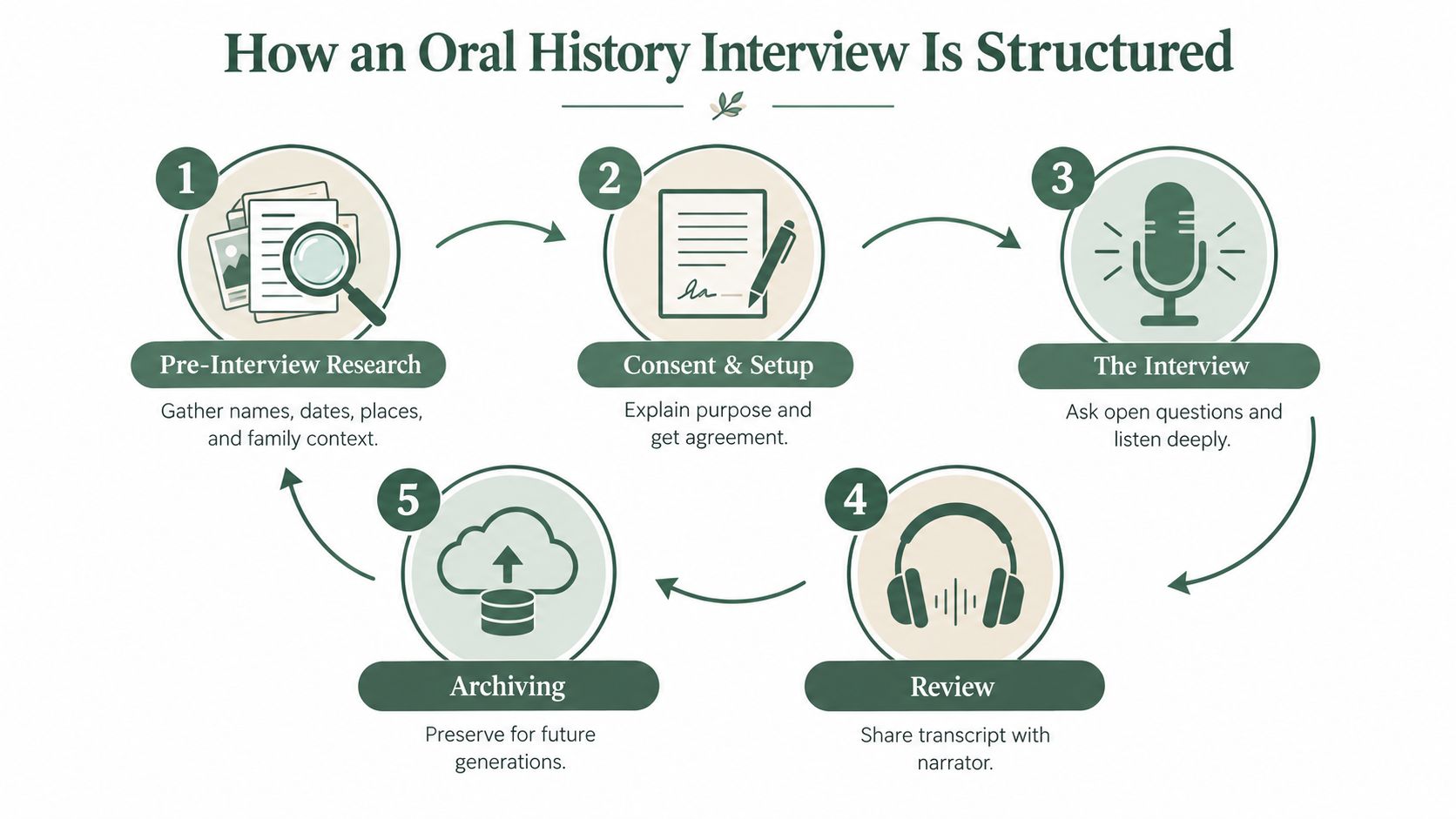
Begin before the recorder starts
First, gather names, places, dates, occupations, relationships, and family documents. You're not trying to prove that you already know the story. You're preparing enough to ask a question that opens a real memory.
“Tell me about your childhood” may produce a vague answer. “What do you remember about the apartment above the bakery?” gives the narrator a doorway into a particular place. Background research also helps you notice when a date, location, or family connection needs clarification later.
At the beginning of the recording, state the narrator's name, your name, the date, the location, and the broad purpose of the interview. Confirm that the narrator understands the recording and agrees to continue. This opening becomes valuable metadata when someone encounters the file years later.
Move from broad memories to details
Organize the main conversation around life chapters or themes. Childhood, school, work, migration, marriage, illness, faith, community life, and a defining event can all provide useful pathways.
A sequence might begin like this:
- “Tell me about the house you grew up in.”
- “Who lived there with you?”
- “What did a normal morning look like?”
- “What changed after your father came home from the war?”
- “What did your mother say when he arrived?”
- “Where were you when that happened, and who else was present?”
The first question invites a broad narrative. The later prompts ask for setting, relationships, timing, and personal perspective. They don't force a conclusion. They give the narrator room to remember.
Listening rule: Ask one clear question, then leave enough silence for the answer to arrive.
Follow-up questions often produce the most valuable material. Ask what a place looked like, how the narrator felt, what happened next, or whether they witnessed an event personally or learned about it from someone else. Avoid correcting a memory in the middle of the story. If another account matters, introduce it gently and invite the narrator to explain the difference.
Close with care and documentation
Near the end, ask, “Is there something important I haven't asked about?” People often remember the story they most wanted to tell only after the prepared questions are finished.
After stopping, write brief notes about the setting, interruptions, mood, people present, and topics covered. Label the file immediately with the narrator, date, subject, and version. Those small actions make the recording easier to identify, transcribe, and preserve.
The following video offers another practical look at the interview process.
How It Differs from Other Interviews
A microphone alone doesn't turn a conversation into oral history. The purpose, preparation, treatment of the recording, and relationship with the narrator all matter.
A casual conversation may contain wonderful memories, but nobody expects the exchange to become a documented record. A journalist usually interviews someone to produce a timely story for an audience. A survey interviewer asks standardized questions so responses can be compared across participants. Oral history gives one narrator room to develop a personal account that can remain available after the original conversation.
| Feature | Casual Conversation | Journalism Interview | Survey Interview | Oral History Interview |
|---|---|---|---|---|
| Main purpose | Connection and everyday exchange | Report a story or event | Gather comparable responses | Preserve firsthand memory and interpretation |
| Question style | Unplanned and conversational | Focused on the publication's story | Often standardized and closed-ended | Open-ended, researched, and responsive |
| Recording permanence | Usually none | Recorded for reporting and production | Recorded or documented for analysis | Preserved as a record for future use |
| Narrator's role | Conversation partner | Source for a published piece | Respondent in a research sample | Narrator whose voice and perspective remain central |
| Access and control | Rarely discussed | Usually shaped by the publisher | Set by the research project | Discussed through consent, restrictions, review, and access planning |
The boundary with journalism can feel especially confusing. Both formats may use a recorder and ask about past events. Journalism generally selects material to support a current story, while oral history preserves the fuller encounter, including context, digressions, and the narrator's way of interpreting experience.
Survey interviews differ in another direction. A survey may ask, “Did you move during the recession?” and record a short answer. An oral historian might ask, “Tell me about the decision to leave your home,” then ask what options the narrator considered, who influenced the decision, and what the move felt like.
Oral history also isn't a promise that every memory is perfectly objective. Personal recollection is shaped by time, emotion, later knowledge, and the situation in which the story is told. That subjectivity is part of the record. The interviewer's task is to document the narrator's perspective carefully, not pretend that a personal memory is the same thing as an official timeline.
Preparing and Recording a Strong Session
Preparation reduces distractions, protects the narrator's comfort, and gives the recording enough context to remain useful. You can treat the session as a practical sequence rather than a performance you have to perfect.
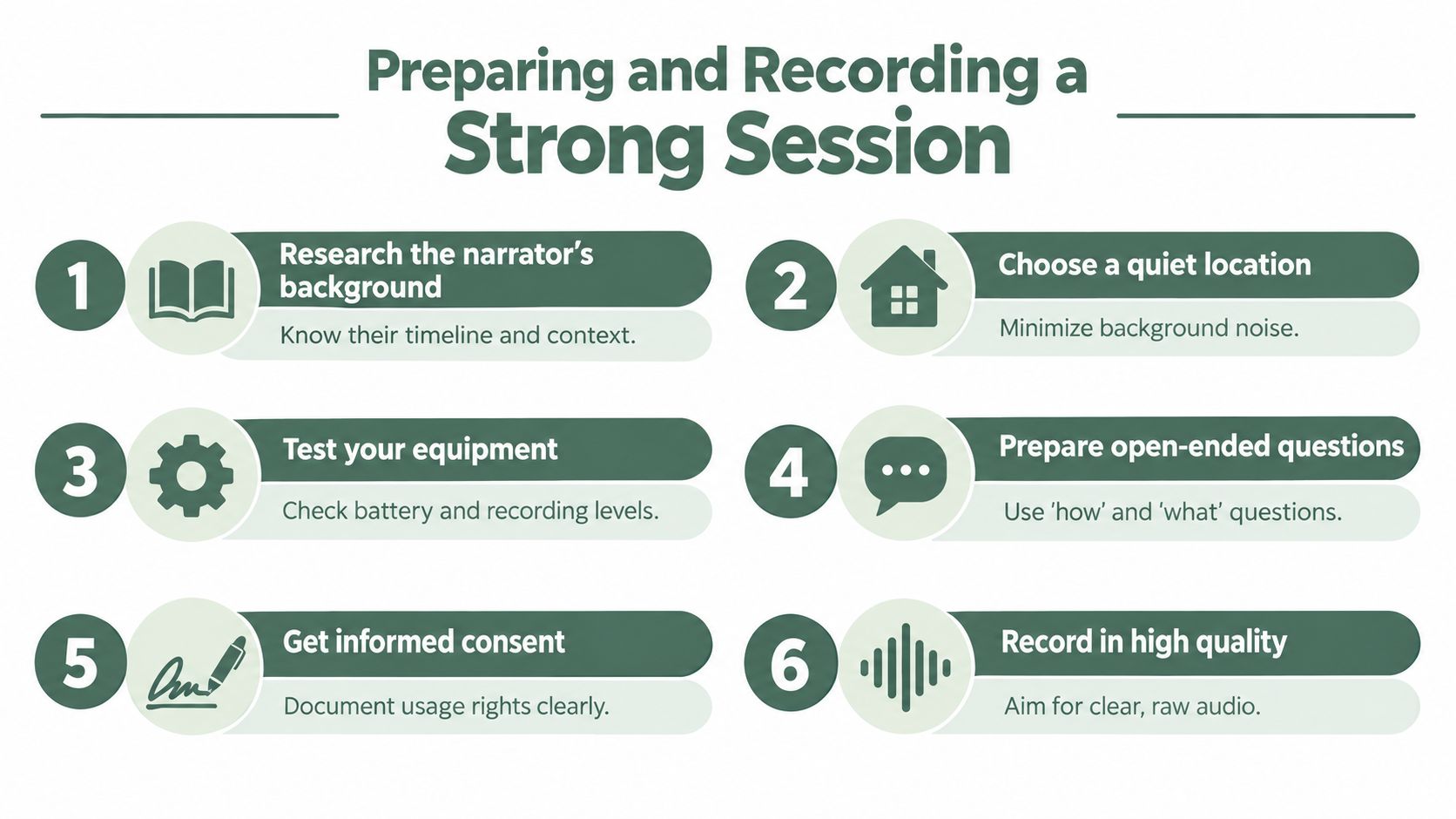
Research the person and choose the setting
Collect the basic timeline first. Review family photographs, letters, certificates, newspaper clippings, maps, or earlier conversations. Write questions that refer to real people and places, but don't load the prompts with your own assumptions.
Choose a quiet room with soft furnishings where possible. Turn off televisions, fans, and notifications. Keep water nearby, make sure the narrator can sit comfortably, and avoid placing the microphone beside a table that you'll tap or move.
A modern smartphone can work for a family project if it's positioned securely and tested in advance. An external microphone can improve clarity, while a dedicated recorder may offer simpler physical controls and dependable battery management. Whatever you use, make a short test recording and listen to it through headphones before the session.
Prepare consent and session notes
Before recording, explain the purpose in plain language. Say who may hear the interview, where it might be stored, whether relatives may receive copies, and how the narrator can request limits on particular subjects or sections.
At the beginning of the recording, capture the essential metadata aloud:
- Names: Identify the interviewer and narrator.
- Date and place: State where the session is happening.
- Subject: Describe the main topic or life period.
- Permission: Confirm that the narrator agrees to the recording and understands its intended use.
The NOAA oral history guide emphasizes quiet conditions, advance research, clear explanations of scope and rights, and documentation such as the interviewer, interviewee, date, location, and subject.
Let the narrator set the pace
Start with an easy memory, such as a home, school, favorite meal, or first job. Use “how,” “what,” “where,” and “tell me about” more often than questions that can be answered with yes or no.
Don't rush to fill a pause. Give the narrator time to find a name or arrange a difficult memory. If emotion rises, ask whether they want to continue, pause, or return to the subject later. Keep the session manageable, and agree in advance that breaks are always allowed.
Make a note when an unexpected story appears. You can return to it with a prompt such as, “You mentioned the train station earlier. What happened there?” For guidance on improving an imperfect recording after the session, consult these restoration workflows for creators. Restoration should clarify the original record, not make it sound as if the narrator said something different.
A recording project can also be supported by tools designed for life story audio recording, particularly when the priority is capturing a natural answer rather than conducting a formal research interview.
Ethics, Consent, and Who Controls the Story
The hardest decision may come after the interview ends. A narrator can feel comfortable sharing a story in a private room and later feel differently about relatives, researchers, or the public hearing it. Consent should therefore be an ongoing conversation, not a form you file and forget.
Before recording, discuss four practical questions:
- Purpose: Why are you making this interview?
- Use: Will it stay within the family, support research, or be shared more widely?
- Access: Who can listen to the audio or read the transcript?
- Restrictions: Can the narrator close a topic, review the transcript, or limit access until a later time?
The Oral History Association's ethics guidance stresses informed consent, review before public release, privacy and access discussions, and the shared power involved in creating the record. It also recognizes more flexible approaches, including consent that can be revisited as circumstances change.
Protect people who aren't in the room
A narrator may mention a living relative, neighbor, coworker, or former partner who never agreed to appear in a recording. Don't promise that every detail will be published just because the narrator said it. Discuss whether a sensitive passage should remain private, be summarized, or be kept for restricted family access.
You should also distinguish between preserving a story and endorsing every factual claim within it. A narrator may remember an event differently from documents or another person. Keep the account intact where appropriate, add contextual notes later, and avoid editing words merely to make the story more convenient.
Put control in writing
A simple family agreement can identify the narrator, interviewer, purpose, intended audience, storage location, review process, and restrictions. It can also record who may make future decisions if the narrator becomes unable to do so.
Copyright and ownership can be complicated because the narrator supplies the words while the interviewer creates the recorded interview. Families should avoid assuming that possession of a phone file automatically settles every right. For valuable or public projects, ask an archive or qualified legal professional about a donor agreement.
Long-term planning belongs alongside interview consent. Digital legacy planning can help families decide who should manage files, passwords, permissions, and access instructions later.
AI, Transcripts, and Trusting the Record
AI transcription can make an oral history easier to search, share, and read. A transcript helps a relative find the story about a childhood home without listening through the entire recording, and it gives people with hearing difficulties another way to access the interview.
That convenience doesn't make automated text authoritative. Accents, overlapping speech, background noise, names, place names, older vocabulary, and emotional delivery can all create errors. A transcript that changes a surname or turns uncertainty into a confident statement can misrepresent the narrator.
The 2026 scholarly discussion of AI and oral history argues that AI requires oral historians to reconsider context and consent. Sector guidance also recommends disclosing AI use, assessing risks, and checking the transcript against the original audio.
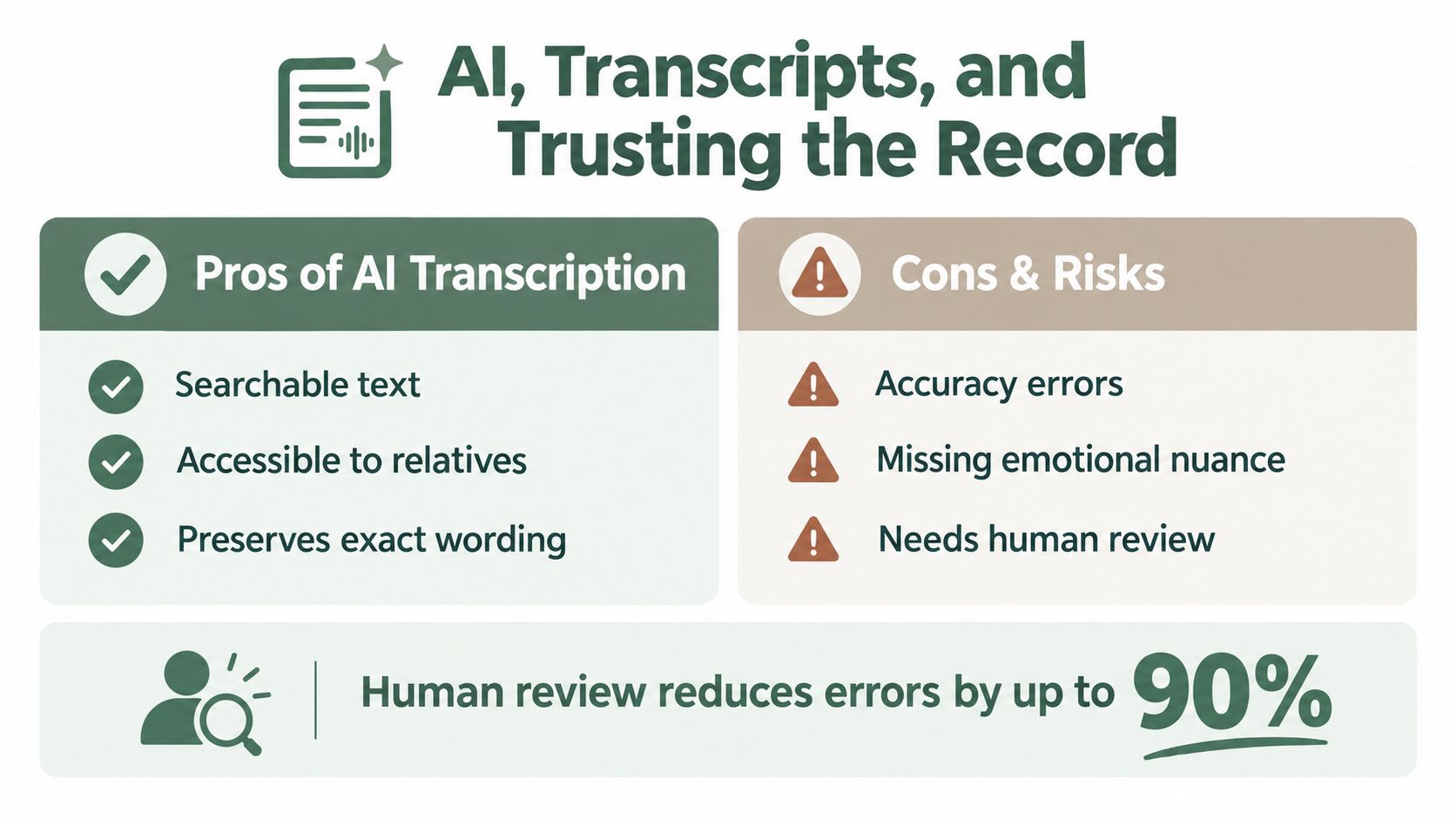
A responsible workflow keeps the original recording untouched. Create an AI-assisted draft if useful, then compare it with the audio, correct names and meaning, mark uncertain words, and preserve a note about the tool used. Resources on producing accurate interview transcripts with AIDictation can help you think through that transcription stage.
Be cautious with AI-generated summaries, synthetic voices, and edited audio. A summary is an aid to discovery, not a replacement for the narrator's account. A synthetic voice should never be presented as if it were the person speaking. The original audio remains the source of truth, supported by a transcript reviewed by a human.
Practical rule: AI can assist with access and organization. It shouldn't silently rewrite the person whose memory you set out to preserve.
Preserving and Sharing the Interview for the Long Term
A recording isn't preserved just because it exists on your phone. Give the files clear names, keep an untouched master, and create copies for ordinary listening.
For audio, an uncompressed or lightly compressed master such as WAV can retain more information for future processing. For video, a high-quality MP4 or MOV can serve as a practical master depending on how it was recorded and stored. Create a separate access copy that relatives can play easily, and never edit the only original.
Build more than one path to the files
A dependable family archive should not rely on one laptop, one USB drive, or one cloud account. Use the 3-2-1 backup rule: keep three copies, on two different types of storage, with one copy stored away from the main location. Check that the backups can be opened, and document who is responsible for maintaining them.
A cloud service can make sharing simple, but a cloud-only plan can fail if an account is closed, a password is lost, or a subscription changes. A guide to cloud storage for families can help you think through access, organization, and continuity.
Make the record usable
Transcription serves two purposes. It makes the interview searchable, and it gives relatives another way to experience the story. Keep a clean transcript close to the spoken words, then consider a lightly edited family version that corrects obvious verbal clutter without changing meaning.
Store the transcript beside the audio rather than in a separate forgotten folder. Include a short readme with the narrator's name, interview date, topics, restrictions, file formats, backup locations, and instructions for opening the files.
Sharing can be private and gradual. You might send relatives a protected family link, mail a USB drive, give a copy to a trusted family member, or donate the recording to a local archive. The right choice depends on consent and the narrator's wishes, not on the interviewer's excitement to publish.
remember.life is one option for family projects because it supports voice recording, keeps an automatic transcript alongside the audio, and uses interview-style prompts that let a loved one answer naturally. Whatever platform you choose, keep an independent copy of the original files and the consent information.
A First-Timer's Checklist Before You Press Record
You don't need a studio or a historian's vocabulary. You need a willing narrator, a clear purpose, a tested recording setup, and enough patience to let the story unfold.
Before the session
- Learn the timeline: Gather names, places, family relationships, photographs, and documents that can lead to specific questions.
- Write open prompts: Prepare questions beginning with “what,” “how,” “where,” or “tell me about.”
- Choose the room: Find a comfortable, quiet space and remove avoidable background noise.
- Test the equipment: Check battery, storage, microphone position, and playback before the narrator arrives.
- Prepare consent: Write down the purpose, intended audience, access limits, review process, and any restrictions.
- Bring practical items: Have water, headphones, a notepad, and a backup way to record if possible.
During the session
- Start with context: State the names, date, place, and subject aloud.
- Check the sound: Make a short test recording and listen before moving into the main questions.
- Follow the narrator: Let an unexpected memory develop if it belongs to the story.
- Respect silence: Don't interrupt a pause because it makes you nervous.
- Protect comfort: Offer breaks and remind the narrator that a topic can be paused or restricted.
- Keep your questions short: Ask one thing at a time, then listen.
After the session
- End gently: Ask whether anything important remains unsaid.
- Label immediately: Include the narrator, date, topic, and version in the filename.
- Write field notes: Record the setting, interruptions, mood, and any unclear names.
- Back up the files: Copy the master, access file, transcript, consent record, and notes.
- Confirm the plan: Thank the narrator and agree on who will review or receive the material.
The goal isn't a flawless performance. A slightly rambling conversation with a real laugh, a remembered smell, or a long pause often carries more life than a polished interview that leaves no room for the person behind the answers.
If you're ready to preserve a parent's or grandparent's stories, remembers.life offers voice recording, interview-style prompts, and automatic transcription stored with the audio. Visit the site to create a simple family record while the person, voice, and memories are still available to share.