7 He Will Be Missed Tribute Ideas
Find seven heartfelt “he will be missed” tribute ideas for obituaries, cards, eulogies, and social posts, with practical examples for preserving memories.
Writing “he will be missed” can feel almost impossible when grief makes every sentence seem too small. You may be preparing an obituary, sympathy card, eulogy, social post, funeral program, or private family record, yet the familiar phrase doesn't fully express who he was or what his absence means. A meaningful tribute adds the detail that makes the words personal. It might preserve a favorite memory, describe his character, honor his work, pass on his wisdom, or show how he shaped the people around him. Obituaries have gradually expanded from brief death notices into fuller accounts of family relationships, achievements, and personality, according to a study of Canadian newspapers covering 1900 to 2021 published in OMEGA. The seven ideas below help you choose a format based on your audience, privacy needs, available memories, and desired length. For a fuller life story beyond one message, remembers.life can help families preserve photographs, stories, milestones, and reflections together.
Table of Contents
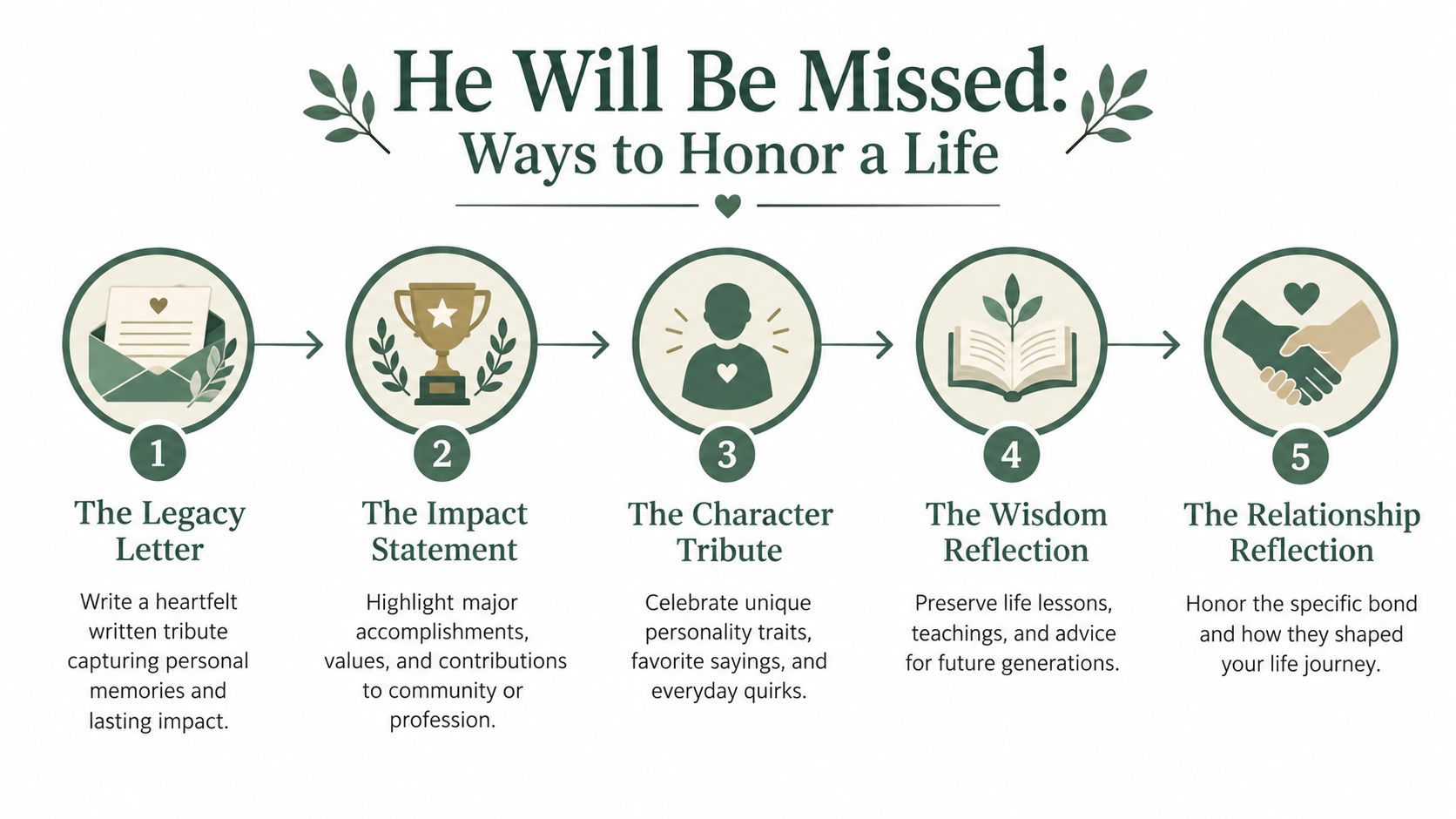
- 1. The Legacy Letter
- 2. The Impact Statement
- 3. The Character Tribute
- 4. The Wisdom Reflection
- 5. The Relationship Reflection
- 6. The Timeline Tribute
- 7. The Community Legacy
- 7-Point Memorial Tribute Comparison
- Turn “He Will Be Missed” Into a Lasting Tribute
1. The Legacy Letter
A legacy letter gives you room to say what a short condolence message can't. Instead of writing that he will be missed, you can explain how he entered your life, what you noticed about him, and why his influence will remain. This format works especially well for a private family archive, a memorial program, a longer obituary, or a message intended for children and grandchildren to read later.
Begin with one scene rather than a broad description. You might remember your father repairing a bicycle at the kitchen table, your uncle greeting every visitor with the same joke, or a grandfather teaching you to plant tomatoes. A concrete moment gives the reader something to see and hear. From there, connect the memory to a quality such as patience, humor, determination, or generosity.
Build the letter around a living memory
Write in separate sittings if the first draft feels emotionally exhausting. You don't need to produce a polished tribute in one attempt. Return to the draft and add a favorite saying, a familiar mannerism, the way he laughed, or the small routine your family will notice is gone.
A useful structure is:
- Begin with a scene: Describe one moment that captures his presence.
- Name his qualities: Explain what made him dependable, funny, brave, or kind.
- Show his influence: Say how he changed you or your family.
- End with continuation: Describe what you'll carry forward because you knew him.
A eulogy can become a letter by changing the audience from a room of mourners to the person who died. For further guidance on shaping memories into a lasting record, see this guide to writing a legacy. A family could also preserve the finished letter with photographs, voice recordings, and related stories on remembers.life.
2. The Impact Statement
Some lives are best remembered through what a person built, protected, taught, or changed. An impact statement is a focused tribute for a public setting, such as a workplace memorial, professional obituary, community notice, academic remembrance, or service program. It recognizes achievement without turning the person into a list of titles.
The strongest version connects accomplishments to values. Rather than writing that he had a successful career, explain that he mentored new colleagues because he believed knowledge should be shared. Rather than saying he served his community, name the people or cause he consistently supported. The achievement matters, but the reason behind it reveals character.
Choose meaning over a résumé
Start by listing the major areas of his life, then select the details that explain his contribution. You might write about a teacher who encouraged shy students, a business owner who treated employees like family, or a volunteer who kept showing up when practical help was needed. If recognitions, certifications, projects, or leadership roles are relevant, include them with enough context for readers outside that field.
Practical rule: Mention an accomplishment, then explain who benefited from it.
Avoid filling the tribute with unsupported praise. “He was respected by everyone” is broad. “He made time to explain difficult tasks to new staff” gives readers evidence of respect and a reason to remember him. If the statement is public, confirm names, dates, roles, and organizational references with the family before publishing.
For a tribute centered on a father's values and accomplishments, these eulogy examples for a dad can help you find an appropriate balance between public recognition and personal warmth. The final paragraph can bring the focus back to absence: he will be missed not only for what he achieved, but for the values he made visible in everyday life.
3. The Character Tribute
A character tribute helps readers recognize him through the details that never appeared on an official résumé. It may suit a sympathy post, photo caption, informal eulogy, family video, or short message when warmth matters more than a complete life summary. Choose it when you want people to feel his presence through familiar habits and mannerisms.
Begin with a detail that sounds unmistakably like him. Perhaps he carried peppermints in every coat pocket, arrived early to every appointment, gave children elaborate nicknames, or turned ordinary errands into stories. One concrete habit, such as those peppermints, carries more emotional truth than a list of adjectives.
Let affection guide the humor
Humor can fit a memorial when it reflects the relationship and respects the audience. Describe quirks with affection rather than criticism. A funny story works best when it also reveals his kindness, loyalty, generosity, or distinctive way of caring for people.
Build the description through details readers can hear, see, smell, or remember:
- Sound: Include the expression, greeting, or laugh people recognized immediately.
- Routine: Describe his morning ritual, gardening habit, Sunday drive, or evening activity.
- Texture and scent: Mention the workshop, kitchen, garden, aftershave, books, or clothing associated with him.
- Action: Show what he did when someone needed help, company, or encouragement.
For example, “He will be missed” becomes more personal in this sentence: “He will be missed at the kitchen table, where his strong coffee, raised eyebrow, and perfectly timed joke could turn a quiet morning into a family gathering.”
Match the tone to the setting. A public announcement may call for gentle warmth, while a private family tribute can include a more specific joke or story. If the audience expects solemnity, let the humor remain understated. A quiet, accurately described habit may help relatives recognize the person they loved and prompt them to share their own memories.

4. The Wisdom Reflection
A wisdom reflection preserves what he taught, whether he taught through formal advice, repeated sayings, practical example, or the way he handled difficulty. It works particularly well for a grandparent, parent, mentor, faith leader, or older friend whose perspective shaped younger people. The tribute doesn't need to present him as perfect. Honest lessons can include the mistakes he acknowledged and the changes he made.
Start with advice family members can still hear in his voice. Maybe he urged everyone to keep promises, save for difficult times, welcome neighbors, or make room for laughter. Then attach each lesson to a story. Advice becomes memorable when readers see how he practiced it.
Turn advice into something future readers can use
You might organize the reflection around areas such as love, work, resilience, friendship, family, or service. For each area, answer three questions: What did he say or do? When did someone need that lesson? How has it affected the family since?
A passage might read: “He taught us that showing up mattered more than having the perfect words. He demonstrated it by visiting relatives in hospital, attending school events after long workdays, and calling when he knew someone was struggling. We'll remember that lesson whenever we choose presence over convenience.”
If you don't have written records, ask relatives what they remember hearing him say. An oral history conversation can preserve tone, pauses, and stories that might disappear when reduced to a sentence. This oral history interview guide can help you prepare prompts for a recorded conversation.
“The advice he gave us still has a place at the table.”
Use direct wording only when you're confident it reflects his actual words. Otherwise, describe the lesson in your own voice and identify it as something you learned from him. That distinction keeps the tribute sincere and protects against creating a polished version of a person no one recognizes.
5. The Relationship Reflection
A relationship reflection answers a profoundly personal question: What was he to me, and what did that relationship make possible? It can describe a father, husband, brother, friend, colleague, neighbor, or mentor without trying to speak for every person who knew him. That makes it a strong choice for a sympathy card, funeral reading, family gathering, or intimate social post.
Begin with the earliest memory you have of knowing him. A child might remember a hand held in a crowded place. A friend might remember the first conversation that became a lifelong habit. A colleague might remember the moment he offered practical help without seeking credit. The starting point doesn't need to be dramatic. It needs to belong to your relationship.
Name both care and growth
The person you loved may have supported you, challenged you, or done both. Explain how he showed care in a way that was specific to him. Perhaps he fixed problems before you asked, listened without interrupting, sent messages at important moments, or pushed you to take yourself seriously.
Then identify what you'll miss most. It might be advice, shared silence, teasing, a weekly call, or the certainty that he would answer. A strong ending describes what you intend to carry forward, such as his patience with children, his willingness to apologize, or his habit of making room for others.
Family members may write separate relationship reflections and bring them together in one memorial. That approach allows a daughter, spouse, friend, and former colleague to describe different sides of the same person without competing for one official version. If grief is placing strain on family communication, family support with Interactive Counselling may offer a separate source of help. A remembrance can hold love and disagreement openly, but it shouldn't be used to settle unresolved conflict.
6. The Timeline Tribute
A timeline tribute follows a life through its changing seasons, giving each memory a place on the larger map. It works well for a detailed obituary, memorial display, family-history project, or digital profile that can grow as relatives add photographs and stories. Choose it when the remembrance you want to create is about the whole journey, not one defining quality.
Begin with the basic facts, then find the human moment inside each period. A childhood photograph becomes more vivid beside a story about what he loved doing. A career milestone gains meaning when you mention who encouraged him or whom he later supported. A move to a new place can open the door to the friendships, routines, and interests that followed.
Build the story around turning points
Organize the tribute by the life stages that shaped him. These might include childhood, education, work, partnership, parenthood, service, retirement, and later interests. Treat each stage like a chapter, with its own change, people, and lasting image. Leave out periods that do not help readers understand his life.
For every chapter, record three details: what changed, who shared that period, and what still brings it to life. The change might be a new job, home, family role, or interest. The people could include relatives, friends, colleagues, or neighbors. The lasting detail might be a photograph, object, favorite saying, or ordinary scene that family members still remember.
A timeline should help the family check the record, too. Ask relatives to confirm names, places, and relationships before publishing the tribute. Keep private information out unless everyone concerned has agreed to share it.
A digital memorial profile can place the chronology beside photographs, a biography, voice recordings, and written memories. This wider frame shows the life that preceded the loss, helping “he will be missed” describe a person's journey rather than only the final event.
The following video may help families decide how to shape the tribute in practical terms.
7. The Community Legacy
A community legacy tribute shows who he was beyond the immediate family. Use it when people remember him through a congregation, sports club, neighborhood, workplace, volunteer group, professional association, or circle of friends. This format fits a life shaped by service, hospitality, mentorship, or commitment to a shared cause.
Begin with the communities that mattered to him, then show how he took part. Describe the meals he organized, the young people he encouraged, the committee work he completed without attention, and the practical help he offered when others needed it. Those details give a community tribute its substance and help readers see the difference he made.
The strongest version gathers several voices. Ask people from different parts of his life for brief memories. A colleague might recall his fairness, a neighbor his reliability, and a volunteer partner his ability to make difficult work manageable. Their perspectives add range while keeping the family from carrying the entire writing task alone.
Build the tribute around a few carefully chosen elements: a service story about one project, event, or act of help; a relationship story showing how he treated people with little power or recognition; and a continuing action, such as a gathering, donation, tree planting, or community activity that reflects his values. A direct welcome can invite others to share memories privately or on a memorial page.
Check with the family before publishing organizational names, photographs, donation instructions, or personal stories. Contributors should also be comfortable with how their memories and names appear in a public tribute.
For practical ways to turn remembrance into an activity others can continue, explore these legacy project ideas. Close with the continuing work: the people he trained and the projects still running are the clearest answer to the phrase he will be missed.

7-Point Memorial Tribute Comparison
| Tribute Type | 🔄 Implementation Complexity | ⚡ Resources & Speed | 📊 Expected Outcomes (⭐ effectiveness) | Ideal Use Cases | 💡 Key Advantages / Tips |
|---|---|---|---|---|---|
| The Legacy Letter - Personal Written Tribute | Medium, emotional effort, low technical skill | Low material cost, moderate time; can be written slowly | Creates a permanent, detailed family record; high emotional authenticity (⭐⭐⭐⭐) | Preserving family history, therapeutic grief work, heirloom documents | Highly personal and preservable; write in multiple sittings, start with a single memory |
| The Impact Statement - Specific Accomplishments and Values | Medium, requires fact-checking and structure | Moderate research/time; efficient once facts gathered | Clear recognition of achievements and values; good public/professional impact (⭐⭐⭐) | Corporate/academic memorials, professional circles, role-model documentation | Structured and inspirational; list 3–5 key accomplishments and include numbers when possible |
| The Character Tribute - Personality and Quirks Memorial | Low, anecdotal, easy to compile collaboratively | Low resources, quick to assemble with contributions | Strong emotional resonance and relatability (⭐⭐⭐⭐) | Funeral eulogies, social media posts, family memory compilations | Makes the person vivid; include 2–3 specific stories, favorite sayings, and sensory details |
| The Wisdom Reflection - Life Lessons and Teachings | Medium, requires reflection and organization | Moderate time to reflect and contextualize; slower to craft well | Preserves actionable guidance and family values; generational continuity (⭐⭐⭐) | Ethical wills, advice for grandchildren, mentorship legacies | Focus on 5–7 recurring lessons with illustrative stories; organize by life categories |
| The Relationship Reflection - How They Shaped Our Lives | High, emotionally nuanced and personal | Moderate time; may require emotional processing | Deeply meaningful for immediate family; supports grief processing (⭐⭐⭐⭐) | Spouse, parent-child, sibling tributes, therapeutic memorials | Highly personal and therapeutic; start with first memory and a turning-point story |
| The Timeline Tribute - Life Journey Chronology | High, substantial factual gathering and organization | High resources (dates, photos, research); time-consuming | Comprehensive life narrative useful for archives and genealogy (⭐⭐⭐) | Family archives, genealogy projects, museum-style displays | Organize into 7–10 life phases, include one memorable moment and photos per era |
| The Community Legacy - Impact Beyond Family | High, coordination with organizations and interviews | High effort to collect community input; slower to produce | Broad social recognition and collective memory; encourages continued legacy work (⭐⭐⭐) | Church memorials, volunteer organizations, civic tributes | Capture statements from organizations, document projects and service years; consider a legacy fund or donation option |
Turn “He Will Be Missed” Into a Lasting Tribute
The right format depends on what you want readers to remember first. Choose a character tribute when you need an intimate message filled with personality, habits, humor, or one vivid detail. Choose a relationship reflection when the tribute should explain how he shaped your life as a parent, spouse, sibling, friend, or mentor. These approaches work well for sympathy cards, short readings, and personal posts because they sound like one person speaking sincerely about another.
An impact statement or community legacy is better for public recognition. Use the impact format to honor work, values, service, or professional contribution. Use the community format when his life reached organizations, neighbors, congregations, clubs, or many separate circles. A timeline tribute suits family history because it helps readers understand the movement of his life, while a wisdom reflection preserves advice that younger relatives may want to revisit.
Choose a legacy letter when you need space for emotion, memory, and a lasting record. It can stand alone or gather the strongest elements of the other formats. A letter might include one character detail, one relationship story, one life lesson, and one sentence about his wider impact.
Before you share the finished tribute, use this practical review:
- Name one specific memory: Give readers a scene, phrase, routine, or object they can recognize.
- Explain his impact: Say what changed because he lived, loved, worked, taught, or served.
- Use the phrase naturally: Let “he will be missed” follow a genuine detail rather than stand in for the whole tribute.
- Check the audience: Adjust the tone for a funeral program, public notice, private letter, or family archive.
- Review privacy: Confirm that names, photographs, stories, and personal details are appropriate to share.
You can also pair a digital tribute with physical remembrance, such as Jessie's Home funeral art, when the family wants a visible place of reflection. A remembers.life memorial can preserve the finished writing alongside photographs, milestones, voice notes, videos, a biography, and a timeline. Family Rooms also give relatives a private place to contribute memories and discuss what they want the record to include. When the words are ready, preserving them gives future family members more than a familiar phrase. It gives them a way to encounter his voice, relationships, humor, values, and story.
Create a shared memorial on remembers.life with written memories, photographs, milestones, voice recordings, videos, and a life timeline. Invite relatives to contribute their own stories in a private Family Room, then preserve the finished tribute for the people who will keep remembering him.