Legacy Touch Keepsakes: How to Preserve Family Stories
Learn how legacy touch keepsakes combine tactile objects with recorded stories to preserve family memories. A practical guide
Your father's old tool handle is sitting in a drawer. It's smooth where his palm rested and nicked near the end, but the story of the porch he built with it is becoming harder to recall. You could keep the tool, record his story, or do both. Pairing the object with his voice gives the next generation a way to encounter not only what he made, but something of how he made it.
Legacy touch keepsakes connect a tangible object to a recorded memory. The process can be simple: choose an object with a distinctive feel, invite its owner to tell the story attached to it, and make sure future family members can find both.
Table of Contents
- Why Touch Makes Memories Last
- What Legacy Touch Keepsakes Are
- How Touch Triggers Memory and Emotion
- Real-Life Examples of Touch Keepsakes
- Pairing Recorded Stories with Physical Objects
- Choosing Textures That Stay Recognizable
- Building a Legacy Plan That Lasts
Why Touch Makes Memories Last
A grandmother's apron may still carry traces of flour in its seams. A kitchen spoon can feel familiar because someone used it every morning. A handwritten letter has the shape of its author's pen strokes. These objects matter not only because of what they look like, but because people have handled them, worn them, and connected them to moments in family life.
An object by itself, though, can leave questions. Who wore that apron? What did the spoon stir? What did the letter's author hope their family would remember? A recording adds the person's account, including the details and turns of phrase that a label or photograph can't preserve.
A useful way to think about it: the object gives a story something to hold on to, and the recording gives it a voice.
Families are finding new reasons to preserve these connections as populations age. The United Nations projects that the number of people aged 60 and over will grow from approximately 1.2 billion in 2024 to 2.1 billion by 2050, with older adults projected to make up about 26% of the world's population, compared with 12% in 2024 (United Nations overview of ageing). Those figures describe a broad demographic shift, but the family question is personal: how can we make the stories we love easier to pass on?
Start with an object that already invites a memory. It might be a wool scarf, a well-used recipe card, or the handle of a favorite garden tool. Ask its owner what it feels like, when they first used it, and which person or moment comes to mind. A small, specific question often opens a richer story than a request to “tell your life.”
What Legacy Touch Keepsakes Are
A legacy touch keepsake pairs a physical object, a tactile detail, and a recorded story. The object could be a garment, a tool, a letter, or a wooden box. The tactile detail might be the rough weave of fabric, the worn grip of a handle, or the ridges left by handwriting. The recording captures why that object matters in the owner's own words.
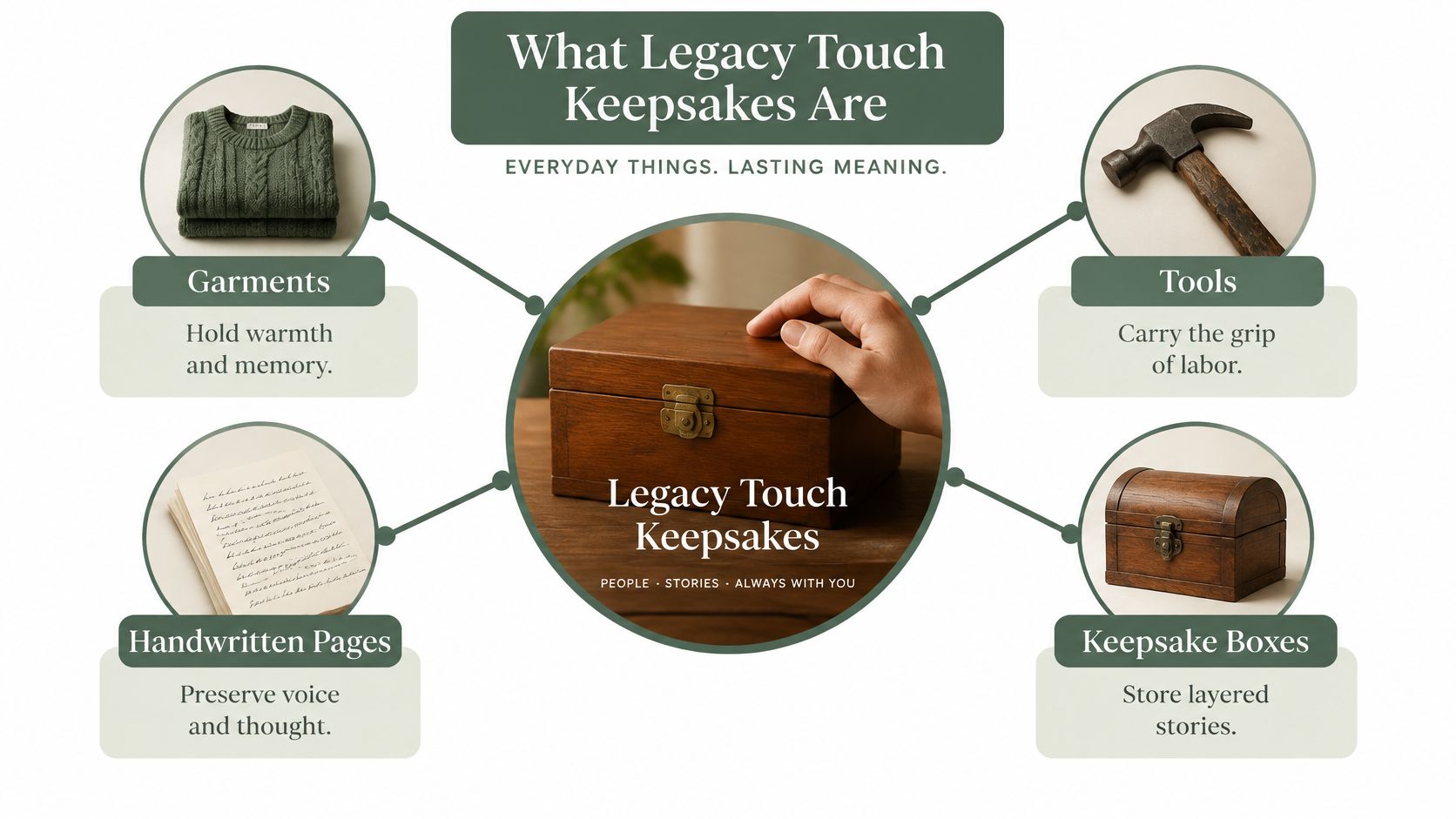
A photograph preserves appearance, while a keepsake adds the experience of handling something associated with a person. The recording fills in context. Without it, a future relative may see a hammer and know it belonged to their grandfather, but not know what he built with it or why its handle has a smooth patch. Together, the object and story create a more complete family record.
The three parts that make the connection
- The object: Choose something that belongs to the story, rather than an item selected only because it looks attractive.
- The tactile signature: Identify the feature that makes it recognizable by touch, such as raised embroidery, grain in the wood, or a paper texture.
- The narrative: Record the memory tied to the object, including names, places, and what the owner wants their family to understand.
An ordinary memento can be meaningful without a recording, and a digital archive can hold many stories without a physical object. The combination is what makes this approach distinct. It gives relatives something they can hold and a voice they can listen to, while preserving the relationship between the two.
The object doesn't have to be valuable or pristine. A patched pocket or a faded recipe page may carry more family meaning than a new keepsake made for display. The point is to preserve the object's context, not to make it perfect.
How Touch Triggers Memory and Emotion
Touch can prompt memories, rather than simply decorate an object. In a study of sensory-evoked memories, tactile cues brought up autobiographical memories with characteristics comparable to memories prompted by sight or sound. Tactile and auditory cues also produced relatively more positive and fewer negative memories in that research (study of sensory-evoked autobiographical memories).
That doesn't mean any rough or soft surface will bring out a meaningful story. The texture works best when it's clearly connected to a particular person or experience. A familiar wool blanket may bring back evenings at a family cabin because someone remembers its weight and scratchy edge. A smooth wooden grip may call up the feel of a tool used during years of home repairs.
The same research describes a reminiscence bump for memories cued by texture and sound, spanning approximately ages 5–9 through 20–24. In plain terms, sensory prompts can bring up memories from childhood, adolescence, and early adulthood, when many formative family experiences take place. The study supports treating texture as a deliberate part of the keepsake, not an afterthought.
Link one distinct cue to one story
Pick a tactile feature that's recognizable and directly associated with the story. If the recording describes a coat worn on winter walks, preserve or document its coarse fabric. If it's about a beloved woodworking project, describe the smooth cedar or the worn grip. Avoid adding several unrelated textures that might make the object harder to connect with a single memory.
Write the cue into the digital record using straightforward terms, such as “coarse linen,” “smooth cedar,” or “raised ink.” That description helps relatives understand what to notice, even if they encounter the audio separately or the object has changed slightly over time. It also keeps the person's explanation close to the physical detail that prompted it.
Real-Life Examples of Touch Keepsakes
A grandmother's linen apron hangs on a hook in the kitchen. Its fabric is coarse, and one pocket has been mended. Beside it, a recording captures her explaining how she learned to make Sunday bread, who used to help, and why she kept the apron long after its color faded.
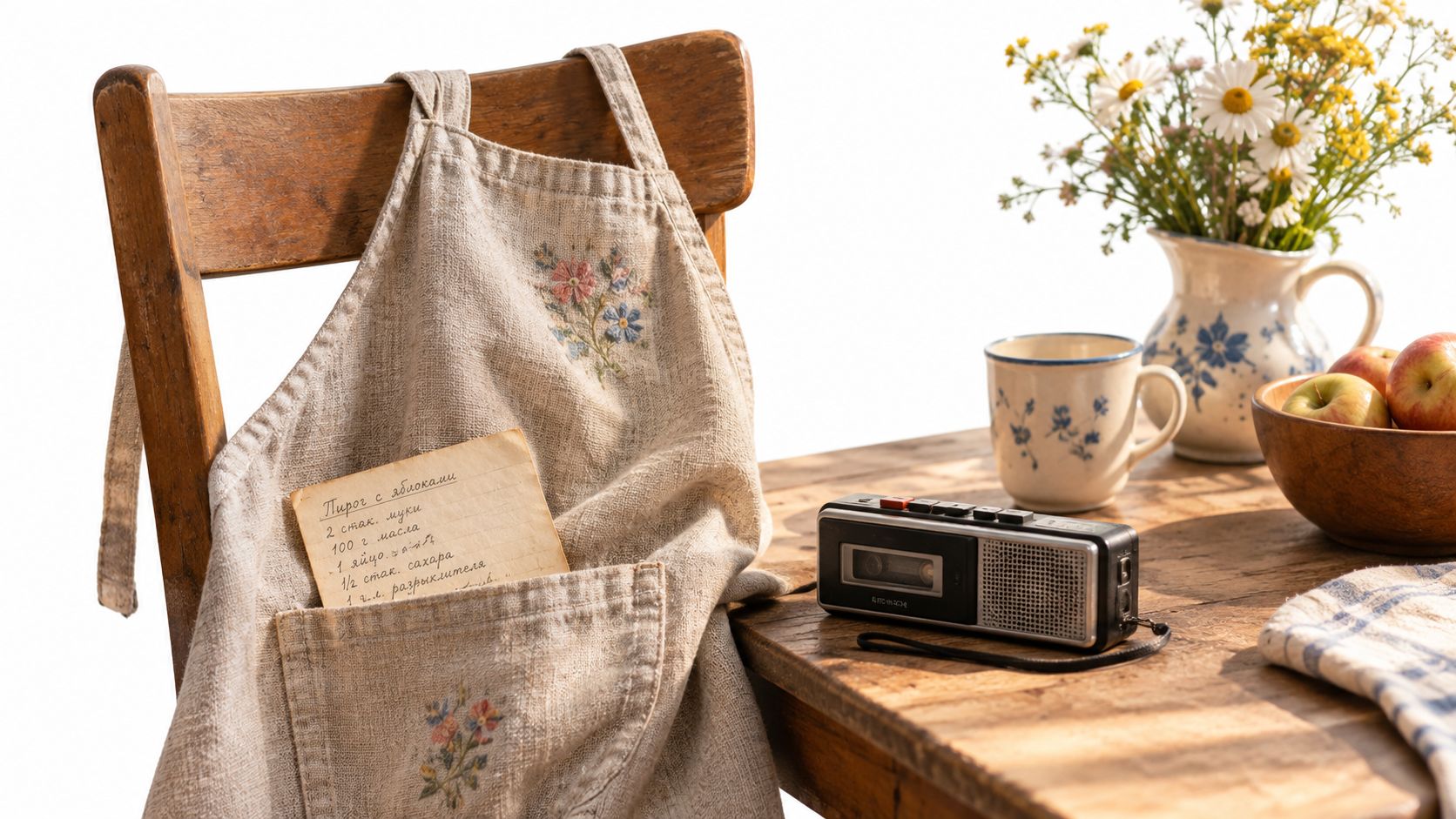
A father's wooden tool has a worn handle where his fingers rested. He records a story about building a family cabin, naming the person who helped and the part of the work he remembers most clearly. The wood's grain gives relatives a concrete detail to notice while they listen.
A handwritten letter offers a different kind of tactile connection. The family preserves the original paper and records its author reading the letter aloud. Later, a relative can follow the lines with their eyes, notice the indentations of the handwriting, and hear the voice that shaped the words.
For more ways to gather and preserve meaningful moments, browse these memory-keeping ideas for families.
Each example begins with an object that already belongs to a story. If you're choosing from a family collection, ask which items prompt a specific memory rather than asking which ones look important. Then ask the owner to describe the object in their hands: its weight, texture, wear, or sound.
The finished keepsake doesn't need elaborate packaging. A clear label or small card can identify the object and explain how to access the recording. The essential connection is that relatives can tell which story belongs to which object.
Listen to a family story and notice how voice adds context to a keepsake.
Pairing Recorded Stories with Physical Objects
A recording doesn't need a studio or a formal interview setup. A quiet room, a phone, and a thoughtful prompt can be enough. The aim is to make the person comfortable and keep the object and story connected from the start.
Choose one object and one memory. Place the item where the person can see and touch it. Ask what they notice first, then invite them to tell a story connected to it. Keep the focus on one memory rather than trying to cover a whole life at once.
Record in a calm, familiar place. Reduce background noise, set the phone or recorder nearby, and make a short test recording. Ask the person to speak naturally. They can pause, start again, or tell the story more than once.
Keep the tactile detail in the story. Prompt with questions like “What does the handle feel like?” or “What part of the fabric do you remember?” These details help connect the audio to the object for a later listener.
Create a written record. Save the audio with a clear title and a short description of the object and its tactile signature. A transcript makes the story easier to search and read. Research on structured autobiographical-memory activities found that participants in a randomized study of 111 institutionalized older adults experienced increased well-being that remained evident for the following 12 months (study on autobiographical memory and well-being). A keepsake recording isn't the same as that intervention, but inviting someone to reflect on a personal memory can make the process meaningful in itself.
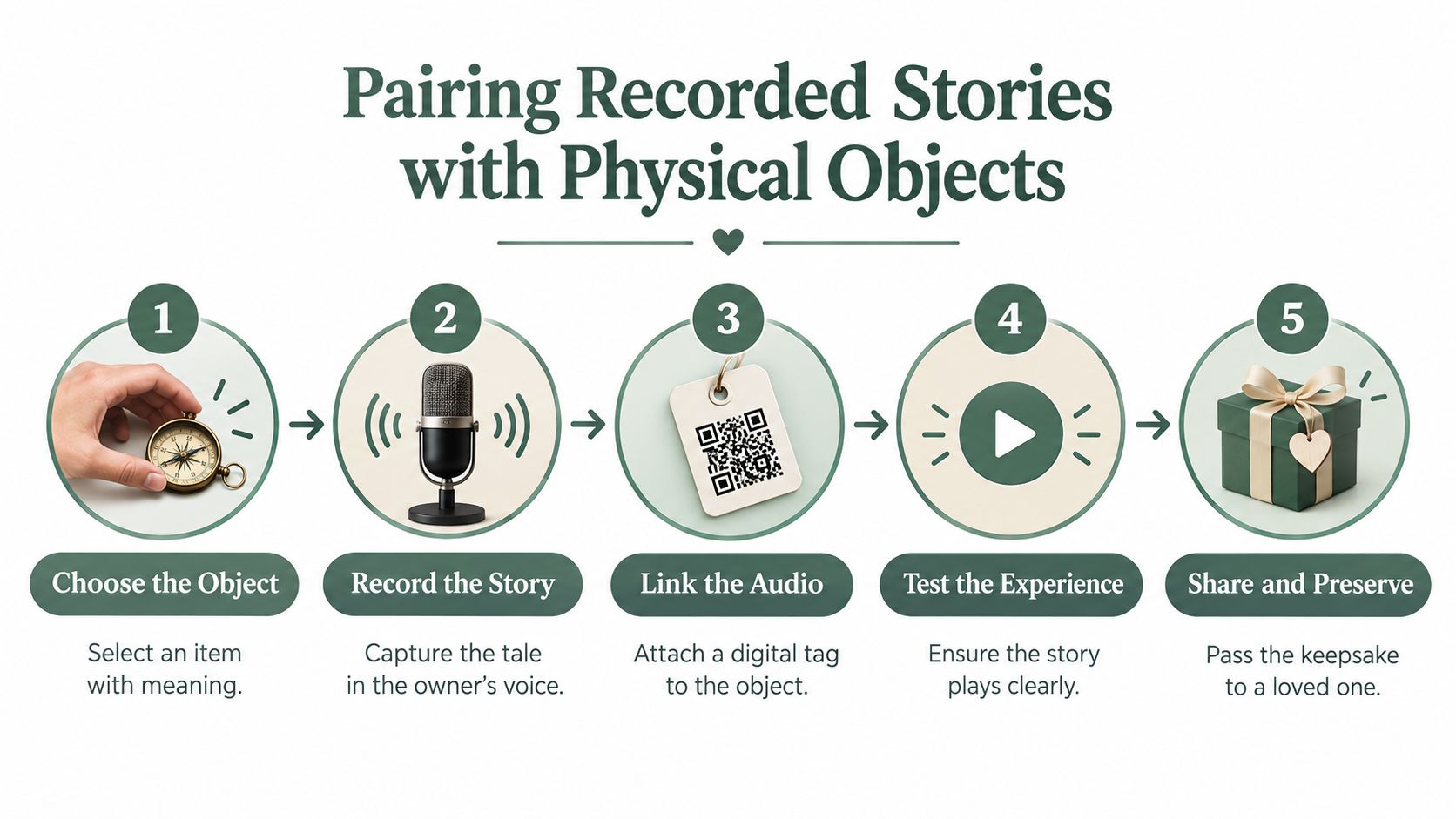
- Link and test the experience. Keep the recording in an organized digital archive, and consider adding a QR code or another simple access route to a label or card stored with the object. Test it with someone who hasn't used the system before. Can they find the story and play it without help?
Practical rule: Save the audio and its description together, and make sure a family member knows where the original file and its backup live.
For help planning a conversation, use these oral history interview suggestions. A family platform such as remembers.life can hold photos, stories, voice recordings, and milestones in a shared, searchable record, with automatic transcription for recorded memories. Whatever tool you choose, write down where the files are stored and how relatives are meant to access them.
Choosing Textures That Stay Recognizable
A texture only helps if the person holding the object can distinguish it. Older adults don't all experience touch in the same way, but age-related changes in tactile sensitivity make it sensible to favor clear, substantial details over tiny surface patterns.
A large assessment of older adults found that pattern-recognition thresholds increased from 6.75 mm among people aged 60–69 to 10.57 mm among people aged 90–99, a 56.6% difference between those groups (research on tactile perception in older adults). That finding points to a practical design choice: use physical differences that are easy to feel, rather than relying on fine microtexturing.
Choose for clarity and durability
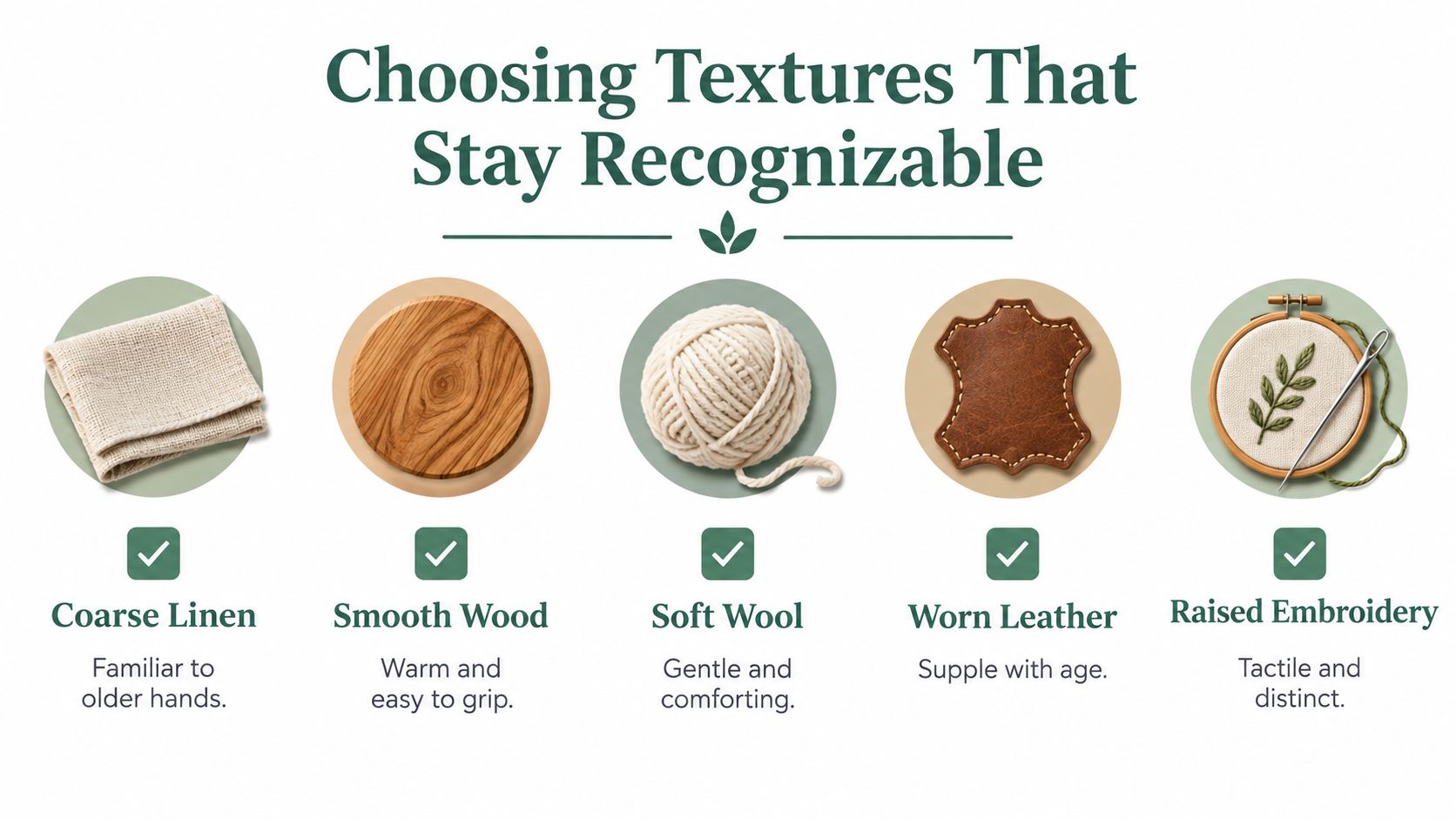
Raised lettering, deep embossing, generous spacing, and large-grain materials are easier to distinguish than subtle surface variations. A broad embroidered name may remain noticeable where delicate stitching disappears into the fabric. A wooden handle with a strong grain can offer a clearer tactile cue than a smooth surface with a faint pattern.
| Texture | What to check |
|---|---|
| Coarse linen | The weave should remain distinct with gentle handling. |
| Smooth wood | The grain and shape should be easy to feel and the object comfortable to grip. |
| Soft wool | The surface should feel recognizable without relying on a subtle difference in fiber. |
| Worn leather | The material should retain a clear character as it softens with use. |
| Raised embroidery | The stitching should have enough height to feel without precise pinching. |
Wear matters. Polishing, abrasion, and compression can flatten a tactile feature until it's difficult to recognize. Choose an object whose important texture is likely to last, and record a description while the cue is clear.
Try a simple test with the intended users. Ask them to identify the texture without looking, then note whether they recognize it comfortably and consistently. Include people with different levels of hand sensitivity, and adjust the design if the cue is hard to find. For advice on caring for related keepsakes, see these ways to preserve family documents.
Building a Legacy Plan That Lasts
A meaningful keepsake needs more than a recording and a safe place for the object. Families also need to decide who may access each story, and when. Some people may want a family-wide recording of a recipe or childhood memory, while choosing to keep a private letter available only to a particular relative.
Research on end-of-life data planning highlights the different purposes and sensitivities of digital materials, and recommends controls such as choosing recipients by data type, setting access duration, and specifying what should happen if an intended recipient dies first (research on planning access to digital legacy data). These choices can help families preserve treasured stories without assuming that every file should be shared in the same way.
Make a straightforward handover plan:
- List the locations. Record where the physical keepsake, original audio, transcript, and backup are stored.
- Name a trusted contact. Choose someone who can help relatives locate the material.
- Set access instructions. Clarify who may listen, share, export, or delete each item.
- Protect account access. Document recovery routes securely, without putting passwords on a public label or in an open family record.
- Check access over time. Periodically confirm that the files still open and the instructions still reflect the owner's wishes.
A keepsake only serves its family if the right people can find it and understand what they're allowed to do with it. Use this legacy planning guide to think through how an object, its story, and access instructions fit into a broader family plan.
remembers.life helps families create a digital record of life stories, photos, voice recordings, and milestones, then share it with relatives for preservation across generations. Pair a keepsake with a recorded memory and invite your family to continue the story at remembers.life.