Family History Story Book: Plan a Lasting Heirloom
Plan a family history story book with prompts, formats, and a structure that keeps uncertain and contested memories honest for the next generation.
You're sitting at the kitchen table and your dad starts the road trip story again, the one where the car broke down and a stranger fed the whole family. You laugh in the right places. Then you realize your grandchildren have never heard it, and nobody has written down where it happened, who was in the car, or why he still tells it. That small gap is where a family history story book begins.
Table of Contents
- Why a Family History Story Book Matters Now
- What Belongs in a Family History Story Book
- Formats and Templates That Fit Real Families
- A Three-Layer Story Structure with Examples
- Gather Sources Without Losing the Truth
- How to Choose Where the Stories Live
- Start the Heirloom with One Story
Why a Family History Story Book Matters Now
Most families don't lose stories all at once. They lose the details around them. A recipe stays in someone's head. A move to a new town gets mentioned but never explained. A photograph survives, but the names on the back are in handwriting nobody can read anymore.
A shoebox of prints is better than nothing, and it's often where a family starts. A phone gallery is handy too, until that phone is replaced, locked, or full of thousands of unsorted images. Neither one tells a grandchild who told the story, when it happened, and why it still matters.
One story is a valid start
You don't need a complete archive to begin. One photo and one short story can be the first page if you attach a name, a place, an approximate date, and the teller's own words. That matters most when the storyteller tires quickly, dislikes typing, or gets flustered by a long list of questions.
Waiting for a quiet month to do it properly is the habit that leaves the history with one person. A short session while someone is alive, relaxed, and willing gives you something a later relative can't reconstruct from a caption. You can always add a second session. You can't go back and ask the cook how much salt she meant by a pinch.
You don't have to finish the book this year. You have to keep the first story from living only in one person's memory.
Think of the book as a place your family can return to. Some relatives will add a long chapter about work or migration. Others will offer a joke, a phrase their mother always used, or a correction to a date. If the format welcomes those different contributions, the heirloom grows at a pace real people can sustain.
Today is the practical second-best time to start. The best time was when the earlier generation was still here to answer. What you can do now is record the living voice in front of you, keep it with the photo or paper it explains, and leave room for the next person to add what they know.
What Belongs in a Family History Story Book
A family history story book isn't a name chart, and it isn't a photo album with longer captions. A chart can tell you that two people married. It can't tell you how they met, what work they did, or why they left one town for another.
The useful material sits in four connected parts.
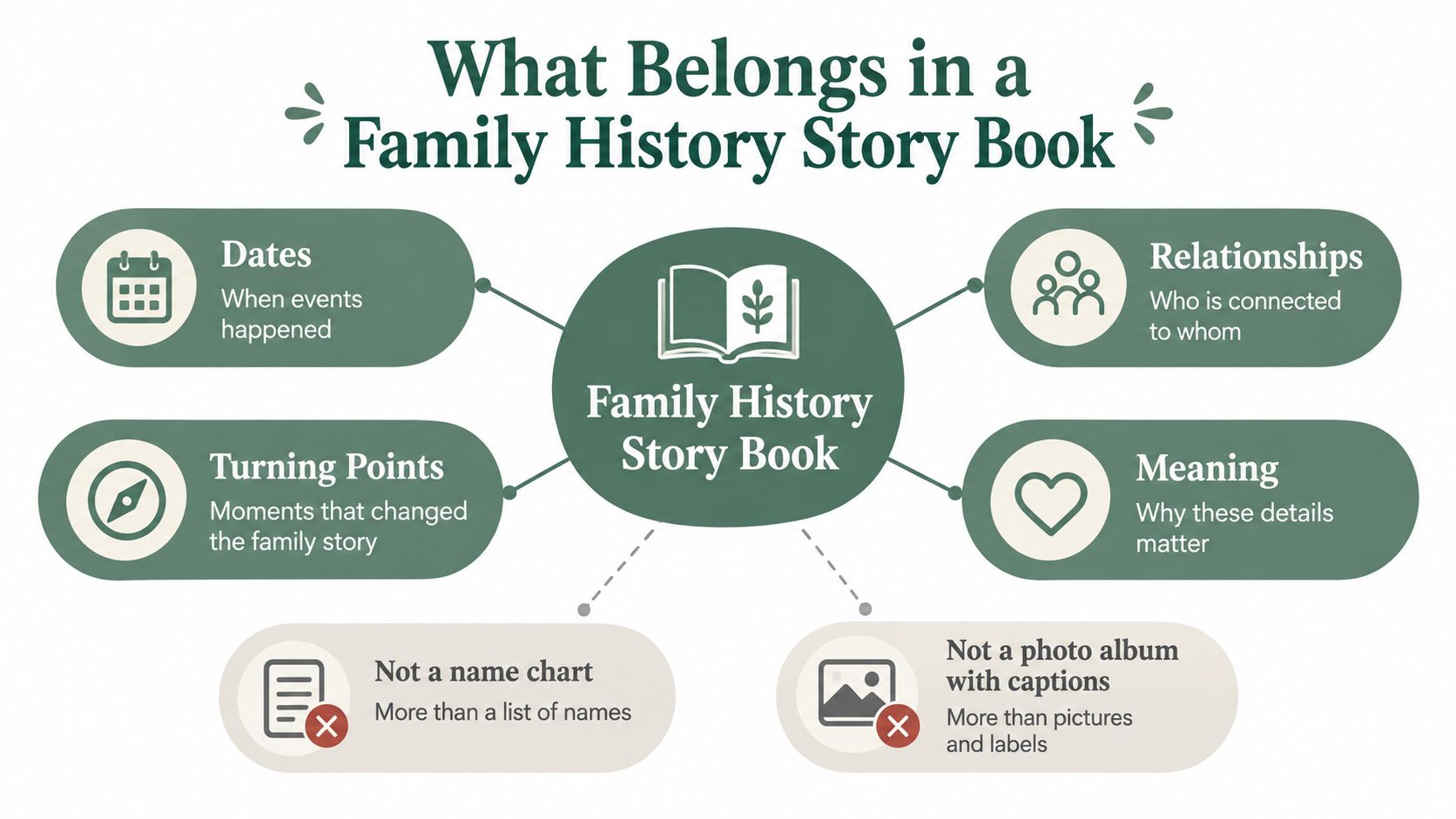
- Dates: When an event happened, even if the year is approximate.
- Relationships: Who is connected to whom, in plain words a young reader can follow.
- Turning points: The move, job loss, illness, marriage, or decision that changed what came next.
- Meaning: The teller's own reading of the event, kept separate from the facts around it.
That last part is what many families skip. They collect certificates and portraits, then wonder why the result feels flat. A page about a grandmother's caregiving years, her humor under pressure, and the advice she repeated tells a descendant who she was, not only where she lived.
Shaping a story is different from casually remembering
There's a research tradition behind this kind of deliberate shaping. A 2024 integrative review of 131 articles published from 1974 to 2023 found life review can offer short-term benefits for life satisfaction, depressive symptoms, and post-traumatic-stress symptoms in some older-adult groups, but is unlikely to improve self-esteem consistently. The same source summary notes a 2007 review of 15 controlled studies reported a moderate reminiscence effect size of 0.54, with structured life review producing greater psychological well-being benefits than simple reminiscence.
Read that carefully. It supports the value of organizing memories into a coherent narrative. It doesn't turn a keepsake book into a treatment for memory loss, and it doesn't guarantee well-being for anyone who sits for an interview. Your book is a preservation project with a thoughtful structure, not a medical promise.
So keep childhood scenes, work, caregiving, migration, jokes, advice, and the small phrases only that person used. If you're unsure where to begin a conversation, practical questions to ask family members before a recording session can help you choose a bounded topic. Save the detailed prompt method for the gathering stage. At this stage, you're deciding what kind of story deserves a page, and the answer is broader than births, weddings, and formal portraits.
Formats and Templates That Fit Real Families
Many how-to guides assume your relative can type a long account, scan photographs, sort dates, and finish a two-hour interview alone. Plenty of people can't, and that doesn't mean their stories are less worth keeping. Eyesight, stamina, hearing, handwriting, and confidence with a computer should shape the format from the start.
That isn't a side concern. A 2025 scoping review covering 1,551 participants, average age about 76, found short formats better suited cognitive or digital-literacy limitations, while longer formats supported deeper reflection, and digital books and albums were useful for intergenerational communication. A separate 2025 intergenerational storytelling program reported 94 percent session attendance and full completion in that same summary, which points to the value of guided, social sessions rather than leaving someone alone with a blank page.
Match the container to the person
| Format | Best when | Session length | Main limit |
|---|---|---|---|
| Physical scrapbook or binder | You want couch reading, gifts, and handwritten notes | Short sorting or dictation sessions | Hard to share with distant relatives |
| Simple digital album | Sharing photos matters more than long narrative | Brief uploads with help | Captions often stay too thin |
| Chapter template book | You want brief anecdotes beside longer chapters | Flexible, from one memory to a full sitting | Needs someone to keep names and dates consistent |
A binder works well for a relative who likes holding pages and pointing at faces. A digital album works when children live in different places and need easy access. A chapter template is often the middle path because a tired storyteller can give you a short anecdote today, and a stronger contributor can write at length next month.
Practical rule: Choose the format the least confident contributor can actually use, not the format the most organized relative prefers.
Use the same simple skeleton for every chapter so readers always know where to look. Write title, people, place, approximate date, what changed, and a note on confidence at the top. That header takes a minute to complete and saves a descendant from guessing which Uncle Joe is meant.
A polished book does not have to begin as a polished manuscript. It can begin with voice notes, short dictated paragraphs, and a few long chapters added by relatives who enjoy writing. The template holds those different lengths together without asking everyone to work the same way.
A Three-Layer Story Structure with Examples
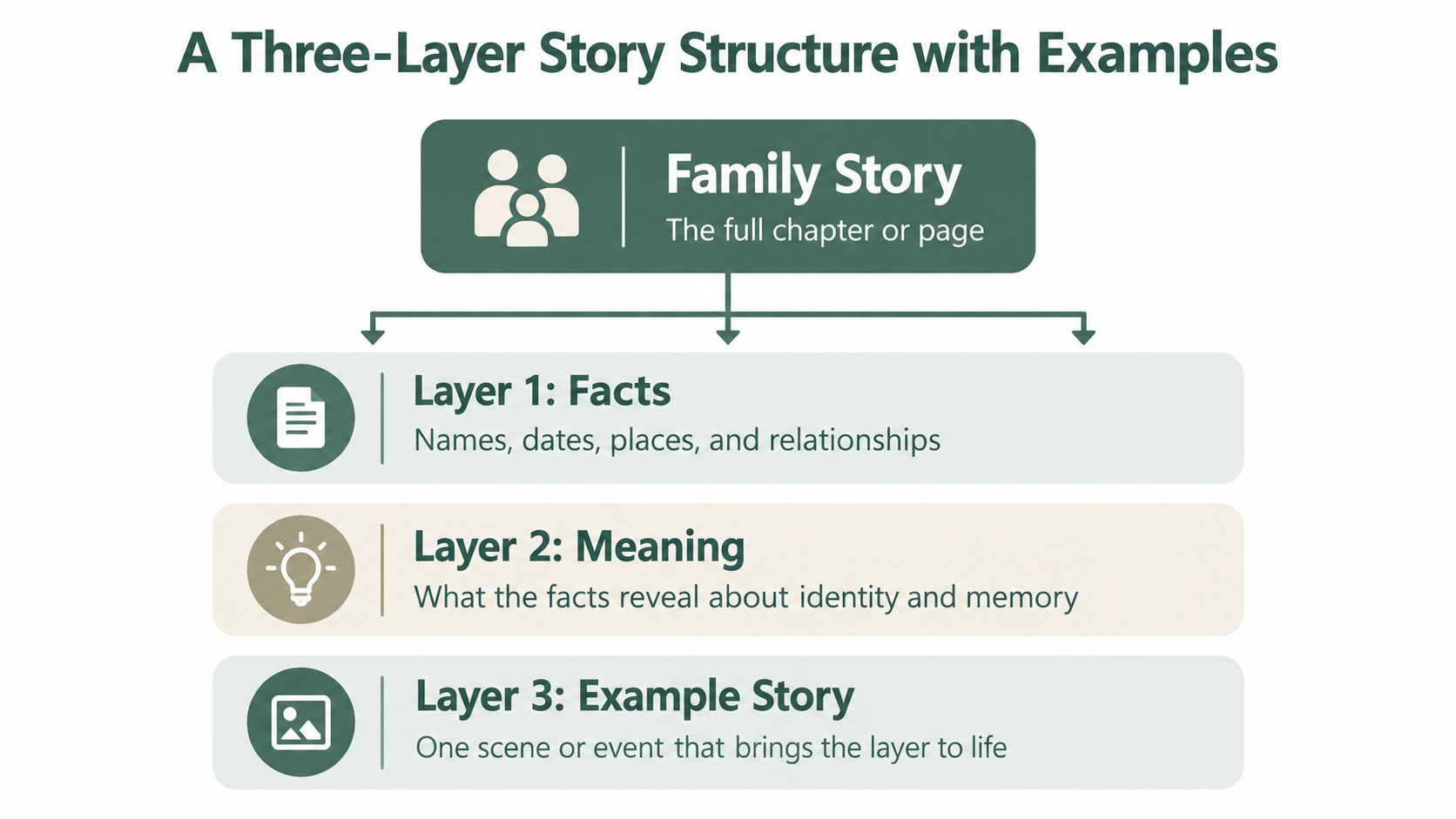
Once you've chosen a container, each story needs a shape that's easy to copy. The three-layer structure keeps facts, feelings, and later reflection from blurring into one smooth account that sounds more certain than it is.
There's a reason to include hard seasons, not only celebrations. In a study of 66 adolescents aged 14 to 16, greater reported knowledge of family history was associated with higher emotional well-being and stronger identity achievement even after controlling for general family functioning. For your book, that's a design clue. A young reader needs to see how relatives responded to difficulty, not just that they posed smiling at milestones.
The three layers on one page
- Layer one, the event and its evidence: State who, where, and approximately when, and name the photo, letter, or record that supports it.
- Layer two, the narrator's view: Record emotions, choices, and uncertainty in the teller's own words where you can.
- Layer three, a later reflection: Add a short, dated note from a child or grandchild about what they learned or how they read the story now.
Take an ordinary work story. Layer one says your mother took a night cleaning job after her youngest started school, and you attach a pay slip or a photo of the building. Layer two keeps her words about being tired, proud, and determined that her children wouldn't have to hide free lunch tickets. Layer three is your note, written today, explaining that you didn't understand the sacrifice until you paid for childcare yourself.
Now take a harder migration story that relatives tell differently. Layer one lists the departure town, the approximate date, and the documents you have. Layer two gives each narrator a labeled paragraph instead of blending them into one voice, so an aunt's memory of excitement can sit beside your father's memory of loss. Layer three records what a grandchild learned from hearing both, without declaring a winner.
Add source metadata under each major story. Write contributor, interview date, location, photo or document identifier, and confidence level. That small block lets descendants add a dated annotation later rather than rewriting the chapter. One person's version stays visible as a version, which is exactly what protects trust when memories differ.
Gather Sources Without Losing the Truth
A finished chapter looks calm. The work behind it is mostly careful listening and honest labeling. If you ask someone to tell you their whole life, you'll usually get the stories they've polished over decades, a few dates that drift, and long pauses where a more specific cue would have helped.
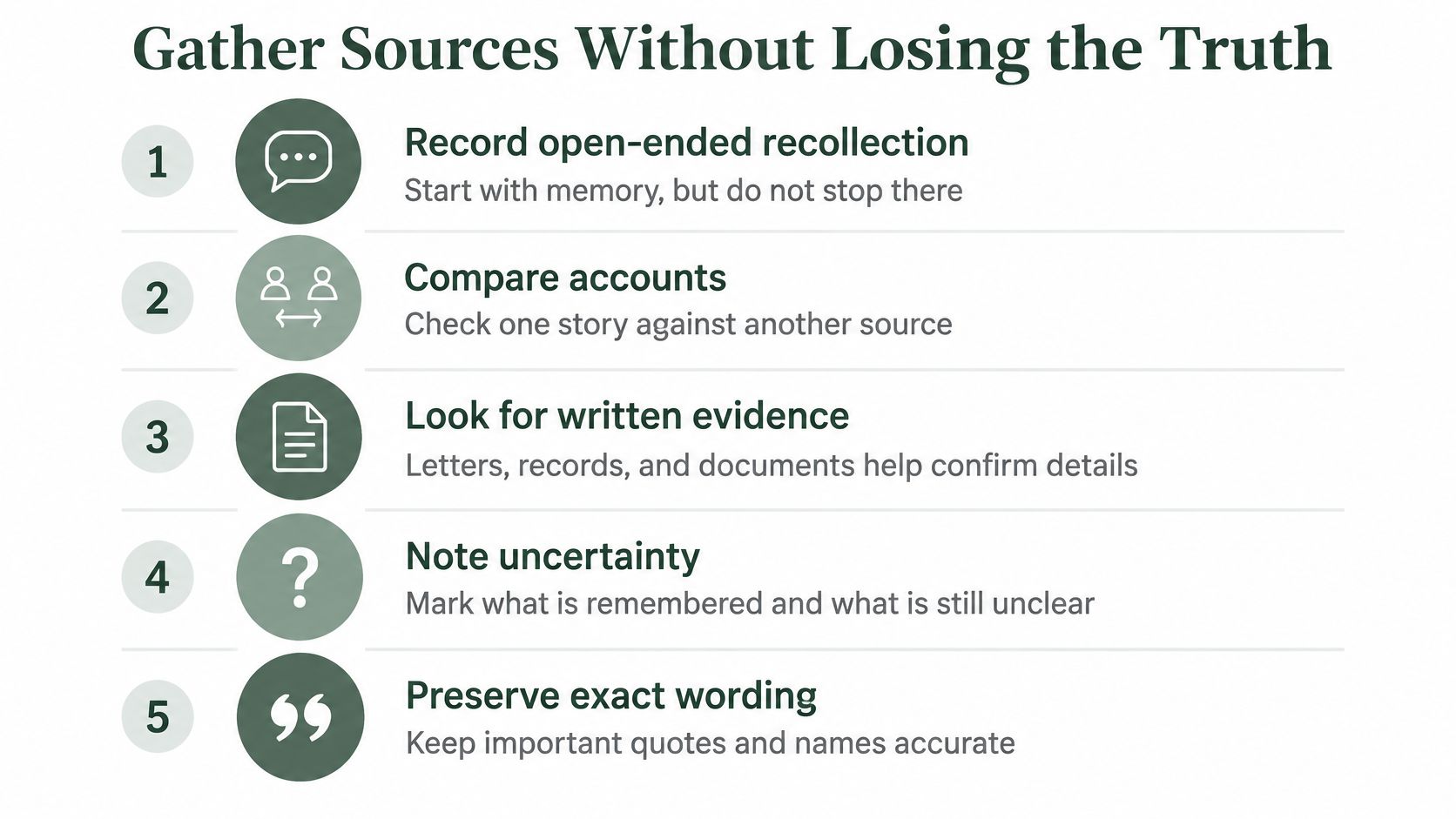
Open-ended recollection alone has limits. In a controlled study of healthy older adults, a simple reminiscence program did not significantly improve autobiographical memory, cognition, or psychological well-being compared with control conditions, which supports using specific retrieval cues and uncertainty labels rather than open-ended recollection alone. Your aim here isn't therapy anyway. It's a source record another relative can check.
Use cues that bring back a scene
Build each short session around people, places, approximate dates, sensory details, turning points, and consequences. Ask who was present. Ask what changed after the event. Ask what the person believed at the time, which may be very different from what they believe now.
Those three questions do more work than a broad request to talk about childhood. They give you a cast, a before and after, and a view from inside the moment. Follow with a photograph or object if one is at hand, and let the item prompt details you wouldn't know to ask about.
- Remembered: The teller recalls this directly.
- Family account: The teller heard this from someone else and is passing it on.
- Date approximate: The season or year is a best estimate, not a verified fact.
Marking uncertainty doesn't weaken a family story. It tells the next reader exactly how much weight to put on each detail.
Log every photograph, letter, or document beside the voice that explains it, and give the original careful handling. There's useful guidance on preserving family documents without damaging fragile originals if you're sorting boxes at the same time. Write a simple identifier in your notes, such as the envelope or album it came from, so a later relative can find the source again.
Keep recording sessions short enough that the storyteller stays fresh. Schedule a brief follow-up to fill gaps, then share a review proof in large print or by reading it aloud. Corrections at that stage are normal, and they're far easier than fixing a printed book that the family has already treated as final.
How to Choose Where the Stories Live
Where the material lives decides who can see it, who can add to it, and who can fix a mistake. That choice matters more when the history includes adoption, migration, estrangement, discrimination, uncertain parentage, or records that no longer exist. A home built for tidy, uplifting memories will strain under that kind of truth.
You're not imagining that difficulty. A 2025 survey project on Black and Brown genealogy describes barriers including lost records and family silence, with participants reporting that research can raise more questions than answers, which supports preserving uncertainty and more than one account. A good home for stories has to hold unanswered questions without pressuring you to invent a neat ending.
Three homes, three trade-offs
A private binder gives you full control and works without passwords, but only one household can hold it at a time. A shared folder is easy to pass around, yet files get renamed, duplicated, and separated from the notes that explain them. A purpose-built memory home keeps the story, media, and contributors together, which helps when several relatives are adding pieces over time.
One option in that third group is remembers.life, where you can build a memory profile and timeline for one person, add written stories with photos and video, and use voice notes with automatic transcripts. Its family room lets relatives contribute to the same record, so the archive doesn't sit on one person's phone. If you're collecting memory keeping ideas that relatives of different ages will actually use, that shared contribution piece is worth weighing against a folder only one person maintains.
Whichever home you choose, run the same decision tests. Can you limit a sensitive chapter to certain people, and get clear consent before sharing it wider? Is the storyteller named on every account, with visible uncertainty markers where the family disagrees or doesn't know? Can an older relative review by listening or in large print instead of typing corrections into a small screen?
A simple test: If a cousin finds a better date next year, can they add it without erasing what your father originally said?
Pick the place that lets you add, correct, and restrict access after the first version exists. Families change their minds about what's private. New documents turn up in attics. A home that treats the first telling as permanent will eventually force someone to choose between accuracy and peace in the family.
Start the Heirloom with One Story
You don't need a launch plan, a family meeting, or agreement on the full table of contents. You need one living storyteller and one bounded memory. A first job, a move, a recipe, a family joke, or a hard season is enough, as long as the person is willing and gives consent to record it.
Choose a memory with edges. The summer someone learned to drive is easier to capture than an entire childhood. A single workplace, house, or journey gives you natural prompts about who was there and what changed when it ended.
A first session you can do this week
- Ask and agree: Explain where the story will live and who may hear it, then stop if the answer is no.
- Capture the voice: Record a short session if possible, and say the speaker's name and the date at the start.
- Attach one item: Add a photo or document if it's nearby, and note where the original is kept.
- Mark what is approximate: Write your uncertainty labels while the conversation is fresh, not weeks later.
If you want a calmer way to run that first conversation, look at practical approaches to oral history interviews online before you sit down. Invite one relative to help or listen, not the whole family at once. A small session produces usable material, while a big announcement often produces opinions about the project and no recorded story at all.
When the session ends, put that single piece into its home the same day. Create the person's profile if you're using a digital timeline, add the voice note or written story, and share access only with people who should hear this particular memory. A story saved in the right place, with the right permissions, is finished enough for today.
Missing chapters are not a failure in a family history story book. Conflicting memories, added annotations, and a page that says the family doesn't know are what make the record durable. Your grandchildren won't need you to have been perfect historians. They'll need you to have started while a voice was still here to record, and that decision can be made with one story today.
If you'd like that first story to live somewhere built for it, remembers.life gives you a memory profile and timeline where you can add voice notes with transcripts, photos, and written chapters in one place. You can invite relatives into a shared family room to add their own accounts, correct a date, or keep a sensitive memory limited to the people who should see it. Start with one bounded story this week, save it with its teller's name and date, and let the heirloom grow from there.