Life Story Writing for Seniors: A Practical Guide
A practical guide to life story writing for seniors, with interview prompts, gentle techniques, and sharing tips that preserve every voice.
The first recording often begins with a question that sounds harmless: “Can you tell me about your childhood?” The senior pauses, looks at the microphone, and says, “Where would I even start?”
Life story writing for seniors works best when that pause is treated as useful information, not a problem to overcome. The finished book, recording, or archive matters, but the process matters more. A respectful project protects pace, dignity, memory, privacy, and editorial control while giving a person room to decide what their life means in their own words.
Table of Contents
- Why the First Conversation Matters More Than the First Page
- Preparing the Project Before the First Prompt
- An Interview Sequence That Respects Voice and Pace
- Writing Techniques That Preserve a Real Voice
- Formats and Preservation Options Worth Comparing
- Sharing the Story With Family Without Losing Control
- A Gentle 90-Day Starter Plan for Hesitant Families
Why the First Conversation Matters More Than the First Page
An adult daughter once arrived with a notebook, a list of questions, and a clear idea of progress. She asked her father about his first job, then his marriage, then the address where he lived as a child. He answered briefly, corrected himself twice, and eventually said he was tired. The daughter left with almost no usable material, and both of them felt they had failed.
The problem wasn't his memory. It was the shape of the encounter. She had treated a personal conversation like a job interview, where the interviewer controls the pace and the subject supplies answers.
A kinder opening might involve tea, an old photograph, a familiar song, or an object from the senior's home. Instead of beginning with a demand for chronology, try: “Would you like to tell me what you remember about this?” Then add a choice: “We can talk about it, leave it for another day, or skip it altogether.”
Capturing a life means making room for a person. Interrogating one means trying to extract a record.
Before asking for a story, agree on the purpose. Is this a private family record, a gift for grandchildren, a personal reflection, or material the senior may eventually share more widely? Ask how they want to sound on the page. Some people prefer polished paragraphs. Others want their spoken rhythm, humor, pauses, or regional expressions preserved.
A short conversation about boundaries can prevent months of confusion. Discuss who may listen to recordings, whether relatives can contribute, and whether the senior can remove a passage later. Families who find difficult conversations intimidating may benefit from this practical guide to family conversations before a crisis, which offers useful context for discussing wishes before decisions become urgent.
Structured reflection has a credible foundation beyond sentimental value. A 2023 systematic review and meta-analysis combining 37 randomized controlled trials and 2,353 participants found a statistically significant improvement in quality of life after structured life review and reminiscence activities, with a standardized mean difference of 1.07 and a 95% confidence interval from 0.48 to 1.66 (review of life-review interventions). That evidence supports taking the process seriously, while still avoiding promises of therapy or guaranteed outcomes.
For a clear distinction between a casual family conversation and a recorded oral-history session, review this explanation of what an oral history interview involves. The first meeting doesn't need a chapter. It needs trust.
Preparing the Project Before the First Prompt
A life story project becomes safer and easier when the decisions are made before the recorder is switched on. Families often focus on questions first, but consent, scope, and control determine whether those questions will feel welcome.
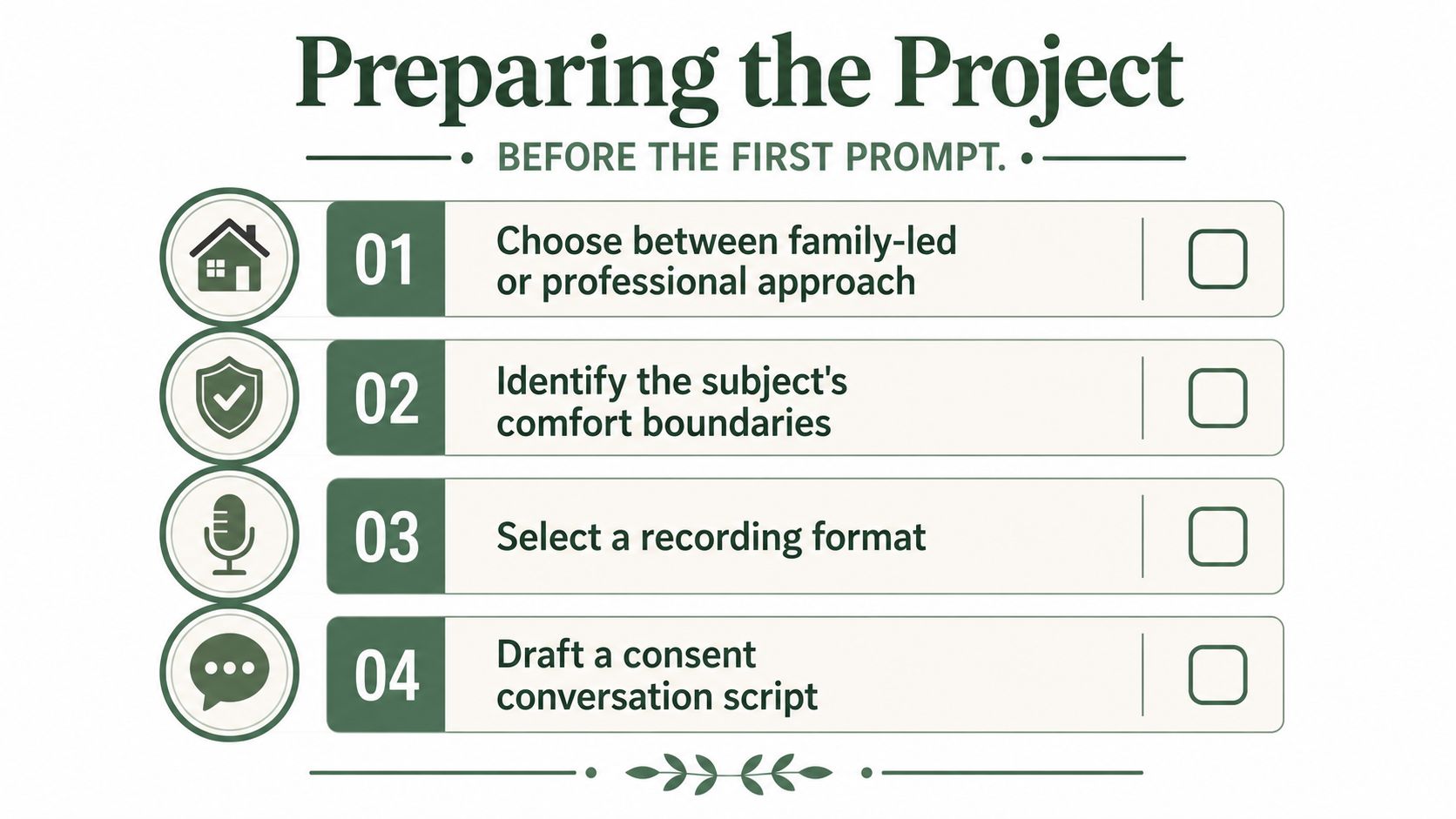
Decide who is leading
A family-led project may feel warm and informal, but family relationships can also make certain subjects difficult. A professional interviewer can offer distance, structure, and practiced listening. Neither option is automatically better. Ask the senior which setting makes it easier to speak freely.
Write down the names of everyone who may participate. Decide whether spouses, adult children, grandchildren, carers, or friends can attend each conversation. A person may share something with one listener that they wouldn't share in a larger group.
Agree on boundaries
Use plain questions before the first prompt:
- Recording permission: May the conversation be recorded, transcribed, photographed, or filmed?
- Topic boundaries: Which subjects are off-limits for now, and which may be revisited later?
- Editorial control: Can the senior correct wording, remove passages, use pseudonyms, or decline publication?
- Session design: What time of day feels best, and when should the conversation stop?
- Access: Who can hear the recordings or read drafts?
Don't assume that a relative's presence is comforting. Ask privately if the senior wants that person there. Also decide how you'll respond if a painful subject appears unexpectedly. A simple agreement such as “pause, reframe, or skip” gives the senior an immediate exit.
Make the equipment ordinary
Choose a quiet room with comfortable seating and familiar devices. Test the phone, microphone, or recorder before the visit, preferably on equipment the senior already understands. Explain where the file will go and who will store it. Technical mystery can feel like loss of control.
Life story writing isn't medical treatment. If grief, trauma, cognitive impairment, family conflict, or severe distress emerges, stop the interview and consider appropriate professional support. The project can offer reflection and connection, but it shouldn't become an undeclared therapy session.
Research supports thoughtful facilitation. A 2025 systematic review and meta-analysis found that reminiscence and life-review interventions reduced loneliness in older adults with a large pooled effect, with an SMD of −1.40, a 95% confidence interval from −1.96 to −0.84, and p < 0.01. The same review found that professionally facilitated sessions outperformed those led by non-professionals (meta-analysis of reminiscence and loneliness). That doesn't turn every memoir project into a clinical intervention, but it does show why interviewer skill and social design deserve attention.
An Interview Sequence That Respects Voice and Pace
A useful interview has a shape, but it shouldn't feel like a test. Move from permission to story, then from story to detail and meaning. Leave chronology flexible.
Start with consent and one open question
Begin by confirming the boundaries: “Are you comfortable recording today?” and “Is there anything you don't want to discuss?” Then ask one broad question, not five narrow ones:
- “What place from your childhood still feels vivid to you?”
- “Tell me about a time when you realized your work mattered to you.”
- “What ordinary routine from family life do you remember most clearly?”
Let the senior choose the direction. If they start with a story from later life, don't force them back to childhood. Personal memory often follows significance rather than calendar order.
Add detail without taking over
Once a story has begun, use gentle follow-ups. Ask what the room looked like, what sounds were present, who else was there, or what happened afterward. Sensory prompts can help when direct recall feels difficult. A photograph, recipe, uniform, tool, letter, or song may open a memory more naturally than a date.
| Prompt category | Example opening | Follow-up probes |
|---|---|---|
| Childhood home | “What did home feel like when you were young?” | “What could you see from the doorway?” “Who usually gathered there?” |
| First work | “Tell me about your first job.” | “What did a normal day involve?” “What did you learn there?” |
| Partnership | “How did you and your partner spend ordinary days?” | “What made you laugh together?” “What changed after you met?” |
| Parenthood | “What part of raising children surprised you?” | “What did you worry about?” “What do you remember doing together?” |
| Turning point | “Was there a decision that changed your direction?” | “What choices did you have?” “How do you understand it now?” |
| Daily ritual | “What small habit has stayed with you?” | “When did it begin?” “Does it mean something different today?” |
The sequence can also help you choose questions to ask family without turning a visit into a questionnaire. Keep the list nearby, but follow the story in front of you.
Use the pause, reframe, or skip rule
When grief, illness, estrangement, abuse, or conflict appears, don't press for a complete account. Say, “Would you like to pause, talk about a different part, or leave this out?” If the senior repeats a story, listen for what the repetition may signal. Correcting them sharply can make the conversation feel like an examination.
Memory can change with age, fatigue, medication, or cognitive impairment. Shorter sessions, familiar objects, and one topic at a time may work better than a long chronological interview. If details conflict, record the distinction respectfully: “You remember the move happening in spring, while another document suggests summer. Which version feels right to include?” The senior should never have to defend their identity to the fact-checker.
Separate memory from later interpretation. Ask, “What did you think at the time?” and then, “How do you understand it now?” Both answers belong in the story, provided the senior wants them included. End by asking what should be corrected, omitted, or revisited later.
Writing Techniques That Preserve a Real Voice
Many families assume good life story writing means making every sentence elegant. That assumption can flatten the person. A polished paragraph may be grammatically excellent and completely unlike the senior who lived the experience.
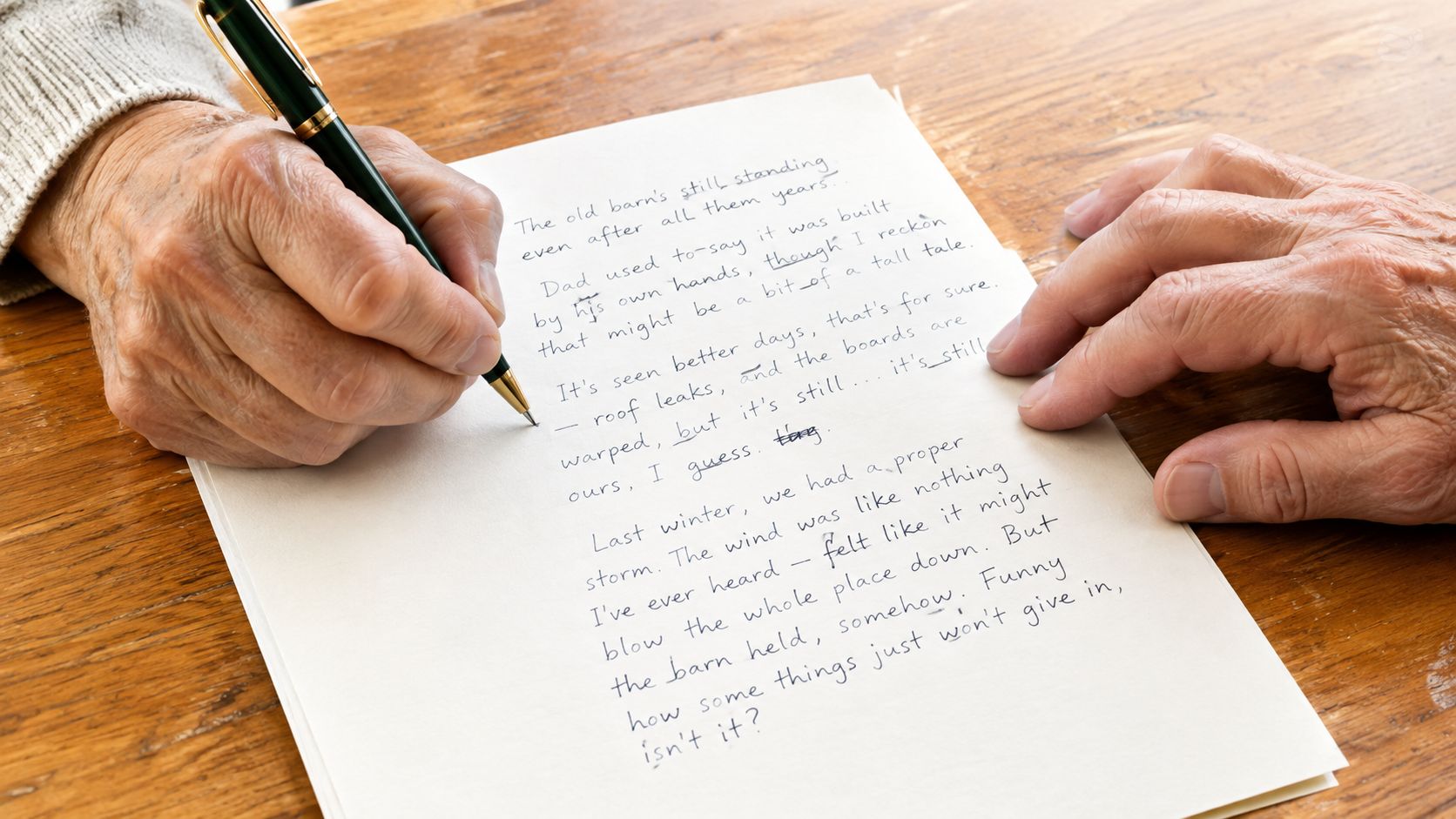
Start with faithful transcription. Keep a distinctive phrase, a pause that carries emotion, or a humorous turn of speech when it helps the reader hear the person. Remove repetition that obscures meaning, but don't erase every hesitation. The aim is clarity without replacing the speaker.
Read drafts aloud with the senior. Ask, “Does this sound like you?” rather than “Is this correct?” A senior may approve the facts but reject the tone. They may want a sentence shorter, a name removed, or an opinion expressed more strongly.
Let structure serve memory
You don't need to organize every chapter by date. A photograph of a kitchen, a workbench, a wedding coat, or a train ticket can anchor a scene more naturally than a year heading. Use short scenes for moments that matter, then add concise context around them.
For someone who finds typing tiring, use dictation on a familiar phone or tablet. A family scribe can type while the senior speaks, or a speech-to-text tool can create a first draft for later review. A practical guide to speed up writing with dictation can help families compare voice-input options without asking the senior to learn a complicated writing system.
A 2025 meta-analysis covering 24 randomized controlled trials and 1,963 participants found improvements in global cognition, memory, depression, and quality of life from reminiscence-based work, but no significant improvement in executive function (meta-analysis of reminiscence-based work). That distinction matters. A project shouldn't measure success by how many pages someone produces or how perfectly they remember a sequence.
Contradictions and missing periods don't automatically need repair. Mark uncertainty, invite corrections, and allow two family memories to coexist when the senior wants that. A guide to writing family history can help with broader structure, but the senior's approval remains the final editorial test.
Formats and Preservation Options Worth Comparing
The right format is the one the senior can access, understand, revise, and control. A beautiful book that no one can update may be less useful than a modest archive with clear permissions.
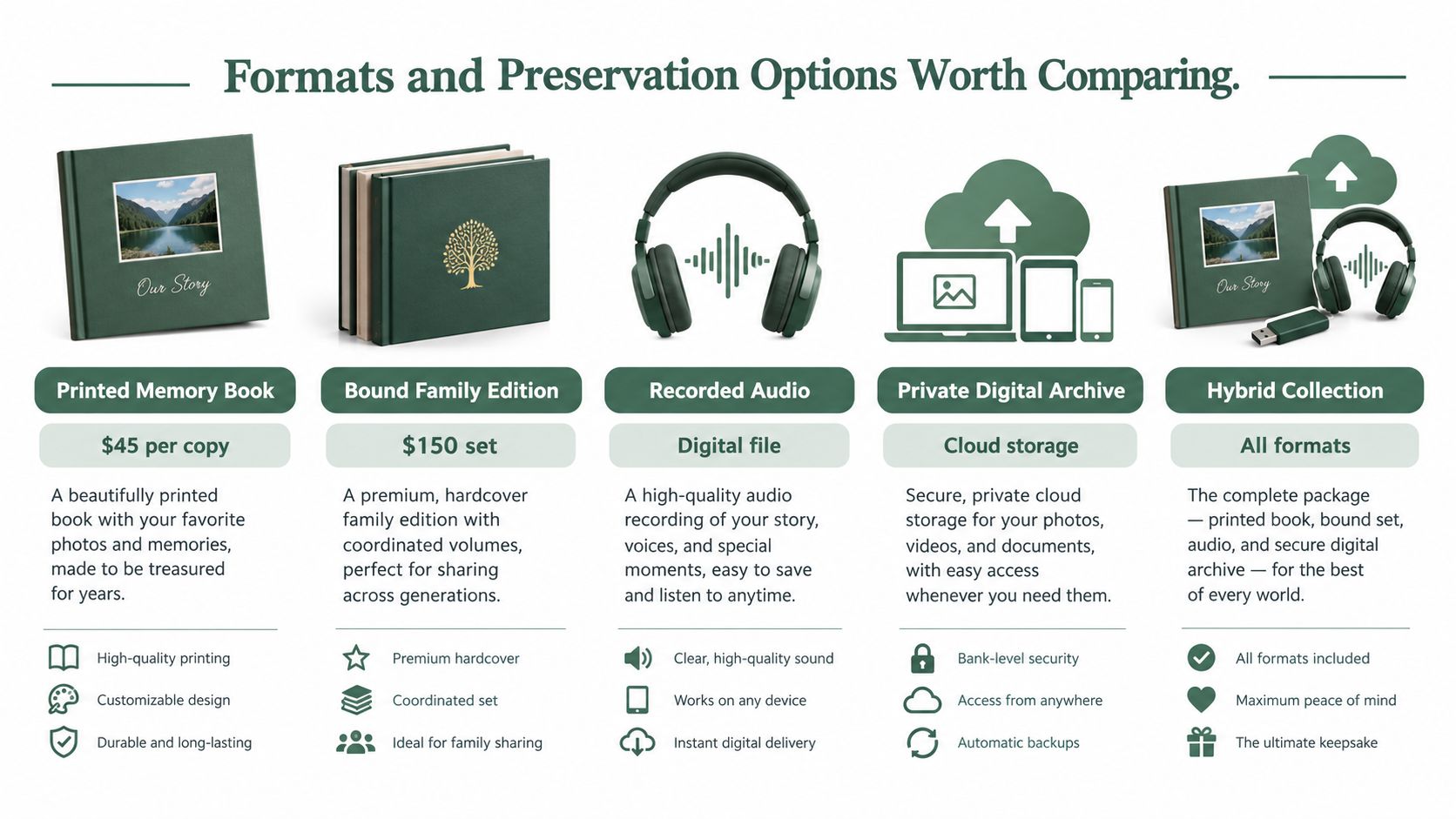
| Format | Durability | Access control | Ease of updating | Senior control |
|---|---|---|---|---|
| Printed memory book | High when stored carefully | Physical possession controls access | Low | Strong at approval stage, limited after printing |
| Bound family edition | High | Shared copies widen access | Low | Depends on who receives copies |
| Recorded audio | Depends on file storage and playback access | Can be restricted digitally | High | Strong if the original files remain available |
| Private digital archive | Depends on account and backups | Detailed permissions may be possible | High | Strong if ownership and deletion rules are clear |
| Hybrid collection | Combines strengths and weaknesses | Must coordinate several formats | Moderate to high | Strong when one person manages permissions transparently |
A printed book is easy to give to someone who doesn't use digital tools. Audio preserves cadence, laughter, and pronunciation that a transcript may lose. A private archive can hold photographs, written passages, milestones, and recordings together, but it requires clear account access and ongoing maintenance. Families considering audio can review this guide to life story audio recording before choosing equipment or file types.
Keep original recordings alongside edited transcripts. Store copies in more than one physical location, and explain who can access them. Use widely supported file formats rather than relying on one aging device, application, or platform. Revisit the archive when technology changes, especially if the senior wants the right to delete or restrict material.
Digital storytelling research identifies privacy as a central barrier, while also finding that attitudes can change when older adults receive structured support and training (research on digital storytelling and older adults). The practical lesson is simple: don't interpret hesitation as resistance. Explain the system, demonstrate control, and let the senior decide whether the convenience is worth the trade-off.
Among the options, remembers.life lets users combine written stories, photographs, milestones, memories, and voice recordings in a shareable record, with recordings transcribed into a searchable family archive. It can suit families who want one collaborative place, provided they still discuss permissions, backups, and future access before uploading sensitive material.
Sharing the Story With Family Without Losing Control
Sharing shouldn't be a single yes-or-no decision. Build layers.
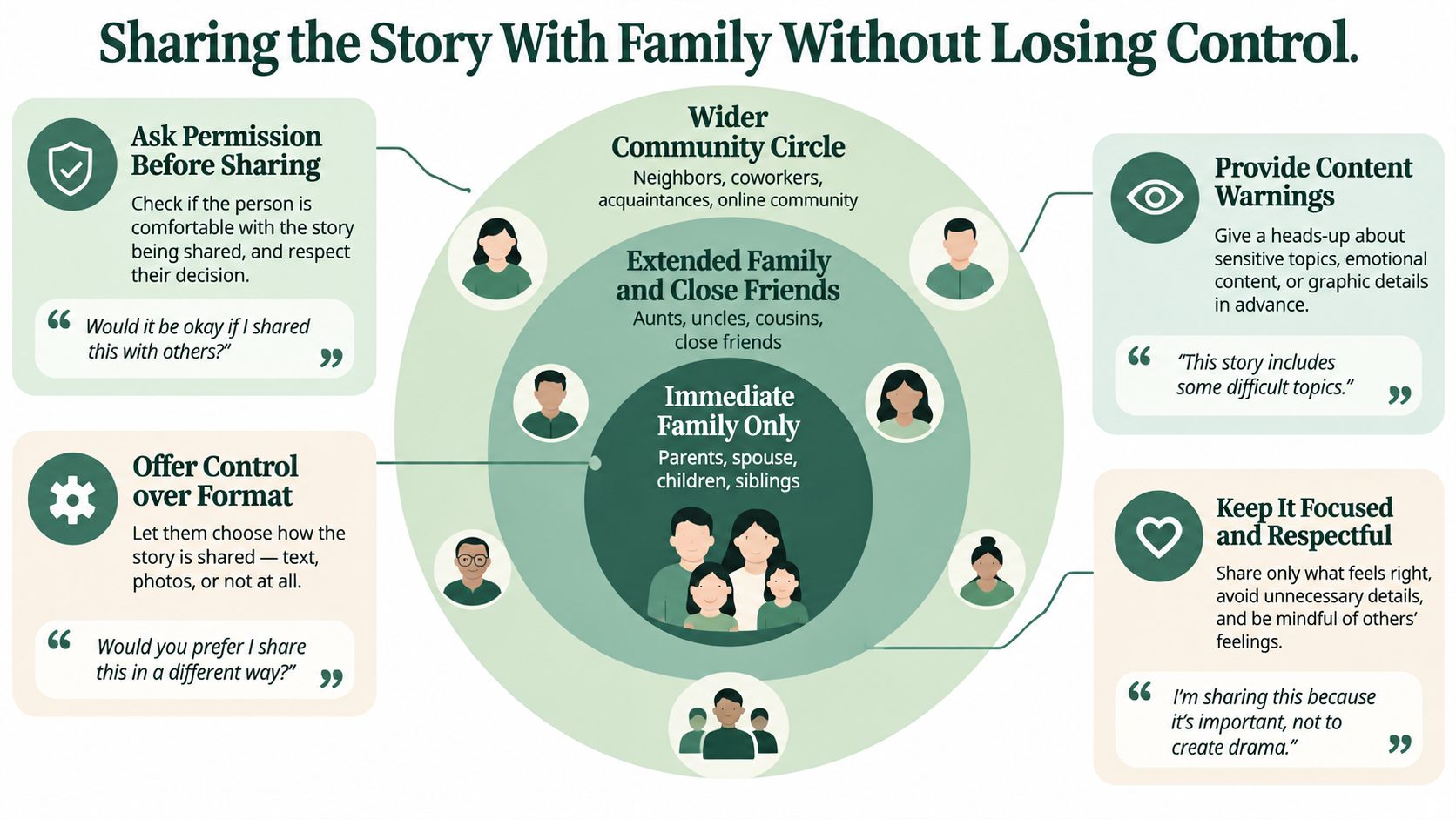
Start with the smallest circle, such as the senior and one trusted editor. Expand to immediate family only if the senior approves the draft. A wider circle, community group, or public publication should require a separate decision, especially when the story includes living relatives.
Useful scripts make consent concrete:
- “Would you like this passage shared with the family, kept private, or removed?”
- “Your sister appears in this story. Would you like to use her name, describe her generally, or leave the passage out?”
- “You can change your mind about access. Who should help carry out that decision if you can't manage the archive later?”
Sensitive subjects need special care. Adoption, migration, illness, financial details, estrangement, and abuse may affect people who aren't present to respond. The senior can tell their experience, but that doesn't automatically grant permission to publish another person's private information. Consider pseudonyms, content warnings, restricted passages, or a private version that never leaves the family archive.
The senior's voice leads. The family's job is to protect it, not overwrite it.
Write down the custodian's role. That person should know how to correct a transcript, remove a file, change access, and respond to a relative's request. If relatives disagree, return to the senior's documented wishes rather than choosing the loudest family member.
A Gentle 90-Day Starter Plan for Hesitant Families
A family that has delayed for years doesn't need a grand launch. It needs a small agreement and a first conversation that ends while everyone still has energy.
This week
Create a one-page project brief. Include the purpose, intended audience, preferred format, participants, recording permission, topics to avoid, and the senior's right to edit or withdraw material. Choose five objects or photographs that might invite stories without forcing a timeline.
Hold one short pilot session. Ask one open question, listen for fatigue, and finish with a review: What felt comfortable? What felt intrusive? What should change next time?
This month
Schedule the next conversations around the senior's energy, not the family's calendar. Decide on a preservation format before the second session becomes a pile of unnamed files. Label recordings clearly, keep originals, and let the senior hear or read a small sample.
Measure the process rather than the word count:
- Completed sessions: Did the agreed conversations happen?
- Participant comfort: Did the senior feel listened to and free to stop?
- Factual corrections: Could the senior revise details without feeling tested?
- Perceived connection: Did the project create a meaningful conversation?
At the 90-day mark
Review the project with the senior. Continue, pause, change interviewer, narrow the subject, or stop if that is what they want. A complete life story doesn't have to include every year. It may be a set of scenes, voices, photographs, and reflections that accurately preserves what the person considers important.
The strongest life story writing for seniors treats the relationship as the core work. A finished book is one possible result, not the measure of whether the project respected the person who made it possible.
remembers.life helps families combine written stories, photos, milestones, memories, and voice recordings into a shareable life story, with spoken memories transcribed for a searchable family archive. Visit remembers.life to begin a respectful record that keeps the senior's voice and choices at the center.