Why Oral History Is Important for Families
Discover why oral history is important for families and communities. Learn how recorded stories preserve memory, identity, and legacy across generations.
A granddaughter opens a recipe tin and finds her grandmother's handwriting, but nothing about who taught her the dish or why she made it every winter. When she asks around, everyone remembers the meal, yet nobody remembers its beginning.
Table of Contents
- What Happens When Family Stories Disappear
- What Oral History Captures That Other Records Miss
- How Recorded Stories Reshape the Historical Record
- Planning and Conducting Meaningful Family Interviews
- Who Controls the Story After It Is Recorded
- Preserving Recordings So They Outlive the Formats
- Your First Family Oral History Project
What Happens When Family Stories Disappear
A family can keep an object and still lose its meaning. A photograph preserves faces, a recipe preserves ingredients, and a certificate preserves an official event, but the people who understood their significance may never have explained them on paper.
Consider a photograph of relatives standing beside packed suitcases. You might know where they went, yet not why they left, who helped them, or what they were afraid to leave behind. Those unanswered questions help explain why oral history is important: it preserves the human context around the evidence families already have.
A photograph can be the starting point for that conversation.

From familiar stories to a lasting record
Oral history means gathering firsthand accounts through conversation and preserving them for future use. Unlike a story told over dinner, an oral-history interview leaves a record that someone else can revisit, examine, and understand.
You don't need a famous ancestor or a dramatic family history. An account of running a household, learning a trade, or choosing where to live can explain relationships and decisions that otherwise disappear from view.
A family story doesn't need to describe a public event to deserve a place in history.
The importance of collecting testimony is visible on a much larger scale. The USC Shoah Foundation's Visual History Archive contains more than 52,000 Holocaust survivor oral histories, is available through 185 access points in 15 countries, and supports educational activities reaching approximately 10 million learners annually, as described in research on Holocaust testimony preservation.
A family archive has a different purpose and scale, but the urgency is recognizable: opportunities to ask firsthand questions narrow as witnesses age. Begin while someone can still explain the people and places in the photograph.
If damage makes an old picture difficult to examine, MyImageUpscaler damaged photo repair is a resource to explore alongside your interview preparation. Keep the untouched original, and treat any repaired version as a viewing aid rather than new historical evidence.
What Oral History Captures That Other Records Miss
A birth certificate may identify someone's parents and birthplace. It won't usually explain who cared for that child when a parent worked away, which neighbor became an honorary aunt, or why the family stopped speaking a particular language at home.
Oral testimony provides situated, first-person evidence. In plain language, that means an account told from someone's position within an event, shaped by what they knew, felt, and understood.
The distinction matters because the same event can look different from different places. A parent might remember moving house as a necessary career decision, while a child remembers leaving friends and struggling to belong.
The following diagram highlights dimensions worth listening for, without treating any of them as automatic proof.
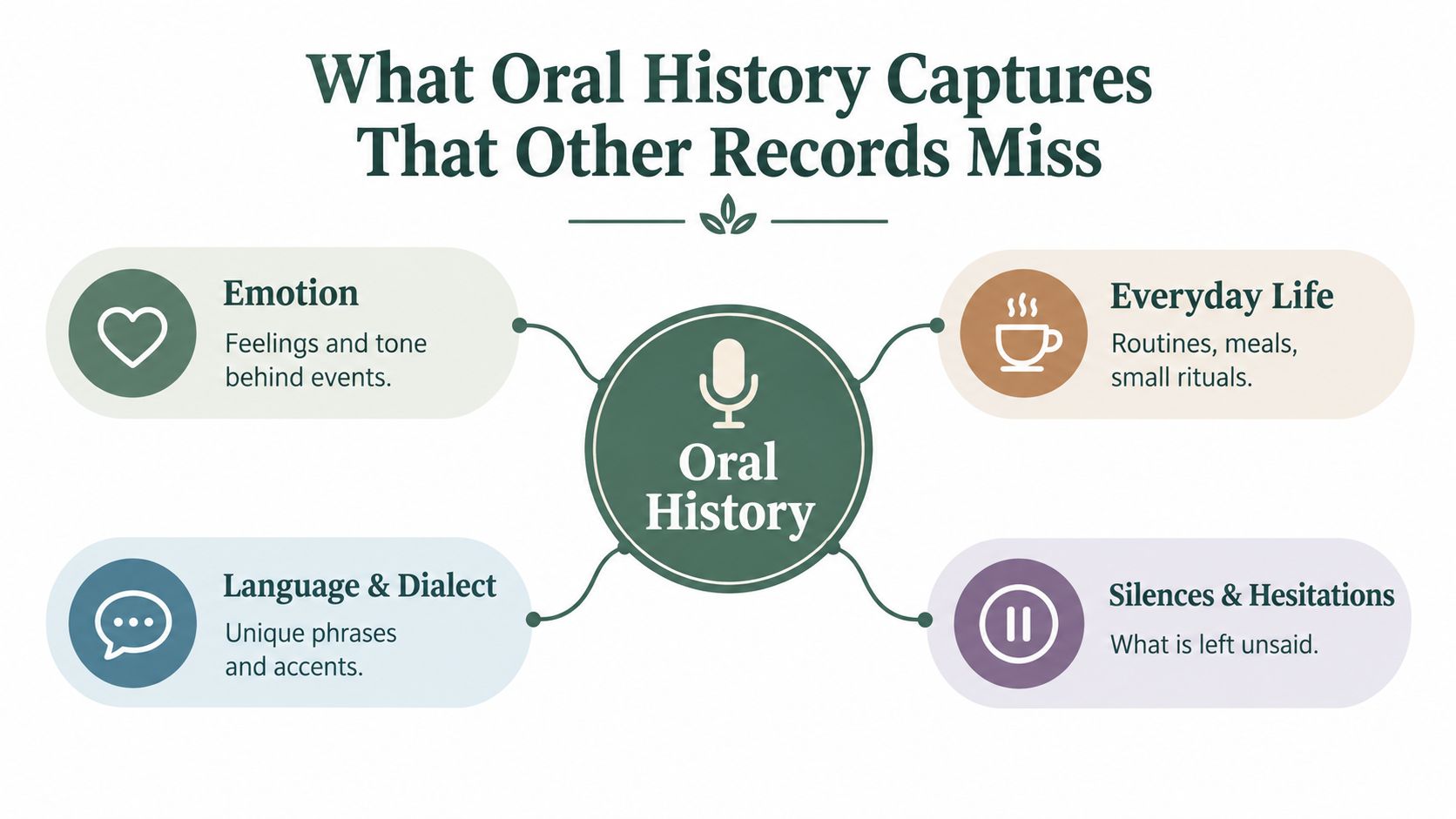
Listen for the reasons behind the facts
Suppose a parent's employment record lists a job change. Their interview might explain that the new position offered time for caregiving, even though it wasn't the work they originally wanted.
That explanation connects an official fact with a lived decision. Useful areas to explore include:
- Motivation: What choices did the person believe were available?
- Everyday practice: How did meals, work, childcare, and neighborly help come about?
- Emotional context: What felt frightening, ordinary, hopeful, or unfair at the time?
- Language: Which expressions did the family use, and what did those expressions mean to them?
- Relationships: Who influenced a decision without appearing in the paperwork?
A 2025 interdisciplinary pilot involving historians, educational psychologists, and cognitive scientists examined conversations between older adults and adolescents over eight weeks and reported more textured understandings of the past alongside differences in identity and self-narratives across generations, according to Sharing Memory and Identity Across Generations.
Preserve the conversation, not just the answer
An oral-history interview differs from a memoir because another person participates in shaping the account. A follow-up question can invite an explanation the narrator wouldn't otherwise have offered.
Keep the interviewer's questions with the answers. An answer to a neutral invitation can carry a different meaning from an answer to a question that already assumes blame or agreement.
Pauses and hesitations also deserve care. They may signal uncertainty, discomfort, or the effort of remembering, but you shouldn't decide which without asking. Invite clarification gently rather than assigning meaning to silence.
How Recorded Stories Reshape the Historical Record
Oral history can change whose experiences count as history. It doesn't merely provide a moving illustration after researchers have settled the facts.
A 2022 historical study of Mexican repatriation during the Great Depression found that oral-history interviews and private collections revealed previously underdocumented experiences of U.S.-citizen women and children targeted during mass repatriation raids. The study described oral history as an “interventional methodology”, meaning that gathering testimony can actively reshape the historical record, as explained in the study of Mexican repatriation and overlooked experiences.
This example challenges a familiar assumption: if an experience mattered, surely someone wrote it down. Institutional records don't necessarily preserve the perspectives of everyone affected by the institutions that created them.
Look beyond the family's usual account
The same issue can arise inside a family. The person who wrote letters, kept documents, or spoke most often at gatherings may have become the main source for everyone else's understanding.
Consider a hypothetical family account of a successful business. The paperwork identifies its owner, but an interview with another relative describes unpaid bookkeeping, meals prepared for workers, and caregiving that allowed the owner to travel.
That testimony doesn't automatically disprove the business record. It changes the questions you ask about contribution, credit, and whose work remained undocumented.
Research habit: Ask whose experience is missing before deciding that the family record is complete.
Use a family history documentation guide to organize interviews alongside letters, photographs, and official records. Keep the materials connected without forcing them to tell an identical story.
Historical value isn't historical certainty
A recollection is evidence of a person's remembered experience, not a guarantee that every date or detail is correct. That distinction protects oral history from becoming family myth-making.
When a narrator remembers a move happening before a wedding, but documents place it afterward, retain both pieces of evidence. Add a note explaining the discrepancy rather than changing the recording or dismissing the person's whole account.
- Separate recollection from confirmation: Identify what the narrator remembers and what documents establish.
- Seek another perspective: Ask other participants independently rather than coaching them toward agreement.
- Keep uncertainty visible: An unresolved question is more honest than a polished but unsupported conclusion.
A mistaken date may coexist with a meaningful account of insecurity, ambition, or belonging. Preserve that meaning while being clear about what remains uncertain.
Planning and Conducting Meaningful Family Interviews
A family interview often begins with an ordinary detail: a first job, a move, or the person who taught a familiar tradition. Follow that detail with care, and a conversation can become a record of how someone lived and understood their world.
Begin with a relative who wants to talk, not automatically the oldest. No one owes the family a complete account. Comfort and trust give the conversation a better foundation than pressure.
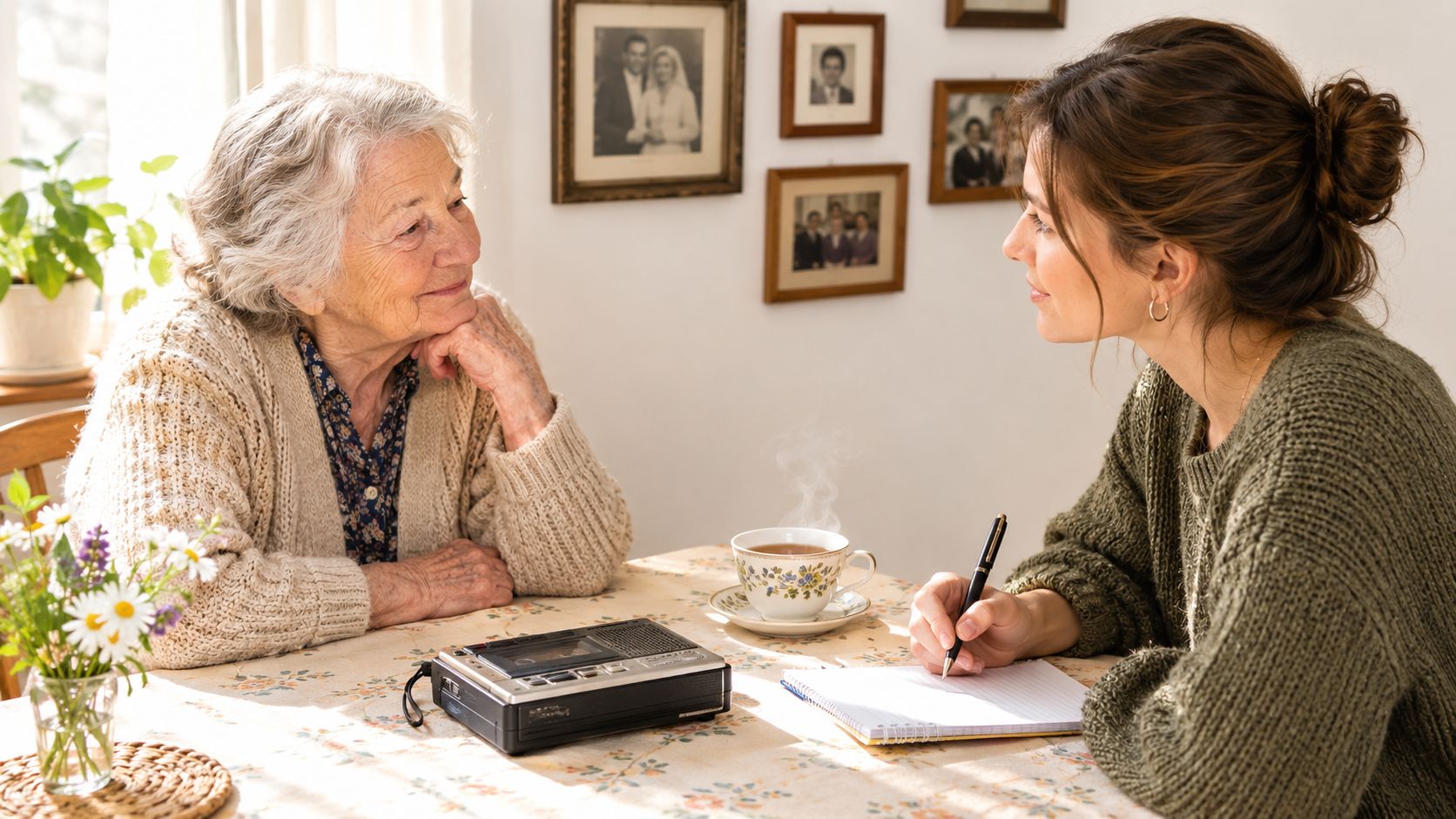
Before you meet, explain why you hope to record the conversation and who might hear it. Make clear that the narrator can skip a subject, pause, or stop. These choices help preserve trust, and they let the narrator shape the boundaries of their own legacy.
Choose a quiet, comfortable place. Test your phone or recorder beforehand, then listen through headphones. A small sound check can reveal background noise or a microphone placed too far away.
Prepare a few themes, not a script that must be completed. You might ask what made a place feel like home, how someone learned a job, who provided care during illness, which decision changed what came next, or who taught a family tradition. For more prompts, see these questions to ask family members. Select questions that fit the person and leave the rest aside.
Follow the detail that matters
Specific questions open the door to concrete memories. If a relative mentions a difficult first job, ask what a typical day involved or who helped them adjust. Then give them time to answer.
Keep your wording open. “How did you feel?” allows a narrator to choose their own description, while “Were you frightened?” suggests an emotion before they have named it.
The video below offers another resource as you prepare.
Silence can be part of a good interview. Resist completing a familiar story for someone; you may know the ending, but not the details they want remembered. If the person grows tired, pause and arrange another conversation rather than pressing for a complete account. A younger relative can listen or help ask questions, if the narrator welcomes them.
End by asking whether there is something they hoped to share that you haven't asked about. Thank them for what they chose to tell you, not for how much they revealed. A recording becomes a meaningful family legacy through attentive listening and clear boundaries, not through collecting every possible detail.
Who Controls the Story After It Is Recorded
A family recording can become a legacy, but the narrator should help decide what that legacy includes and who may hear it. Agreeing to talk with a child does not automatically mean agreeing to publication, social-media clips, or access for relatives the narrator would rather keep at a distance.
Consent to record and consent to share are separate decisions. Treating an interview as family property can erase the narrator's say over their own words.
The interviewer also shapes the account. Questions guide what gets remembered, while choices about excerpts and file descriptions influence how later listeners understand the speaker. This shared authorship is discussed in oral-history scholarship on authorship and authority.
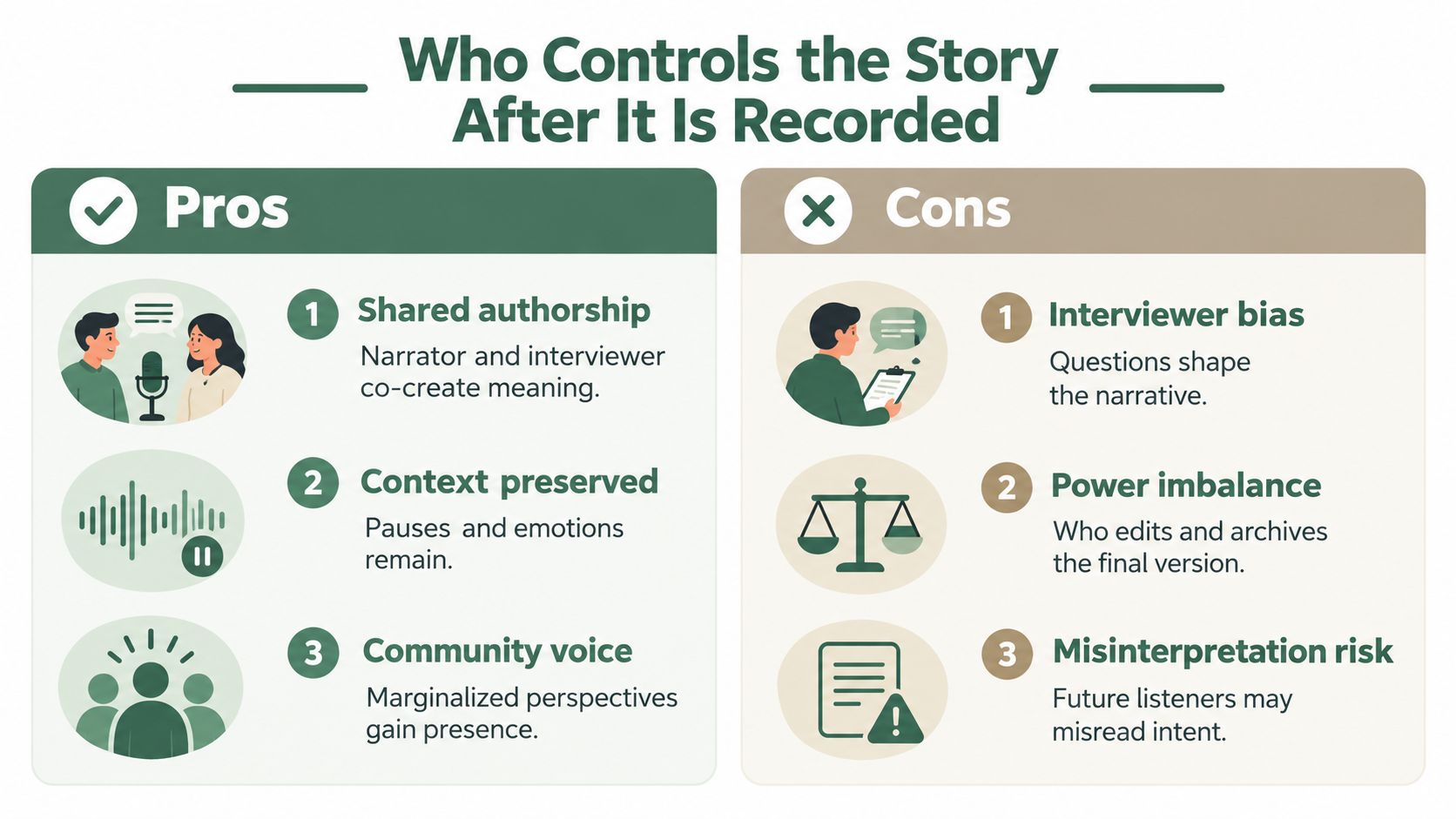
Start by asking the narrator who they want to reach. They may welcome sharing with everyone, prefer to limit access to close family or named people, or want the recording kept private until a certain condition is met. Write the agreement in plain language, so the family can return to it later.
Cover the practical choices: who can hear the full recording or receive excerpts; whether anyone may edit it, correct a transcript, or publish a summary; and who approves those changes. Note which passages should remain private, whether access can change later, and who will manage the files when the current keeper cannot. Discuss what should happen if the narrator asks for removal. Be honest about the limits: once a copy has been shared, you may not be able to retrieve every version.
Preservation should protect a person's voice while respecting their boundaries.
Family stories can also include people who did not take part in the interview. An account of illness, parentage, trauma, or conflict may identify a relative who never agreed to share their experience. Before making it available, consider who could be recognized and whether a less revealing version would still serve the family's purpose. Restrict sensitive passages where appropriate, rather than assuming that access within a family is harmless.
For help thinking through difficult accounts, read this guide to handling family conflict stories. Preserving an interview does not require pressing someone to disclose more or presenting an allegation as established fact.
Clear boundaries can make a recording easier to share with confidence. The narrator knows what will happen to their words, and the family has a practical agreement for caring for the story over time.
Preserving Recordings So They Outlive the Formats
A family interview might sit for years on a phone, then become inaccessible when the device fails or its file format stops working. Keeping the story available takes more than saving the audio: someone must preserve the recording, explain its contents, and retain the permissions that govern its use.
A useful archive has three connected parts: the recording, information that identifies it, and guidance for whoever cares for it later. If one part is missing, a future relative may have sound they cannot place, or a file they are unsure they are allowed to share.
Archival guidance recommends retaining original recordings alongside transcripts, descriptive and technical metadata, rights information, and records of format changes. It also recommends high-resolution WAV preservation copies and MP3 access copies, as explained in guidance for preserving oral-history collections.
Metadata is information about a recording. It gives an unfamiliar listener a way to identify the voices, place, and subject without relying on family memory.
- Identify the interview: Record the narrator and interviewer's names, the date and location, and the subjects discussed.
- Keep useful companions together: Store the transcript, a short summary, relevant photographs, and permissions with the audio.
- Link words to sound: Add time tags so readers can locate passages in the recording.
- Keep master and listening copies distinct: Leave the preservation version unchanged and use a smaller copy for ordinary listening.
- Keep independent backups: Maintain at least two copies managed independently, and document their locations, following the archival guidance above.
When a collection may go to a library or archive, consistent description helps another keeper understand it. Standards such as Dublin Core for text and PBCore for audiovisual materials can provide a framework for labeling.
Begin with a life-story audio recording guide and establish a routine for checking that files still open. Record any changes made during a transfer or conversion, so future listeners can follow how the files have been handled.
Families may also come across AI conversation recreation tools. Keep generated conversations separate from the archive and label them clearly. They are later creations, not original interviews or evidence that a person spoke those words.
The distinction matters: future generations should be able to tell what was recorded, what was transcribed, and what was created afterward. A well-kept archive preserves the family's account while making its history and permissions understandable to its next keeper.
Your First Family Oral History Project
Choose a manageable beginning: a willing narrator, a meaningful topic, and a recording setup you already understand. You don't need to capture an entire life before producing something worth keeping.
First Project Checklist
| Stage | Key Actions | Common Pitfalls |
|---|---|---|
| Invite | Explain the purpose and let the narrator choose a topic. | Treating participation as a family obligation. |
| Agree | Establish the intended audience and review process. | Assuming recording permission includes publication. |
| Prepare | Select flexible prompts and test the equipment. | Over-preparing questions and leaving no room to listen. |
| Record | Follow the narrator's pace and ask for clarification. | Interrupting or steering toward a preferred account. |
| Organize | Label files and attach context and permissions. | Leaving an unidentified recording on a device. |
| Preserve | Complete the archive package and appoint a keeper. | Assuming another relative will manage it. |
If relatives are coordinating a shared project, AONMeetings for growing organizations is an option to review for planning conversations. Evaluate any meeting service's recording, access, and export arrangements before using it for an interview.
Finish something small
Start with an account you can review and organize without becoming overwhelmed. Ask the narrator whether the description represents what they meant and whether the agreed audience still feels right.
Don't assume that privacy is always the narrator's preference, either. Someone may want descendants to hear their story, and an unexplained restriction could frustrate that intention.
The first successful project isn't the longest recording. It's a conversation gathered respectfully and left in a condition that its next keeper can understand.
At remembers.life, you can record voices and stories, automatically transcribe them, and organize memories for future generations. Visit to begin a family oral history with a willing relative, then preserve the conversation alongside the context and permissions that make it meaningful.